
Hellig Kvinde
DatedEst. 2800–1800 BCE
Photo Hans-Peter Balfanz · CC BY 3.0Source file on Wikimedia Commons

Overview
About this site
What the sources say
Hellig Kvinde er en 2,6 m høj bautasten på en stenrøse, der står ved landevejen mellem Svaneke og Gudhjem nær Gyldensås udløb på Bornholms nordøstkyst. Stenen er fra jernalderen og er omgivet af en skibssætning af mindre sten "Hellig Kvindes børn". Den er en hilsesten, der kræver høflighed, og er mødested for Bevar Bornholmsk som Hestestenene oven for Gudhjem.
Article in DanishRead on Wikipedia2 min readCC BY-SA 4.0
Where it sits in time
The site's dated range, placed against world reference points.
The scale is logarithmic: each step to the left is about ten times older than the last.
The full article
Hellig Kvinde: the whole story
In briefSources for this section
- Wikipedia (Danish): Hellig KvindeCC BY-SA 4.0
Sources for this section
- Wikipedia (Danish): Hellig KvindeCC BY-SA 4.0
Hellig Kvinde, meaning Holy Woman, is a 2.6 m high standing stone, a bautasten, on a stone mound. It stands by the main road between Svaneke and Gudhjem, near the mouth of Gyldensås on the north-east coast of Bornholm, Denmark.
The stone is dated to the Iron Age and is surrounded by a ship setting of smaller stones called Hellig Kvindes børn, the children of Hellig Kvinde. It is described as a greeting stone, which demands politeness. It is also a meeting place for the group Bevar Bornholmsk, at the Hestestenene above Gudhjem.
The Atlas record gives a typological estimate for its age rather than a measured date, and no excavation is described.
In Scandinavia a standing stone is a bauta or bautastein, and the word Bauta is also used in Germany. Overall 1,176 menhirs are registered in Norway, and the stones are often included as part of a tomb. As a rule each grave was marked with a single stone, but sometimes several stones were used.
The introduction to the Heimskringla by Snorri Sturluson says that it was the custom to burn all the dead and raise monoliths for them, and that this custom was kept in Norway and Sweden for a long time. In Sweden menhirs were erected as markers for the graves of warriors until the thirteenth century. Many Scandinavian standing stones are therefore not Neolithic.
No English Wikipedia article exists for it; the full text below is the Danish article "Hellig Kvinde", shown in the original language.
Summary in EnglishSources for this section
- Wikipedia (Danish): Hellig KvindeCC BY-SA 4.0
Sources for this section
- Wikipedia (Danish): Hellig KvindeCC BY-SA 4.0
Hellig Kvinde is a menhir (standing stone) in Bornholm regional municipality, Denmark. Wikidata describes it as: menhir in Bornholm Regional Municipality (2185). A typological estimate: 2800 BCE to 1800 BCE. No English Wikipedia article exists for it; the full text below is the Danish article "Hellig Kvinde", shown in the original language.
Eksterne kilder og henvisningerSources for this section
- Wikipedia (Danish): Hellig KvindeCC BY-SA 4.0
Sources for this section
- Wikipedia (Danish): Hellig KvindeCC BY-SA 4.0
Hellig Kvinde i Slots- og Kulturstyrelsens database
Billeder og beskrivelse
Hellig kvinde på Bornholm
Bornholms oldtidsminder og Oldsager, E. Vedel, 1886
How this page was madeSources for this section
- Wikipedia (Danish): Hellig KvindeCC BY-SA 4.0
Sources for this section
- Wikipedia (Danish): Hellig KvindeCC BY-SA 4.0
The summary at the top of this page was written by Claude Sonnet 5.5 (2026-11-06) from the cited Wikipedia article “Hellig Kvinde”, translated from Danish. The numbers in it were checked automatically against the source text. The rest of the page is the article itself, the structured records and computed distances.
Tradition and region
About this kind of monument
Scandinavian standing stones (bautastones)
In Scandinavia a standing stone is a bauta or bautastein, and the word Bauta is also used in Germany. Overall 1,176 menhirs are registered in Norway, and the stones are often included as part of a tomb. The introduction to the Heimskringla by Snorri Sturluson says that it was the custom to burn all the dead and raise monoliths for them, and that this custom was kept in Norway and Sweden for a long time. As a rule each grave was marked with a single stone, but sometimes several stones were used, as in the burial site known as De fem dårlige jomfruer at Karmsund.
In Sweden menhirs were erected as markers for the graves of warriors until the thirteenth century. Snorri writes that the Swedes burned the body of their king Vanlade and raised a stone over his ashes by the River Skyt, and the custom is mentioned in the Hávamál as well. Many Scandinavian standing stones are therefore not Neolithic at all but later memorials.
Anundshög near Västerås shows how the stones sit among other graves: of its 42 remains, 14 are standing stones, alongside 12 burial mounds, 10 round stone settings, 5 stone ships and one runestone.
For the Atlas, a Scandinavian stone that has not been excavated receives a broad range and is marked as of uncertain date, since a bauta cannot be dated by shape alone.
When visiting, look near burial mounds and beside old roads.
Paraphrased from Wikipedia: Bautastone, Wikipedia: Menhir, Wikipedia: List of menhirs, Wikipedia: Anundshög · CC BY-SA 4.0
See it in 3D
An interpretive reconstruction of the monument, standing on the real ground at its exact point, under the sun for that place and season. Drag to look around it.
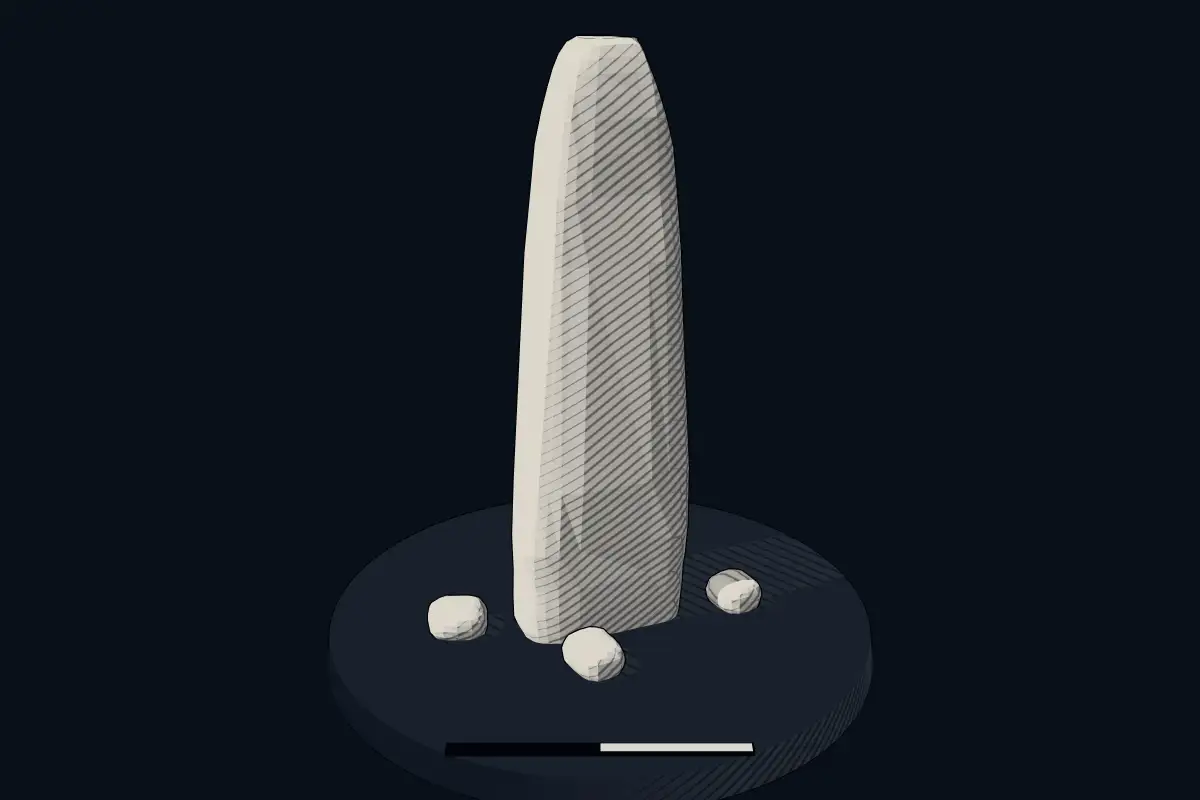
The reconstruction is ours, not a survey: it shows what a monument of this type looks like, at the size the record gives for this one.
Photographs
8 photographs, each with its author and licence
More photographs


Lore
Evidence & Lore
What the sources actually support — and, kept apart, what has been claimed.
What the evidence supports
Dates
Est. 2800–1800 BCEHow this date was established: Type comparisonTypical range for menhirs in Denmark; this site has not been dated itself. Standing stones are associated with the Beaker people of the European late Neolithic and early Bronze Age c. 2800-1800 BC.Source for this date
Where it stands
Denmark
The pin marks the monument itself — its exact point.
- Coordinates
- 55°08′58″ N, 15°05′32″ EFor a GPS or map app: 55.14953, 15.09230
Access is as our sources describe it; we have not visited the site to check.
Nearby
The closest sites in the Atlas, by straight line.
- Megalithic mound (tumulus with integral stones)Hellig-Kvinde3500–500 BCE
- Megalithic mound (tumulus with integral stones)Bølshavn3500–500 BCE
- Megalithic mound (tumulus with integral stones)Elvehøj3500–500 BCE
- Megalithic mound (tumulus with integral stones)Lillehøj3500–500 BCE
- Megalithic mound (tumulus with integral stones)Kurehøj3500–500 BCE
- Megalithic mound (tumulus with integral stones)Bøgehøj3500–500 BCE
- Megalithic mound (tumulus with integral stones)Ypnasted3500–500 BCE
- Megalithic mound (tumulus with integral stones)Maglegrav3500–500 BCE
Sources
Every record behind this page, with the link it came from.
2 sources behind this page
- 01Wikidata Q1602849wikidata.org
- 02Source for this dateen.wikipedia.org
Image files
- Hellig Kvinde 2013-09.JPGHans-Peter BalfanzCC BY 3.0
- Hellig Kvinde Bornholm 03.jpgUnukornoCC BY 4.0
- Hellig Kvinde Bornholm 02.jpgUnukornoCC BY 4.0
- Hellig Kvinde Bornholm 01.jpgUnukornoCC BY 4.0
- Hellig Kvinde.jpgRodejongCC BY-SA 3.0
- Hellig Kvinde - menhiry - panoramio.jpg7alaskanCC BY-SA 3.0
- Hellig Kvinde, menhiry, "Święta kobieta" i jej dzieci - panoramio.jpg7alaskanCC BY-SA 3.0
- Helligkvinde (8959253283).jpgAndreas Peter MadsenCC BY-SA 2.0
Report a correctionWrong date, name, photograph or source? Tell us and it will be put right.
Around this place
The ten nearest sites, by compass
Credit
Text, licence and sources
Text from the Wikipedia article "Hellig Kvinde" (Danish), licensed CC BY-SA 4.0; authors are listed in the page history. Reused under CC BY-SA 4.0. Read on Wikipedia · Edit history and authors
- Wikipedia (Danish): Hellig KvindeCC BY-SA 4.0
- Wikidata Q1602849CC0