
Glavendrup
DatedEst. 1000 BCE–1000 CE
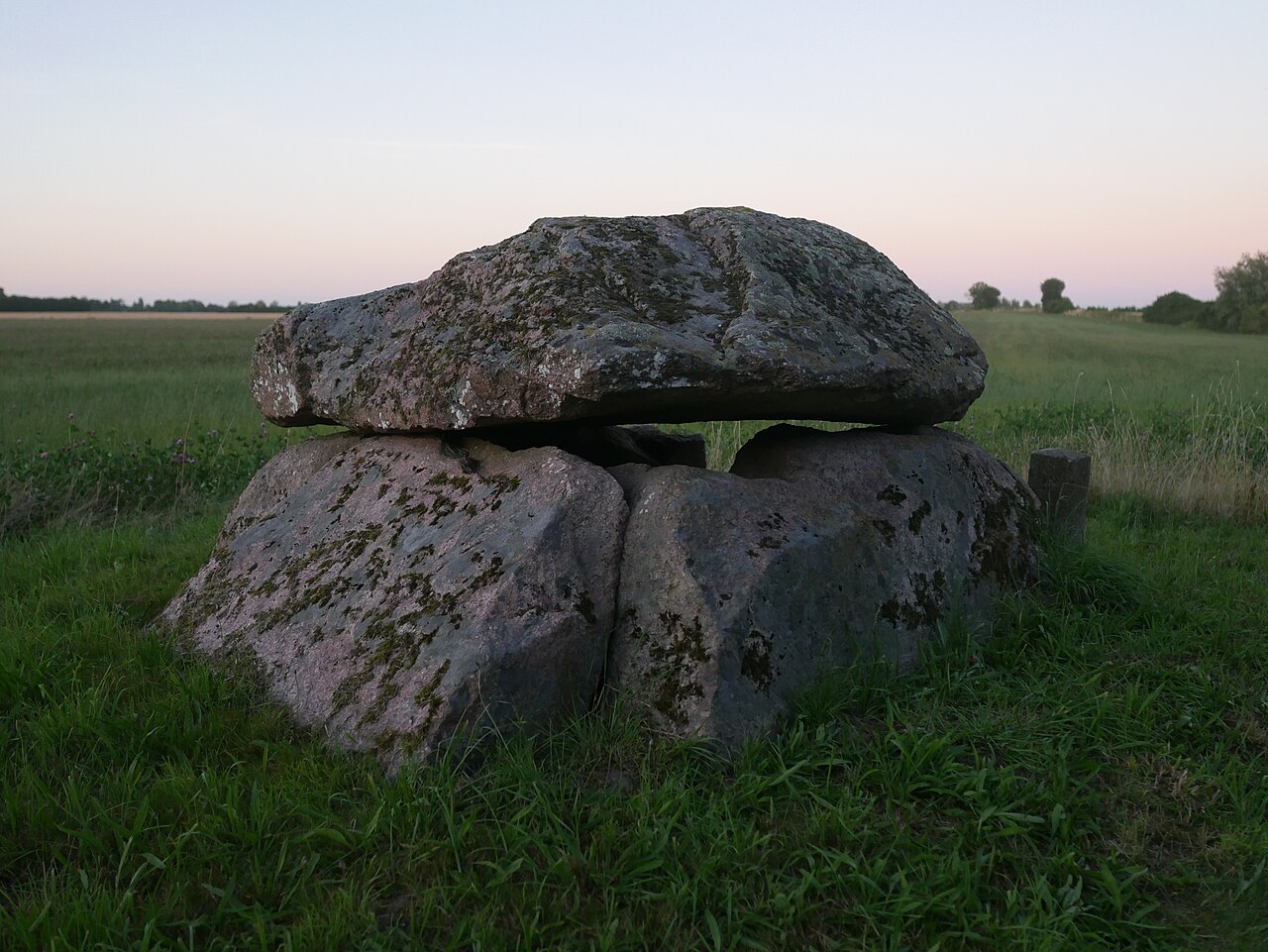
Photo Kåre Thor Olsen · CC BY-SA 3.0Source file on Wikimedia Commons

Overview
About this site
What the sources say
Glavendrup is a ship setting in Nordfyn Municipality, Denmark. Its entries are Wikidata item Q30110016; the position in the catalogue is 55.5096° N, 10.2934° E.
Built from structured records, not from an articleSources and licences
Where it sits in time
The site's dated range, placed against world reference points.
The scale is logarithmic: each step to the left is about ten times older than the last.
The full article
About Glavendrup
This kind of monument hereSources for this section
- en.wikipedia.orgCC BY-SA 4.0
- en.wikipedia.orgCC BY-SA 4.0
- en.wikipedia.orgCC BY-SA 4.0
- en.wikipedia.orgCC BY-SA 4.0
Sources for this section
- en.wikipedia.orgCC BY-SA 4.0
- en.wikipedia.orgCC BY-SA 4.0
- en.wikipedia.orgCC BY-SA 4.0
- en.wikipedia.orgCC BY-SA 4.0
In the Atlas, Denmark has the most stone ship settings. The stone ship, or ship setting, was an early burial custom in Scandinavia, northern Germany and the Baltic states, in which a grave or cremation was surrounded by slabs or stones in the outline of a ship. Ships were erected from about 1000 BCE to 1000 CE, and they are often found in grave fields, though sometimes far from any other remains. The full article, “Danish stone ship settings”, follows below under About this kind of monument.
DatingSources for this section
- en.wikipedia.orgCC BY-SA 4.0
Sources for this section
- en.wikipedia.orgCC BY-SA 4.0
The Atlas shows 1000 BCE to 1000 CE for this site, but that is a regional estimate for this kind of monument, not a date for this particular ship setting. No excavation, radiocarbon sample or other measurement is recorded for it, so the real age could fall anywhere within the range, or outside it.
The range rests on this regional background (source: the Wikipedia article “Stone ship”): The stone ships vary in size and were erected from c. 1000 BCE to 1000 CE.
Landscape and neighbours
Within 10 km lie 19 other catalogued sites (2 within 1 km, 9 within 5 km); none of them is of the same kind. In Nordfyn Municipality, Denmark, 1 of the 34 catalogued sites are classed as ship setting.
Nearest to it are Rævehøjene (0.1 km east, megalithic mound); Thorhøj (0.8 km north-west, megalithic mound); Skamby Jættestue (1.8 km north-west, passage tomb); Stensby Dolmen (1.9 km south-west, dolmen). The catalogue is assembled from open records and is not complete, so unrecorded monuments may lie closer.
Records and protectionSources for this section
Sources for this section
Wikidata lists the site with the heritage status protected ancient monument in Denmark. The open records for it are Wikidata (Q30110016), where corrections and further identifiers can be added. Many such sites stand on private land; check local access rules and respect the monument and its surroundings.
How this page was madeSources for this section
Sources for this section
Nothing on this page was written by an AI model: it is assembled by program from Wikidata (CC0), the heritage register named above and the regional article “Danish stone ship settings”, written for the Atlas from the Wikipedia articles it cites (CC BY-SA 4.0), with distances and counts calculated from the catalogue coordinates.
Tradition and region
About this kind of monument
Danish stone ship settings
In the Atlas, Denmark has the most stone ship settings. The stone ship, or ship setting, was an early burial custom in Scandinavia, northern Germany and the Baltic states, in which a grave or cremation was surrounded by slabs or stones in the outline of a ship. Ships were erected from about 1000 BCE to 1000 CE, and they are often found in grave fields, though sometimes far from any other remains.
The most famous Danish ship is at Jelling in Jutland, where the remains of the longest stone ship known lie beneath the two royal barrows. It was formerly thought to have extended between the two mounds and to have been 170 metres long. Re-evaluation of large pits on the west side of the north mound, noted in the 1960s, has led to a different reconstruction in which the ship had the north mound at its centre and was 354 metres long, corresponding to 1,200 Roman feet. King Harald Bluetooth raised a great mound over an existing Bronze Age burial mound, the largest burial mound in Denmark, and placed in it his father Gorm the Old; tree-ring evidence dates the building of the north mound and its new burial chamber to 958 to 959 CE, matching Gorm's death that winter, and the south mound to about 970.
At Lindholm Høje, north of Aalborg, a major Viking burial site, the lower southern part dates to 1000 to 1050 CE and the higher northern part to the fifth century CE. The first major excavation began in 1952 and ultimately included 589 of the approximately 700 graves.
When visiting, look at the large stones at the stem and stern, and at how the ship is laid out in relation to the mounds.
Paraphrased from Wikipedia: Jelling stone ship, Wikipedia: Jelling stones, Wikipedia: Lindholm Høje, Wikipedia: Ship setting · CC BY-SA 4.0
Photographs
1 photograph, each with its author and licence
Lore
Evidence & Lore
What the sources actually support — and, kept apart, what has been claimed.
What the evidence supports
Dates
Est. 1000 BCE–1000 CEHow this date was established: Type comparisonTypical range for ship settings in Denmark; this site has not been dated itself. The stone ships vary in size and were erected from c. 1000 BCE to 1000 CE.Source for this date
Where it stands
Denmark
The pin marks the monument itself — its exact point.
- Coordinates
- 55°30′35″ N, 10°17′36″ EFor a GPS or map app: 55.50959, 10.29338
Access is as our sources describe it; we have not visited the site to check.
Nearby
The closest sites in the Atlas, by straight line.
- Megalithic mound (tumulus with integral stones)Rævehøjene3500–500 BCE
- Megalithic mound (tumulus with integral stones)Thorhøj3500–500 BCE
- Passage tomb (passage grave)Skamby Jættestue3500–2800 BCE
 Stensby Dolmen3500–2800 BCE
- Megalithic mound (tumulus with integral stones)Dallund Folehave3500–500 BCE
- Passage tomb (passage grave)Pengesten3500–2800 BCE
- Megalithic mound (tumulus with integral stones)Kirkehøj3500–500 BCE
- Megalithic mound (tumulus with integral stones)Finshøj3500–500 BCE

Sources
Every record behind this page, with the link it came from.
2 sources behind this page
- 01Wikidata Q30110016wikidata.org
- 02Source for this dateen.wikipedia.org
Image files
- Denmark-Glavendrup stone ship.jpgKåre Thor OlsenCC BY-SA 3.0
Report a correctionWrong date, name, photograph or source? Tell us and it will be put right.
Around this place
The ten nearest sites, by compass
Credit
Text, licence and sources
This page is assembled from open records (Wikidata, CC0; OpenStreetMap, ODbL) and a tradition article paraphrasing Wikipedia (CC BY-SA 4.0). No article exists for this site, and nothing here is written by a model.
- Wikidata Q30110016CC0
- en.wikipedia.orgCC BY-SA 4.0
- en.wikipedia.orgCC BY-SA 4.0
- en.wikipedia.orgCC BY-SA 4.0
- en.wikipedia.orgCC BY-SA 4.0
- en.wikipedia.orgCC BY-SA 4.0