Gåsesten
DatedEst. 3500–2800 BCE
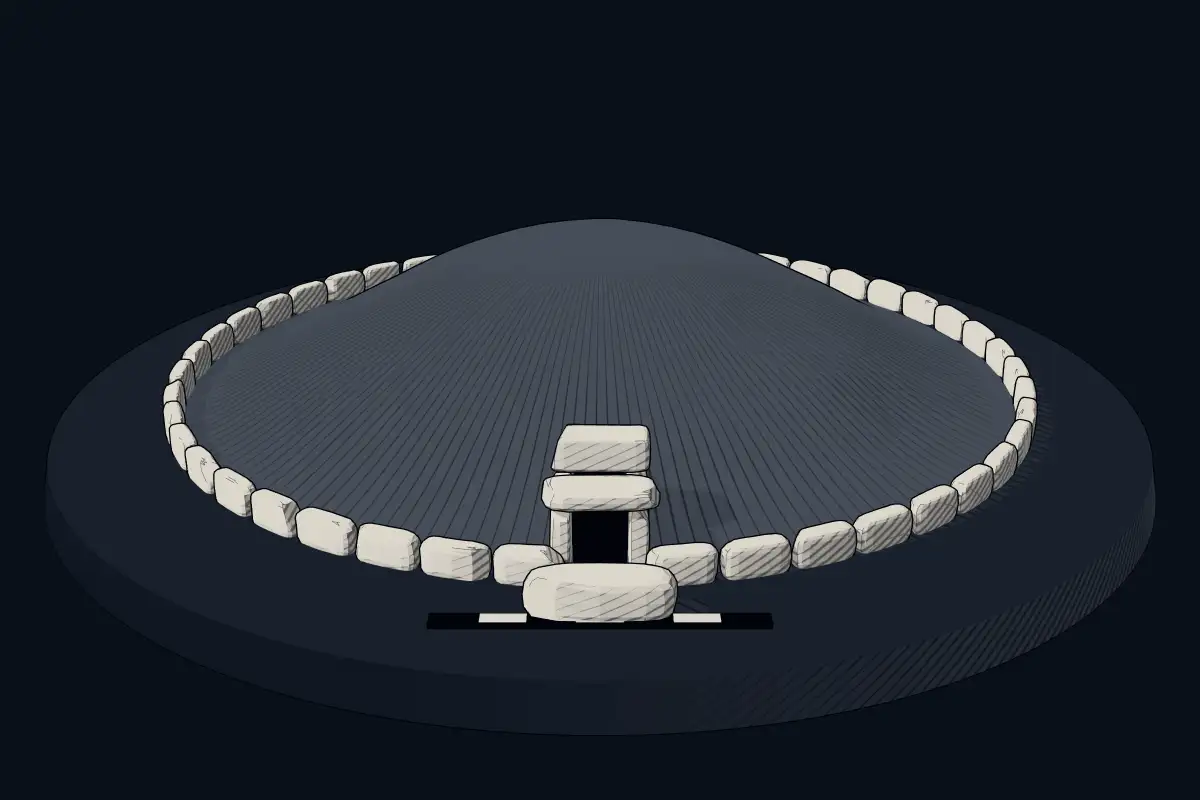
No licensed photograph yetWe have no photograph we may publish for this site, so the interpretive 3D view leads instead.
Overview
About this site
What the sources say
Das 1954 ausgegrabene und restaurierte Ganggrab Gåsesten (dänisch Gåsestenen) liegt in den Resten seines Rundhügels am Pugholmvej nördlich von Emmelev und von Odense in der Nordfyns Kommune auf der dänischen Insel Fünen.
Das Ganggrab (dänisch Jættestue) ist eine Bauform jungsteinzeitlicher Megalithanlagen, die aus einer Kammer und einem baulich abgesetzten, lateralen Gang besteht. Diese Form ist primär in Dänemark, Deutschland und Skandinavien, sowie vereinzelt in Frankreich und den Niederlanden zu finden. Der Gåsesten (deutsch Gänsestein) stammt aus der Jungsteinzeit etwa 3000 v. Chr. und ist eine Megalithanlage der Trichterbecherkultur (TBK).
Die birnenförmige, Nord-Süd orientierte Kammer besteht aus sieben Tragsteinen, zwischen denen teilweise Trockenmauerwerk erhalten ist. Die beiden Decksteine befinden sich noch in situ. Auf dem nördlichen sind mindestens zwei Schälchen zu erkennen. Im Gang, der sich nach Osten erstreckt, sind zwei Seitensteinpaare sowie ein Deckstein, unmittelbar vor der Kammer zu sehen.
In der Kammer wurden Bernstein, Feuersteinartefakte, Keramik und schwache Skelettspuren erkannt, die von der TBK, und der spätneolithischen Einzelgrabkultur stammen.
Article in GermanRead on Wikipedia2 min readCC BY-SA 4.0
Where it sits in time
The site's dated range, placed against world reference points.
The scale is logarithmic: each step to the left is about ten times older than the last.
The full article
Gåsesten: the whole story
Summary in EnglishSources for this section
- Wikipedia (German): GåsestenCC BY-SA 4.0
Sources for this section
- Wikipedia (German): GåsestenCC BY-SA 4.0
Gåsesten is a passage tomb (passage grave) in Nordfyn Municipality, Denmark. Wikidata describes it as: ancient monument in Nordfyn Municipality (5360). A typological estimate: 3500 BCE to 2800 BCE. No English Wikipedia article exists for it; the full text below is the German article "Gåsesten", shown in the original language.
Tradition and region
About this kind of monument
Scandinavian passage graves
In Denmark and Sweden the passage grave is the grandest form of the Funnel Beaker culture's megalithic tombs. A passage grave has a chamber under a mound, entered by a long passage of large stones. Nordic megalith architecture, the style of Scandinavia and northern Germany, emerged mainly between 3500 and 2800 BCE, and passage graves are one of its main types alongside dolmens, long barrows and stone cists.
Kong Asgers Høj on the Danish island of Møn is one of the best known. Its chamber is 10 metres long and 2 metres wide, with a passage 7.5 metres long. This kind of grave is found primarily in Denmark, Germany and Scandinavia, and only occasionally in France and the Netherlands. The tomb is structurally untouched since ancient times, though it may have been cleared at some time, and it was reused for secondary burial in the Corded Ware period. Passage graves were often used for generations. At Frälsegården in Sweden, genetic analysis of several dozen buried individuals suggests that the dead were largely male descendants of one ancestor, with women who had married in from outside, so such a tomb could belong to an extended family.
The passage grave tradition is thought to have originated in Brittany and been spread to other regions by colonists, a view found in the wider literature but one that remains debated.
Dating of Scandinavian tombs relies on the pottery of the Funnel Beaker culture and on radiocarbon dates from bone.
When visiting, look at the size of the capstones over the chamber, the kerbstones around the mound, and the line of the passage.
Paraphrased from Wikipedia: Passage grave, Wikipedia: Nordic megalith architecture, Wikipedia: Funnel beaker culture, Wikipedia: Kong Asgers Høj · CC BY-SA 4.0
From the article
Dated moments in the story
- 3000 BCE
Der Gåsesten (deutsch Gänsestein) stammt aus der Jungsteinzeit etwa 3000 v. Chr. und ist eine Megalithanlage der Trichterbecherkultur (TBK).
Source - 1954
Das 1954 ausgegrabene und restaurierte Ganggrab Gåsesten (dänisch Gåsestenen) liegt in den Resten seines Rundhügels am Pugholmvej nördlich von Emmelev und von Odense in der Nordfyns Kommune auf der dänischen Insel Fünen.
Source
Lore
Evidence & Lore
What the sources actually support — and, kept apart, what has been claimed.
What the evidence supports
Dates
Est. 3500–2800 BCEHow this date was established: Type comparisonTypical range for passage tombs in Denmark; this site has not been dated itself. Danish passage graves belong to the Nordic megalith tradition which emerged predominantly between 3500 and 2800 BC.Source for this date
Where it stands
Denmark
The pin marks the monument itself — its exact point.
- Coordinates
- 55°32′26″ N, 10°22′23″ EFor a GPS or map app: 55.54067, 10.37295
Access is as our sources describe it; we have not visited the site to check.
Nearby
The closest sites in the Atlas, by straight line.
- Megalithic mound (tumulus with integral stones)Norup3500–500 BCE
 Kappendrup Kirke3500–2800 BCE
- Megalithic mound (tumulus with integral stones)Rorslev3500–500 BCE
- Passage tomb (passage grave)Pengesten3500–2800 BCE
- Megalithic mound (tumulus with integral stones)Rævehøjene3500–500 BCE
- Megalithic mound (tumulus with integral stones)Thorhøj3500–500 BCE
 Glavendrup1000 BCE–1000 CE
- Megalithic mound (tumulus with integral stones)Finshøj3500–500 BCE


Sources
Every record behind this page, with the link it came from.
2 sources behind this page
- 01Wikidata Q30109973wikidata.org
- 02Source for this dateen.wikipedia.org
Report a correctionWrong date, name, photograph or source? Tell us and it will be put right.
Around this place
The ten nearest sites, by compass
Credit
Text, licence and sources
Text from the Wikipedia article "Gåsesten" (German), licensed CC BY-SA 4.0; authors are listed in the page history. Reused under CC BY-SA 4.0. Read on Wikipedia · Edit history and authors
- Wikipedia (German): GåsestenCC BY-SA 4.0
- Wikidata Q30109973CC0