Menhir (standing stone)The Bronze Age
De Hvide Jomfruer
DatedEst. 2800–1800 BCE
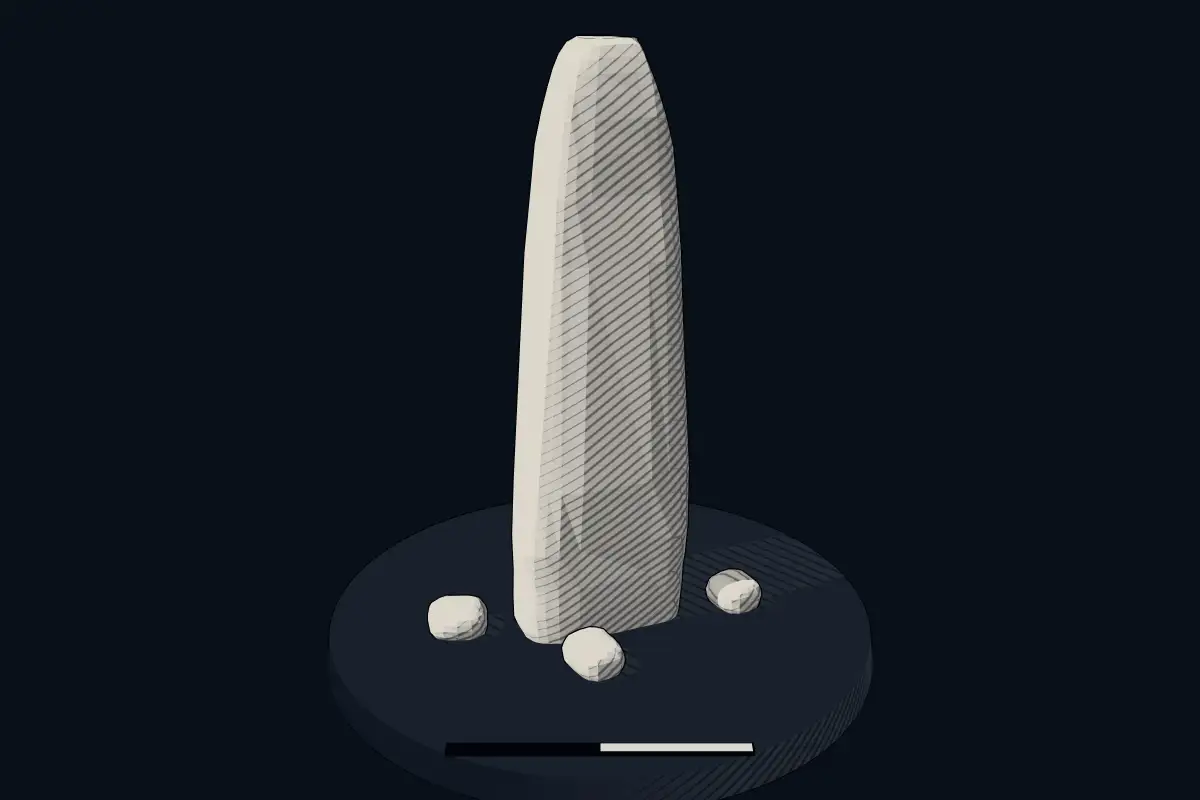
No licensed photograph yetWe have no photograph we may publish for this site, so the interpretive 3D view leads instead.
Overview
About this site
Overview
De Hvide Jomfruer (German: Die weißen Jungfrauen; also De hvide piger, 'the White Virgins' or 'the white girls') are two standing stones, about 2.0 m high, at Råkilde-Ellidshøj near Aalborg in Himmerland, North Jutland, Denmark. They are described as bautastones (Bautasteine) and stand at the edge of the Råkilde skov, west of the main road.
The catalogue record gives a typological estimate of 2800 to 1800 BCE for the stones.
Read on Wikipedia2 min readCC BY-SA 4.0
Where it sits in time
The site's dated range, placed against world reference points.
The scale is logarithmic: each step to the left is about ten times older than the last.
Article
De Hvide Jomfruer
NameSources for this section
- Wikipedia (German): Die weißen JungfrauenCC BY-SA 4.0
Sources for this section
- Wikipedia (German): Die weißen JungfrauenCC BY-SA 4.0
The Danish name is (to) Hvide Jomfruer, with the variant De hvide piger. It refers to the whitewashing of the stones described below.
Local tradition holds that the stones commemorate two maidens from Råkilde who either killed each other or took their own lives because they loved the same man.
FolkloreSources for this section
- Wikipedia (German): Die weißen JungfrauenCC BY-SA 4.0
Sources for this section
- Wikipedia (German): Die weißen JungfrauenCC BY-SA 4.0
Local tradition holds that the stones commemorate two maidens from Råkilde who either killed each other or took their own lives because they loved the same man. According to one tradition both were seduced by him; according to another, the stones commemorate two maidens who were executed though innocent.
The legend also says that anyone who tries to destroy the stones will fare badly. It is told that in 1920 a man in Ellidshøj who was putting up a new building lacked stones, thought of the two girls and went to work on them. Warned by the pastor, he gave up the work, but died shortly afterwards.
The inhabitants of the Råkildegård farm see to it that the monoliths are whitewashed every spring. Local belief holds that if this is neglected, bad luck will come to the farm, or Råkildegård will even burn down.
ContextSources for this section
- Wikipedia (German): Die weißen JungfrauenCC BY-SA 4.0
Sources for this section
- Wikipedia (German): Die weißen JungfrauenCC BY-SA 4.0
In Scandinavia a standing stone is called a bauta or bautastein, and the word Bauta is also used in Germany. Standing stones in the region are often included as part of a tomb.
Tradition and region
About this kind of monument
Scandinavian standing stones (bautastones)
In Scandinavia a standing stone is a bauta or bautastein, and the word Bauta is also used in Germany. Overall 1,176 menhirs are registered in Norway, and the stones are often included as part of a tomb. The introduction to the Heimskringla by Snorri Sturluson says that it was the custom to burn all the dead and raise monoliths for them, and that this custom was kept in Norway and Sweden for a long time. As a rule each grave was marked with a single stone, but sometimes several stones were used, as in the burial site known as De fem dårlige jomfruer at Karmsund.
In Sweden menhirs were erected as markers for the graves of warriors until the thirteenth century. Snorri writes that the Swedes burned the body of their king Vanlade and raised a stone over his ashes by the River Skyt, and the custom is mentioned in the Hávamál as well. Many Scandinavian standing stones are therefore not Neolithic at all but later memorials.
Anundshög near Västerås shows how the stones sit among other graves: of its 42 remains, 14 are standing stones, alongside 12 burial mounds, 10 round stone settings, 5 stone ships and one runestone.
For the Atlas, a Scandinavian stone that has not been excavated receives a broad range and is marked as of uncertain date, since a bauta cannot be dated by shape alone.
When visiting, look near burial mounds and beside old roads.
Paraphrased from Wikipedia: Bautastone, Wikipedia: Menhir, Wikipedia: List of menhirs, Wikipedia: Anundshög · CC BY-SA 4.0
See it in 3D
An interpretive reconstruction of the monument, standing on the real ground at its exact point, under the sun for that place and season. Drag to look around it.
The reconstruction is ours, not a survey: it shows what a monument of this type looks like, at the size the record gives for this one.
Lore
Evidence & Lore
What the sources actually support — and, kept apart, what has been claimed.
What the evidence supports
Dates
Est. 2800–1800 BCEHow this date was established: Type comparisonTypical range for menhirs in Denmark; this site has not been dated itself. Standing stones are associated with the Beaker people of the European late Neolithic and early Bronze Age c. 2800-1800 BC.Source for this date
Where it stands
Denmark
The pin marks the monument itself — its exact point.
- Coordinates
- 56°55′09″ N, 9°51′01″ EFor a GPS or map app: 56.91927, 9.85014
Access is as our sources describe it; we have not visited the site to check.
Nearby
The closest sites in the Atlas, by straight line.
- Megalithic mound (tumulus with integral stones)Ellidshøj3500–500 BCE
- Megalithic mound (tumulus with integral stones)Ellidshøj3500–500 BCE
- Megalithic mound (tumulus with integral stones)Ellidshøj3500–500 BCE
- Megalithic mound (tumulus with integral stones)Ellidshøj3500–500 BCE
- Megalithic mound (tumulus with integral stones)Ellidshøj3500–500 BCE
- Megalithic mound (tumulus with integral stones)Ellidshøj3500–500 BCE
- Megalithic mound (tumulus with integral stones)Tværhøje3500–500 BCE
- Megalithic mound (tumulus with integral stones)Tværhøje3500–500 BCE
Sources
Every record behind this page, with the link it came from.
2 sources behind this page
- 01Wikidata Q18572384wikidata.org
- 02Source for this dateen.wikipedia.org
Report a correctionWrong date, name, photograph or source? Tell us and it will be put right.
Lore, kept apart
Legends and claims
These are stories and claims reported by the sources. They are not evidence, and they never stand in for the dating above.
- Tradition
Sie tragen der Legende nach diesen Namen, um an zwei Jungfrauen aus Råklide zu erinnern, die sich entweder gegenseitig töteten oder Suizid begingen, weil sie denselben Mann liebten.
Sie tragen der Legende nach diesen Namen, um an zwei Jungfrauen aus Råklide zu erinnern, die sich entweder gegenseitig töteten oder Suizid begingen, weil sie denselben Mann liebten. Eine Überlieferung besagt, dass beide von ihm verführt wurden – eine andere überliefert, dass die Steine an zwei Jungfrauen erinnern, die unschuldig hingerichtet wurden. Die Legende besagt auch, dass es dem schlecht ergeht, der versucht, die Steine zu zerstören. 1920 errichtete ein Mann in Ellidshøj ein neues Gebäude, und es fehlten Steine. Er dachte an „die beiden Mädchen“ und ging hin, um sie zu bearbeiten. Vom Pfarrer gewarnt gab er seine Arbeit auf, starb aber kurz darauf. Die Bewohner des Råkildegård (Hof) sorgen dafür, dass die Monolithen jedes Frühjahr weiß getüncht werden, denn wenn dies vernachlässigt wird, würde dies Pech auf dem Hof bringen, oder Råkildegård würde sogar abbrennen.
Source
Around this place
The ten nearest sites, by compass
Credit
Text, licence and sources
Adapted from the Wikipedia article "Die weißen Jungfrauen" (German), licensed CC BY-SA 4.0; authors are listed in the page history. Reused under CC BY-SA 4.0. Read on Wikipedia · Edit history and authors
- Wikipedia (German): Die weißen JungfrauenCC BY-SA 4.0
- Wikidata Q18572384CC0