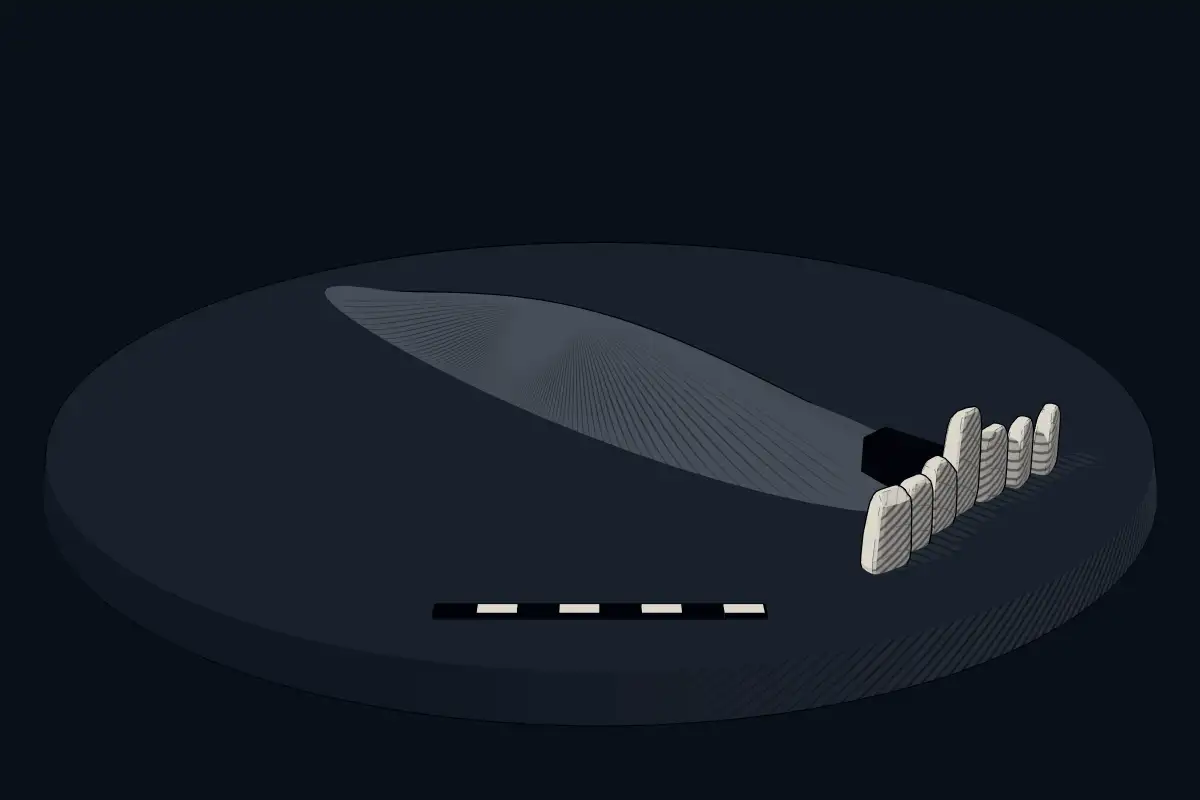
Megalithic long barrowThe Copper Age
Buerup
DatedEst. 3500–2800 BCE
No licensed photograph yetWe have no photograph we may publish for this site, so the interpretive 3D view leads instead.
Overview
About this site
Overview
Buerup is a megalithic long barrow in Kalundborg Municipality, Denmark. It lies at 55.6028° N, 11.3500° E.
Catalogue recordSources and licences
Where it sits in time
The site's dated range, placed against world reference points.
The scale is logarithmic: each step to the left is about ten times older than the last.
Article
Buerup
ContextSources for this section
- en.wikipedia.orgCC BY-SA 4.0
- en.wikipedia.orgCC BY-SA 4.0
- en.wikipedia.orgCC BY-SA 4.0
- en.wikipedia.orgCC BY-SA 4.0
Sources for this section
- en.wikipedia.orgCC BY-SA 4.0
- en.wikipedia.orgCC BY-SA 4.0
- en.wikipedia.orgCC BY-SA 4.0
- en.wikipedia.orgCC BY-SA 4.0
Further north, the long barrow tradition took its own form. In Denmark and southern Sweden the long barrows typically used stone in their construction, and in the Netherlands and northern Germany they also used stone where it was available. The long barrows in parts of Poland are typically earthen rather than megalithic. They belong to the Funnel Beaker culture, and the architecture of Scandinavia and northern Germany, called Nordic megalith architecture, appeared mainly between 3500 and 2800 BCE. The regional background, “Northern European long barrows (langdysser)”, is given below.
DatingSources for this section
- en.wikipedia.orgCC BY-SA 4.0
Sources for this section
- en.wikipedia.orgCC BY-SA 4.0
No scientific date has been published for this site. Monuments of this type in Denmark are generally dated 3500 BCE to 2800 BCE; the site itself may fall inside or outside that range.
Danish long barrows (langhoje) belong to the Nordic megalith tradition which emerged predominantly between 3500 and 2800 BC.
Setting
56 other recorded monuments lie within 10 km (1 within 1 km, 22 within 5 km), 5 of them of the same type. The site belongs to a dense concentration of monuments. In Kalundborg Municipality, Denmark, 5 of the 245 recorded monuments are of this type.
The nearest recorded monuments are Parcelstub (0.0 km south-west, megalithic mound); Katterup (1.7 km east, megalithic long barrow); Buerup (1.7 km south-west, megalithic long barrow); Løgtved (1.9 km south, megalithic mound).
ProtectionSources for this section
Sources for this section
Heritage status: protected ancient monument in Denmark.
Tradition and region
About this kind of monument
Northern European long barrows (langdysser)
Further north, the long barrow tradition took its own form. In Denmark and southern Sweden the long barrows typically used stone in their construction, and in the Netherlands and northern Germany they also used stone where it was available. The long barrows in parts of Poland are typically earthen rather than megalithic. They belong to the Funnel Beaker culture, and the architecture of Scandinavia and northern Germany, called Nordic megalith architecture, appeared mainly between 3500 and 2800 BCE.
In Mecklenburg-Vorpommern many dolmens lie inside a trapezoid frame of standing stones that the Germans call a Hünenbett, "giants' bed". Excavators there recognise the "unchambered long barrow" as a type of its own, along with simple dolmens, extended dolmens, passage graves and stone cists.
The purpose of early Neolithic long barrows is not known, though archaeologists can make suggestions based on recurring patterns. One argument is that they were religious sites, perhaps erected as part of a system of ancestor veneration; an alternative is that they were primarily economic or territorial markers.
Folklore: the German name Hünenbett, "giants' bed", reflects the old belief that giants lay in such graves. The barrows were in fact built by Neolithic farmers.
Dating relies on pottery and on radiocarbon dates from the few that have been excavated.
When visiting, look for the long outline of the mound, any kerbstones, and the chambers within it.
Paraphrased from Wikipedia: Long barrow, Wikipedia: Nordic megalith architecture, Wikipedia: Megaliths in Mecklenburg-Vorpommern, Wikipedia: Funnel beaker culture · CC BY-SA 4.0
Lore
Evidence & Lore
What the sources actually support — and, kept apart, what has been claimed.
What the evidence supports
Dates
Est. 3500–2800 BCEHow this date was established: Type comparisonTypical range for megalithic long barrows in Denmark; this site has not been dated itself. Danish long barrows (langhoje) belong to the Nordic megalith tradition which emerged predominantly between 3500 and 2800 BC.Source for this date
Where it stands
Denmark
The pin marks the monument itself — its exact point.
- Coordinates
- 55°36′10″ N, 11°21′00″ EFor a GPS or map app: 55.60282, 11.35005
Access is as our sources describe it; we have not visited the site to check.
Nearby
The closest sites in the Atlas, by straight line.
- Megalithic mound (tumulus with integral stones)Parcelstub3500–500 BCE
- Megalithic long barrowKatterup3500–2800 BCE
- Megalithic long barrowBuerup3500–2800 BCE
- Megalithic mound (tumulus with integral stones)Løgtved3500–500 BCE
- DolmenUllerup3500–2800 BCE
- DolmenVakkerdysse3500–2800 BCE
- DolmenGraadysse3500–2800 BCE
- Passage tomb (passage grave)Hallebyore3500–2800 BCE
Sources
Every record behind this page, with the link it came from.
2 sources behind this page
- 01Wikidata Q30149153wikidata.org
- 02Source for this dateen.wikipedia.org
Report a correctionWrong date, name, photograph or source? Tell us and it will be put right.
Around this place
The ten nearest sites, by compass
Credit
Text, licence and sources
Compiled from open records (Wikidata, CC0; OpenStreetMap, ODbL) and a regional background article based on Wikipedia (CC BY-SA 4.0).
- Wikidata Q30149153CC0
- en.wikipedia.orgCC BY-SA 4.0
- en.wikipedia.orgCC BY-SA 4.0
- en.wikipedia.orgCC BY-SA 4.0
- en.wikipedia.orgCC BY-SA 4.0