
Megalithic mound (tumulus with integral stones)
Breddysse
DatedEst. 3500–500 BCE
Photo Commander-pirx · CC BY-SA 4.0Source file on Wikimedia Commons

Overview
About this site
What the sources say
Breddysse er et dansk oldtidsminde i form af en runddysse, der er beliggende cirka 900 m sydvest for Kirke Stillinge på Vestsjælland.
Det neolitiske megalitiske kompleks blev bygget mellem 3500 og 2800 f.Kr. af Tragtbægerkulturen.
Article in DanishRead on Wikipedia5 min readCC BY-SA 4.0
Where it sits in time
The site's dated range, placed against world reference points.
The scale is logarithmic: each step to the left is about ten times older than the last.
The full article
Breddysse: the whole story
In briefSources for this section
- Wikipedia (Danish): BreddysseCC BY-SA 4.0
Sources for this section
- Wikipedia (Danish): BreddysseCC BY-SA 4.0
Breddysse is a Danish megalithic monument in the form of a round mound, situated about 900 m southwest of Kirke Stillinge on Vestsjælland. The Neolithic megalithic complex was built between 3500 and 2800 BCE by the Tragtbægerkulturen. The monument is dated broadly from 3500 BCE to 500 BCE by typological estimate.
The round mound contains two well-preserved, parallel chambers, although some parts are missing. Each chamber is made up of five supporting stones, a threshold stone and a capstone. No shell middens or antiquities were found in the chambers. Together with Poskær Stenhus and Runddyssen i Vielsted, Breddysse is among the best-preserved examples of this type in Denmark. Two or more chambers within one frame are fairly common in long barrows but very rare in round barrows.
People of the Bronze Age evidently took an interest in the monument, which was already more than a thousand years old. On the capstone of the southern, larger chamber, they carved over 90 cup marks about one centimetre deep and three to five centimetres in diameter, as well as images of one large and one small ship. One ship shows 6 rowers and the other 20, if these are indeed rowers. Ship carvings on megaliths are very rare.
Local tradition held that a king was buried in the large chamber and a queen in the small one. The site was also used for offerings as late as the 1800s. A nearby farmer named Knud Larsen, who lived there in the 1840s, was said to acquire wisdom by visiting the mound. In 1936, his grandson Vilhelm Knudsen recalled annual offerings at Christmas, with food and money placed on a flat stone and always gone by morning. How true these stories are cannot be known, but the mound clearly retained a magical and mythic significance into the middle of the 1800s.
No English Wikipedia article exists for it; the full text below is the Danish article "Breddysse", shown in the original language.
Summary in EnglishSources for this section
- Wikipedia (Danish): BreddysseCC BY-SA 4.0
Sources for this section
- Wikipedia (Danish): BreddysseCC BY-SA 4.0
Breddysse is a megalithic mound (tumulus with integral stones) in Slagelse Municipality, Denmark. Wikidata describes it as: dolmen. A typological estimate: 3500 BCE to 500 BCE. No English Wikipedia article exists for it; the full text below is the Danish article "Breddysse", shown in the original language.
Betydning for eftertidenSources for this section
- Wikipedia (Danish): BreddysseCC BY-SA 4.0
Sources for this section
- Wikipedia (Danish): BreddysseCC BY-SA 4.0
Bronzealderfolkets helleristninger
Tilsyneladende har bronzealderfolket også interesseret for fortidsmindet, der for dem allerede var over tusind år gammel. De har udskåret helleristninger på det sydlige (større) kammers dæksten Der er udskåret over 90 skåltegn på omkring en centimeter dybde og omkring tre-fem centimeters diameter. Skåltegnene kan tænkes at have symboliseret solen, der spillede en afgørende religiøs rolle for bronzealdermenneskene.
Derudover er der helleristninger af et stort og et lille skib. I det ene ses 6 roere, og i den anden er der 20 roere (hvis det virkelig forestiller roere). Sådanne helleristninger af skibe på kæmpesten er ganske sjældne
Historisk tid - sagn og lokalmiljø
Ifølge lokale overleveringer og mundtlig tradition blev der begravet en konge i det store kammer og en dronning i det lille kammer. Stedet har også været benyttet til ofringer helt op til 1800-tallet. Blandt andet fortælles det at en nærboende bonde, ved navn Knud Larsen (boede der bl.a. i 1840erne), fik tilnavnet "Kloge Knud", da man sagde han tillærte sig klogskab ved runddyssen. Angiveligt red han ud til dyssen hver nytårsaften eller juleaftensdag for at lære sine kunstner. Hans barnebarn, Vilhelm Knudsen, fortalte i 1936:
"Jeg husker fra min barndom, at min bedstefader hvert år ofrede til højfolkene, de underjordiske. Det foregik juleaftensdag sidst på eftermiddagen. Knud gav sin kone besked om at tage en kurv og deri lægge noget af det bedste, der var i huset, kage, flæsk, pølse, osv. Desuden lagde han selv nogle penge i kurven. Så red han på en bestemt af sine heste ud på marken, red 3 gange rundt om dyssen og lagde derpå maden og pengene på en flad sten. Om morgenen var offeret altid forsvundet."
Hvor meget sandhed der er i disse historier kan ikke vides, men det er dog sikkert at Breddysse beholdt en vis magisk-mytisk betydning helt op til midten af 1800-tallet.
Arkæologisk betydningSources for this section
- Wikipedia (Danish): BreddysseCC BY-SA 4.0
Sources for this section
- Wikipedia (Danish): BreddysseCC BY-SA 4.0
Runddyssen består af to velbevarede, parallelle kamre. Visse dele af runddyssen er dog ikke bevaret. De to kamre består hver af fem støttesten, en tærskelsten og en dæksten. Der blev ikke fundet skelletter eller oldtidsfund i kamrene.
Sammen med Poskær Stenhus og Runddyssen i Vielsted (de) er Breddysse i Kirke Stillinge Sogn et af de bedst bevarede eksempler af denne type i Danmark. To eller flere kamre inden for én ramme er relativt almindeligt i langdysser, men meget sjældne i runddysser.
Videre læsningSources for this section
- Wikipedia (Danish): BreddysseCC BY-SA 4.0
Sources for this section
- Wikipedia (Danish): BreddysseCC BY-SA 4.0
Ingrid Falktoft Anderson: Vejviser til Danmarks oldtid. 1994, ISBN 87-89531-10-8, s. 250.
Klaus Ebbesen: Danmarks megalitgrave. Bind 1: Katalog. Attica, København 2008, ISBN 978-87-7528-731-4, no. 1441.
Karsten Kjer Michaelsen: Politikkens bog om Danmarks oldtid. København 2002, ISBN 87-567-6458-8, s. 198.
https://xn--solhjemgrden-0cb.dk/images/SolData/SOLHJEMGAARD.Historie.pdf
Breddysse i Slots- og Kulturstyrelsens database
How this page was madeSources for this section
- Wikipedia (Danish): BreddysseCC BY-SA 4.0
Sources for this section
- Wikipedia (Danish): BreddysseCC BY-SA 4.0
The summary at the top of this page was written by MiniMax-M3 (2026-11-07) from the cited Wikipedia article “Breddysse”, translated from Danish. The numbers in it were checked automatically against the source text. The rest of the page is the article itself, the structured records and computed distances.
Tradition and region
About this kind of monument
Danish barrows (gravhøje)
Denmark has a very large number of surviving barrows, protected by law since 1937, and the Atlas draws most of its Danish mounds from the national register of monuments. The oldest belong to the Funnel Beaker culture of the fourth millennium BCE, whose long barrows and stone-chambered tombs are described in their own articles. The great majority of the round mounds are younger. Many were raised in the Nordic Bronze Age, from about 1700 to 500 BCE.
The Bronze Age barrows hold remarkable burials. In a number of them, oak coffins stayed sealed and waterlogged, so that wool clothing, hair and textiles survived; only the bones of the dead are gone. The Egtved Girl, a young woman buried beneath the mound Storehøj in a woollen blouse and corded skirt with a bronze belt plate, is the best-known case: tree rings in her oak coffin date the burial to the summer of 1370 BCE. Borum Eshøj gave similar finds from the fourteenth and thirteenth centuries BCE. Later in the Bronze Age cremation took over from inhumation, and the dead were buried in urns.
Mound-building did not stop with the Bronze Age: Danish round barrows were raised from the Neolithic to the Viking Age.
When visiting, look for flat tops where old diggers cut in, and for the hollows where kerb stones were once removed.
Paraphrased from Wikipedia: Tumulus, Wikipedia: Funnel beaker culture, Wikipedia: Nordic Bronze Age, Wikipedia: Egtved Girl, Wikipedia: Borum Eshøj, Wikipedia: Jelling · CC BY-SA 4.0
From the article
Dated moments in the story
- 2800 BCE
Det neolitiske megalitiske kompleks blev bygget mellem 3500 og 2800 f.Kr. af Tragtbægerkulturen.
Source - 1441
1441. Karsten Kjer Michaelsen: Politikkens bog om Danmarks oldtid.
Source - 1800
Stedet har også været benyttet til ofringer helt op til 1800-tallet.
Source - 1800
Om morgenen var offeret altid forsvundet." Hvor meget sandhed der er i disse historier kan ikke vides, men det er dog sikkert at Breddysse beholdt en vis magisk-mytisk betydning helt op til midten af 1800-tallet.
Source - 1936
Hans barnebarn, Vilhelm Knudsen, fortalte i 1936: "Jeg husker fra min barndom, at min bedstefader hvert år ofrede til højfolkene, de underjordiske.
Source - 2002
København 2002, ISBN 87-567-6458-8, s.
Source - 2008
Attica, København 2008, ISBN 978-87-7528-731-4, no.
Source
See it in 3D
An interpretive reconstruction of the monument, standing on the real ground at its exact point, under the sun for that place and season. Drag to look around it.
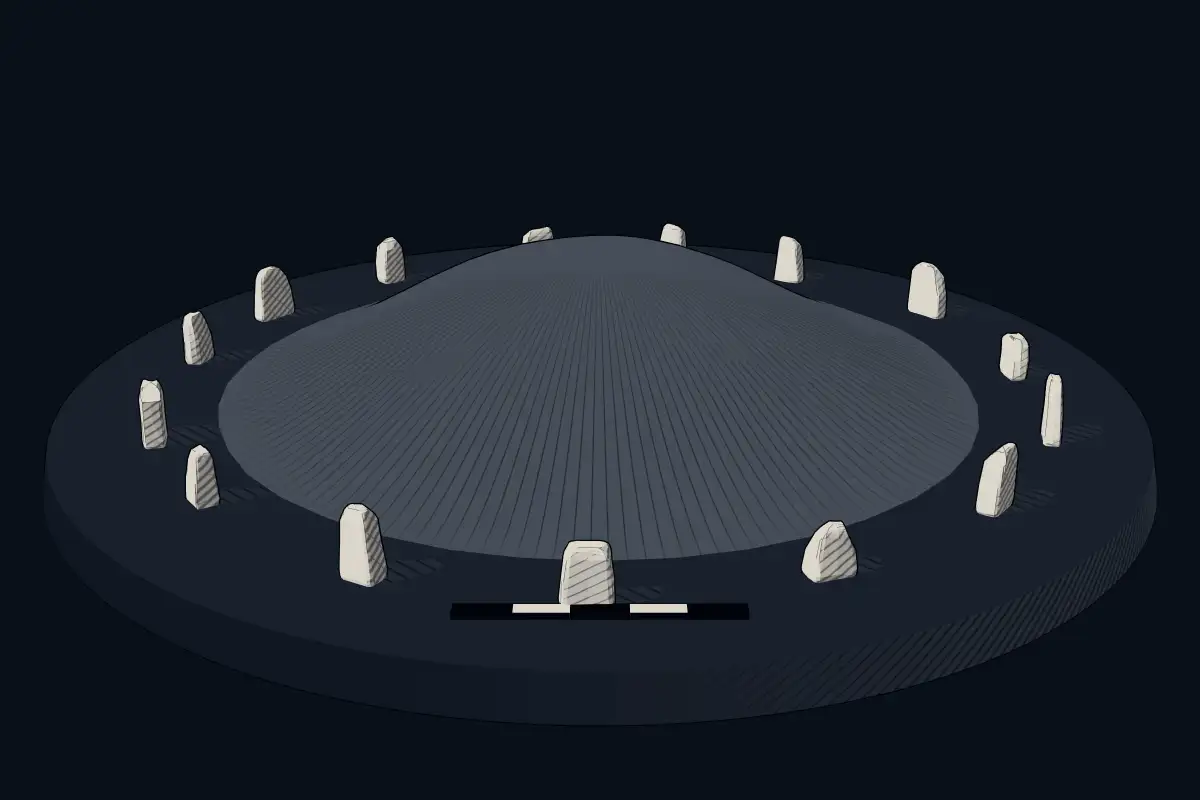
The reconstruction is ours, not a survey: it shows what a monument of this type looks like, at the size the record gives for this one.
Photographs
2 photographs, each with its author and licence
More photographs

Lore
Evidence & Lore
What the sources actually support — and, kept apart, what has been claimed.
What the evidence supports
Dates
Est. 3500–500 BCEHow this date was established: Type comparisonTypical range for megalithic mounds in Denmark; this site has not been dated itself. Denmark has about 20,000 preserved tumuli with the oldest around 5,000 years old; the Neolithic examples are Nordic megalithic mounds (dysser) of c. 3500-2800 BC.Source for this date
Where it stands
Denmark
The pin marks the monument itself — its exact point.
- Coordinates
- 55°25′58″ N, 11°13′49″ EFor a GPS or map app: 55.43286, 11.23027
Access is as our sources describe it; we have not visited the site to check.
Nearby
The closest sites in the Atlas, by straight line.
- Megalithic long barrowSvinerodsdysse3500–2800 BCE
- Megalithic mound (tumulus with integral stones)Glohøj3500–500 BCE
- Megalithic mound (tumulus with integral stones)Taarnhøj3500–500 BCE
- DolmenGrimskærdysse3500–2800 BCE
- Megalithic mound (tumulus with integral stones)Grønhøj3500–500 BCE
- Megalithic mound (tumulus with integral stones)Bildsø3500–500 BCE
- Megalithic mound (tumulus with integral stones)Knudsrødgaard3500–500 BCE
- Megalithic mound (tumulus with integral stones)Bildsø3500–500 BCE
Sources
Every record behind this page, with the link it came from.
2 sources behind this page
- 01Wikidata Q904692wikidata.org
- 02Source for this dateen.wikipedia.org
Image files
- Breddysse 01.jpgCommander-pirxCC BY-SA 4.0
- Breddysse 02.jpgCommander-pirxCC BY-SA 4.0
Report a correctionWrong date, name, photograph or source? Tell us and it will be put right.
Lore, kept apart
Legends and claims
These are stories and claims reported by the sources. They are not evidence, and they never stand in for the dating above.
- Tradition
Local tradition held that a king was buried in the large chamber and a queen in the small one.
Local tradition held that a king was buried in the large chamber and a queen in the small one. The site was also used for offerings as late as the 1800s. A nearby farmer named Knud Larsen, who lived there in the 1840s, was said to acquire wisdom by visiting the mound. In 1936, his grandson Vilhelm Knudsen recalled annual offerings at Christmas, with food and money placed on a flat stone and always gone by morning. How true these stories are cannot be known, but the mound clearly retained a magical and mythic significance into the middle of the 1800s.
Source
Around this place
The ten nearest sites, by compass
Credit
Text, licence and sources
Text from the Wikipedia article "Breddysse" (Danish), licensed CC BY-SA 4.0; authors are listed in the page history. Reused under CC BY-SA 4.0. Read on Wikipedia · Edit history and authors
- Wikipedia (Danish): BreddysseCC BY-SA 4.0
- Wikidata Q904692CC0