
Megalithic mound (tumulus with integral stones)The Copper Age
Tumulus von Evessen
DatedEst. 3500–500 BCE
Photo Christian Fischer · CC BY-SA 4.0Source file on Wikimedia Commons
Overview
About this site
Overview
The Tumulus von Evessen is a large burial mound in Evessen, Lower Saxony, Germany, that has not so far been archaeologically investigated. It has been protected as a natural monument since March 1945. It has a diameter of 34 metres and a height of 6 metres. The catalogue gives an estimated date of between 3500 and 500 BCE.
Read on Wikipedia3 min readCC BY-SA 4.0
Where it sits in time
The site's dated range, placed against world reference points.
The scale is logarithmic: each step to the left is about ten times older than the last.
Article
Tumulus von Evessen
The mound belongs to a group of burial mounds between the Elm and the Asse that are regarded as princely graves.
DescriptionSources for this section
- Wikipedia (German): Tumulus von EvessenCC BY-SA 4.0
Sources for this section
- Wikipedia (German): Tumulus von EvessenCC BY-SA 4.0
The mound belongs to a group of burial mounds between the Elm and the Asse that are regarded as princely graves. They include the Galgenberg north of Klein Vahlberg, the Meescheberg south of Klein Vahlberg, the partly destroyed Muspott near Eilum, and two further mounds near Evessen, the Kleines Hoch and the Thies-Hoch, which were excavated and removed in the 18th century. In the excavation of the Kleines Hoch in 1745 an urn was found, presumably from a secondary burial.
Research historySources for this section
- Wikipedia (German): Tumulus von EvessenCC BY-SA 4.0
Sources for this section
- Wikipedia (German): Tumulus von EvessenCC BY-SA 4.0
As early as 1745 Pastor Johann Friedrich Faicke recognised that the mound at Evessen must be a prehistoric grave. An essay in the Braunschweigische Anzeigen of 16 January 1745 held the Evessen tumulus to be a princely grave dating from the Early Bronze Age (1800 to 1600 BCE) or from the Neolithic (4000 to 2000 BCE). It is possible that, like other burial mounds, it was visited repeatedly as a burial place over long periods, so that its present form is the result of long-lasting processes.
An eyewitness described the excavation of one of the other mounds in November 1744. A farmer looking for red sand at the Kleines Hoch caught sight of two stones facing each other and dug deeper in the hope of treasure. Beneath the broken vault the witness saw ash and charcoal, and found in the fragments of a broken urn burnt bones and a molar of a human, which he collected and took home.
HistorySources for this section
- Wikipedia (German): Tumulus von EvessenCC BY-SA 4.0
Sources for this section
- Wikipedia (German): Tumulus von EvessenCC BY-SA 4.0
A lime tree stands on the top of the mound, at the western edge of the village; its age is estimated at up to 800 years. It was declared a natural monument in 1944, and in October 2022 it was proclaimed a National Heritage tree.
Under the lime tree on the mound the Vogteigericht (manorial court) held its sessions. Court hearings at Evessen are mentioned in the accounts of the Brunswick cathedral chapter as early as 1347, and the court was abolished only in 1808. In Venturini's book on the Duchy of Brunswick it is stated in 1826 that the tree under which the court was held can still be seen. The court dealt with questions of neighbour and family law, including thefts of wood, and with disputes and scuffles among villagers. Sales were also recognised as valid in traditional forms: the seller symbolically laid a hand on the judge's hat, and the buyer also took hold of the hat to take possession. Parties who failed to appear had to pay a fine of ten groschen, which went to the court to be drunk.
FolkloreSources for this section
- Wikipedia (German): Tumulus von EvessenCC BY-SA 4.0
Sources for this section
- Wikipedia (German): Tumulus von EvessenCC BY-SA 4.0
Legends surround the origin of the mound, the landmark of the village, which is also called dat Hoch. According to local tradition, a giant came from the Elm with thick clods on his boots. He tore out a tree to scrape the clods from his soles and stuck the lime tree into one of the clods. This is now the mound with the thick lime tree on top.
ContextSources for this section
- Wikipedia (German): Tumulus von EvessenCC BY-SA 4.0
Sources for this section
- Wikipedia (German): Tumulus von EvessenCC BY-SA 4.0
Burial mounds are found across Germany, from the northern plain to the south. Those of the Middle Bronze Age give a whole culture its name: the Tumulus culture (Hügelgräberkultur), which was dominant in Central Europe from about 1600 to 1300 BCE and buried its dead beneath mounds.
Tradition and region
About this kind of monument
German Hügelgräber and megalithic mounds
Burial mounds are found across Germany, from the northern plain to the south. Those of the Middle Bronze Age give a whole culture its name: the Tumulus culture (Hügelgräberkultur), which was dominant in Central Europe from about 1600 to 1300 BCE and buried its dead beneath mounds. It descended from the Unetice culture and covered parts of southern Germany, the Czech Republic, Austria, Switzerland, Poland and France. Its society was a warrior society, as the weapons in the graves show. The Late Bronze Age Urnfield culture, which followed it, preferred cremation, and the Hallstatt culture of the Early Iron Age revived the great mound for chieftains.
Hallstatt-period mounds can be spectacular. The Hochdorf grave in Baden-Württemberg, of about 530 BCE, was found in 1968 and excavated in 1978 to 1979. Its mound, originally 6 metres high and about 60 metres across, had been worn down to about 1 metre. Inside lay a man of about fifty on a bronze recliner with eight wheels, wearing a gold-plated torc, with a four-wheeled wagon and drinking horns.
In the north, many mounds are older and belong to the Funnel Beaker culture, whose stone-chambered tombs are described in the articles on northern German megalithic tombs. Here a mound may cover a megalithic chamber, and the Atlas's classification sometimes cannot tell the two apart without a field visit.
Dating usually combines typology, pottery and metalwork and, where timber survives, tree-ring dating. Many mounds have been ploughed down, as Hochdorf shows.
When visiting, look for mounds in groups in woodland, where they survive best, for the hollow of an old central trench, and for kerbs of stone.
Paraphrased from Wikipedia: Tumulus culture, Wikipedia: Hallstatt culture, Wikipedia: Funnel beaker culture, Wikipedia: Tumulus, Wikipedia: Heuneburg, Wikipedia: Hochdorf Chieftain's Grave · CC BY-SA 4.0
From the article
Dated moments in the story
- 1600 BCE
In den Braunschweigischen Anzeigen vom 16. Januar 1745 erschien ein Aufsatz, wonach der Evesser Tumulus für ein Fürstengrab gehalten wurde, das aus der frühen Bronzezeit (1800 bis 1600 v. Chr.) oder aus der Jungsteinzeit (4000 bis 2000 v. Chr.) stamme.
Source - 800 CE
Auf der Kuppe des Hügels am westlichen Ortsrand von Evessen steht eine Linde, deren Alter auf bis zu 800 Jahre geschätzt wird.
Source - 1347
In Rechnungen des Braunschweiger Domstiftes werden schon 1347 die Evesser Gerichtsverhandlungen erwähnt.
Source - 1745
Bei der Grabung im Kleinen Hoch wurde 1745 eine Urne, vermutlich eine Nachbestattung, gefunden.
Source - 1745
Bereits 1745 erkannte Pastor Johann Friedrich Faicke, dass es sich bei dem Hügel in Evessen um ein vorgeschichtliches Grab handeln müsse.
Source - 1808
Aufgehoben wurde das Gericht erst 1808. In Venturinis Buch über das Herzogtum Braunschweig heißt es 1826: "Der Baum, worunter das Vogteigericht gehalten wurde, ist noch zu sehen".
Source - 1944
Der Baum wurde 1944 zum Naturdenkmal erklärt.
Source - 1945
Seit März 1945 steht er als Naturdenkmal unter Schutz.
Source - 2022
Im Oktober 2022 wurde die markante Sommerlinde zum Nationalerbe-Baum ausgerufen.
Source
See it in 3D
An interpretive reconstruction of the monument, standing on the real ground at its exact point, under the sun for that place and season. Drag to look around it.
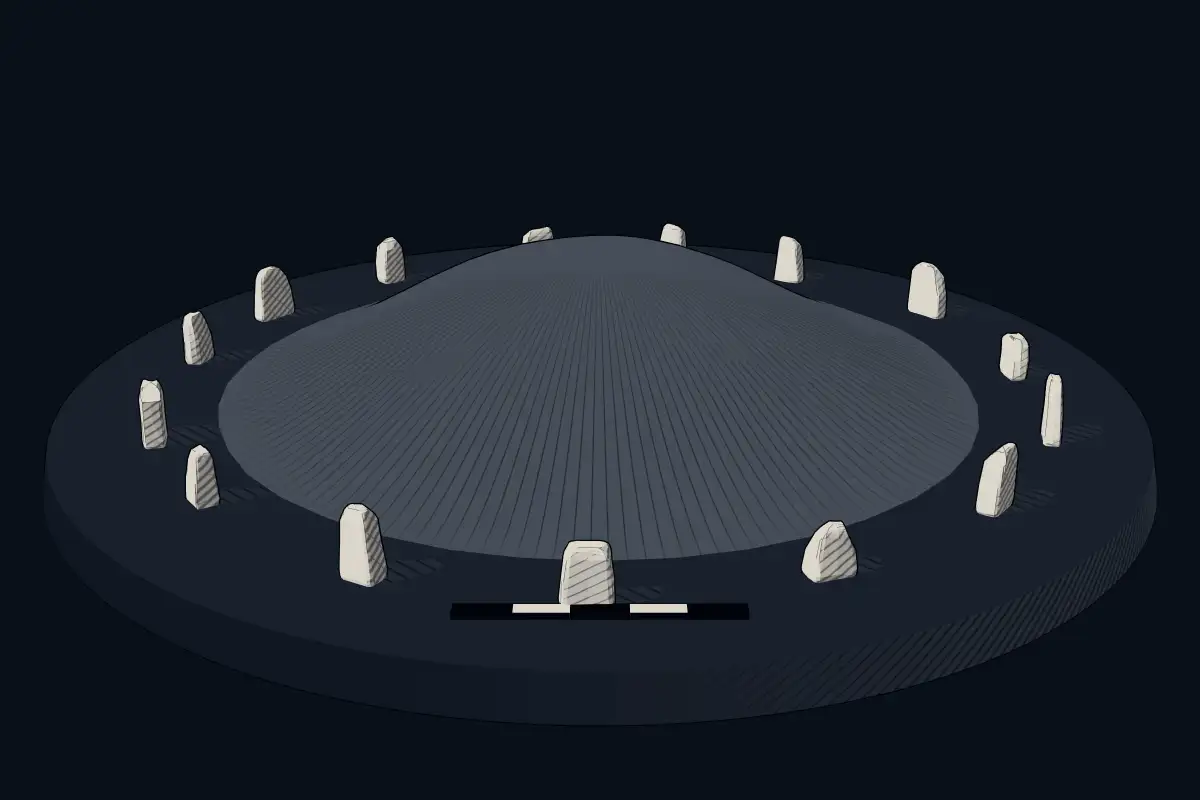
The reconstruction is ours, not a survey: it shows what a monument of this type looks like, at the size the record gives for this one.
Photographs
3 photographs, each with its author and licence
More photographs
Lore
Evidence & Lore
What the sources actually support — and, kept apart, what has been claimed.
What the evidence supports
Dates
Est. 3500–500 BCEHow this date was established: Type comparisonTypical range for megalithic mounds in Germany; this site has not been dated itself. German barrows ( Hugelgraber) run from the Neolithic (construction in central and south-west Germany c. 3500 BC and northern and central Germany c. 3400 BC) to the Late Bronze and Iron Age.Source for this date
Where it stands
Germany
The pin marks the monument itself — its exact point.
- Coordinates
- 52°11′19″ N, 10°42′19″ EFor a GPS or map app: 52.18858, 10.70535
Access is as our sources describe it; we have not visited the site to check.
Nearby
The closest sites in the Atlas, by straight line.


Sources
Every record behind this page, with the link it came from.
2 sources behind this page
- 01Wikidata Q19310243wikidata.org
- 02Source for this dateen.wikipedia.org
Image files
- Tumuluslinde Evessen.jpgChristian FischerCC BY-SA 4.0
- Tumulus von Evessen Grössenvergleich.jpgAxel HindemithCC BY-SA 3.0
- Tumulus von Evessen frontal.jpgAxel HindemithCC BY-SA 3.0
Report a correctionWrong date, name, photograph or source? Tell us and it will be put right.
Lore, kept apart
Legends and claims
These are stories and claims reported by the sources. They are not evidence, and they never stand in for the dating above.
- Tradition
Sagen und Legenden ranken sich um das Entstehen des Wahrzeichens des Ortes, das Hügelgrab (lat.
Sagen und Legenden ranken sich um das Entstehen des Wahrzeichens des Ortes, das Hügelgrab (lat. Tumulus), das auch als dat Hoch bezeichnet wird. Der Sage nach sei ein Riese vom Elm dahergekommen, mit dicken Kluten an den Stiefeln. Er riss einen Baum aus, um die Sohlen von den Kluten zu säubern. Den Lindenbaum steckte er in einen der Erdklumpen. Das ist nun der Hügel mit der dicken Linde obenauf.
Source
Around this place
The ten nearest sites, by compass
Credit
Text, licence and sources
Adapted from the Wikipedia article "Tumulus von Evessen" (German), licensed CC BY-SA 4.0; authors are listed in the page history. Reused under CC BY-SA 4.0. Read on Wikipedia · Edit history and authors
- Wikipedia (German): Tumulus von EvessenCC BY-SA 4.0
- Wikidata Q19310243CC0