
Megalithic mound (tumulus with integral stones)
Tipkenhoog
DatedEst. 3500–500 BCE
Photo Andreas Ständer · CC BY-SA 4.0Source file on Wikimedia Commons
Overview
About this site
What the sources say
Der Tipkenhoog ist ein Grabhügel, der sich in unmittelbarer Nähe des Harhoogs in Keitum auf Sylt befindet.
Der Hügel soll der Legende nach das Grab des Wächters der Sylter Kämpen (kämpfende Riesen) gewesen sein. Der Riese fiel im Kampf mit dänischen Eindringlingen und wurde in dem Tipkenhoog beigesetzt. Dort soll sich der Überlieferung nach ein Wachturm des Riesen befunden haben. Forschungsgrabungen am Tipkenhoog vom 15. bis 18. August 1870 durch H. Hamelmann blieben ohne bedeutenden Befund. Im Sommer 1940 diente die Anhöhe als Beobachtungsstand der Marineflak. Im April des Jahres 1982 erfolgte die Restaurierung durch den Lions-Club Sylt und das Landesamt für Vor- und Frühgeschichte Schleswig-Holstein.
Article in GermanRead on Wikipedia3 min readCC BY-SA 4.0
Where it sits in time
The site's dated range, placed against world reference points.
The scale is logarithmic: each step to the left is about ten times older than the last.
The full article
Tipkenhoog: the whole story
In briefSources for this section
- Wikipedia (German): TipkenhoogCC BY-SA 4.0
Sources for this section
- Wikipedia (German): TipkenhoogCC BY-SA 4.0
The Tipkenhoog is a burial mound that stands in the immediate vicinity of the Harhoog in Keitum on the island of Sylt, in Germany. The catalogue classes it as a megalithic mound, a tumulus with integral stones, and gives a typological estimate for its date of between 3500 and 500 BCE. Little else is recorded about its structure, and no description of its size or stonework is available.
Local legend holds that the mound was the grave of the guardian of the Sylt Kämpen, the fighting giants. According to the story, this giant fell in battle against Danish invaders and was laid to rest in the Tipkenhoog. Tradition also says that a watchtower of the giant once stood on the spot.
Research excavations were carried out at the mound from 15 to 18 August 1870 by H. Hamelmann, but they produced no significant findings. In the summer of 1940 the hilltop was used as an observation post by the naval anti-aircraft artillery. In April 1982 the mound was restored by the Lions Club Sylt together with the State Office for Prehistory and Early History of Schleswig-Holstein.
Burial mounds are found across Germany, from the northern plain to the south. Those of the Middle Bronze Age give a whole culture its name, the Tumulus culture, which was dominant in Central Europe from about 1600 to 1300 BCE and buried its dead beneath mounds. The Late Bronze Age Urnfield culture that followed preferred cremation, and the Hallstatt culture of the Early Iron Age revived the great mound for chieftains. These facts describe the wider setting of such mounds rather than this particular one, whose builders and burials are not recorded.
No English Wikipedia article exists for it; the full text below is the German article "Tipkenhoog", shown in the original language.
Summary in EnglishSources for this section
- Wikipedia (German): TipkenhoogCC BY-SA 4.0
Sources for this section
- Wikipedia (German): TipkenhoogCC BY-SA 4.0
Tipkenhoog is a megalithic mound (tumulus with integral stones) in Sylt, Germany. A typological estimate: 3500 BCE to 500 BCE. No English Wikipedia article exists for it; the full text below is the German article "Tipkenhoog", shown in the original language.
How this page was madeSources for this section
- Wikipedia (German): TipkenhoogCC BY-SA 4.0
Sources for this section
- Wikipedia (German): TipkenhoogCC BY-SA 4.0
The summary at the top of this page was written by Claude Sonnet 5.5 (2026-11-06) from the cited Wikipedia article “Tipkenhoog”, translated from German. The numbers in it were checked automatically against the source text. The rest of the page is the article itself, the structured records and computed distances.
Tradition and region
About this kind of monument
German Hügelgräber and megalithic mounds
Burial mounds are found across Germany, from the northern plain to the south. Those of the Middle Bronze Age give a whole culture its name: the Tumulus culture (Hügelgräberkultur), which was dominant in Central Europe from about 1600 to 1300 BCE and buried its dead beneath mounds. It descended from the Unetice culture and covered parts of southern Germany, the Czech Republic, Austria, Switzerland, Poland and France. Its society was a warrior society, as the weapons in the graves show. The Late Bronze Age Urnfield culture, which followed it, preferred cremation, and the Hallstatt culture of the Early Iron Age revived the great mound for chieftains.
Hallstatt-period mounds can be spectacular. The Hochdorf grave in Baden-Württemberg, of about 530 BCE, was found in 1968 and excavated in 1978 to 1979. Its mound, originally 6 metres high and about 60 metres across, had been worn down to about 1 metre. Inside lay a man of about fifty on a bronze recliner with eight wheels, wearing a gold-plated torc, with a four-wheeled wagon and drinking horns.
In the north, many mounds are older and belong to the Funnel Beaker culture, whose stone-chambered tombs are described in the articles on northern German megalithic tombs. Here a mound may cover a megalithic chamber, and the Atlas's classification sometimes cannot tell the two apart without a field visit.
Dating usually combines typology, pottery and metalwork and, where timber survives, tree-ring dating. Many mounds have been ploughed down, as Hochdorf shows.
When visiting, look for mounds in groups in woodland, where they survive best, for the hollow of an old central trench, and for kerbs of stone.
Paraphrased from Wikipedia: Tumulus culture, Wikipedia: Hallstatt culture, Wikipedia: Funnel beaker culture, Wikipedia: Tumulus, Wikipedia: Heuneburg, Wikipedia: Hochdorf Chieftain's Grave · CC BY-SA 4.0
From the article
Dated moments in the story
- 1870
Forschungsgrabungen am Tipkenhoog vom 15. bis 18. August 1870 durch H.
Source - 1940
Im Sommer 1940 diente die Anhöhe als Beobachtungsstand der Marineflak.
Source - 1982
Im April des Jahres 1982 erfolgte die Restaurierung durch den Lions-Club Sylt und das Landesamt für Vor- und Frühgeschichte Schleswig-Holstein.
Source
See it in 3D
An interpretive reconstruction of the monument, standing on the real ground at its exact point, under the sun for that place and season. Drag to look around it.
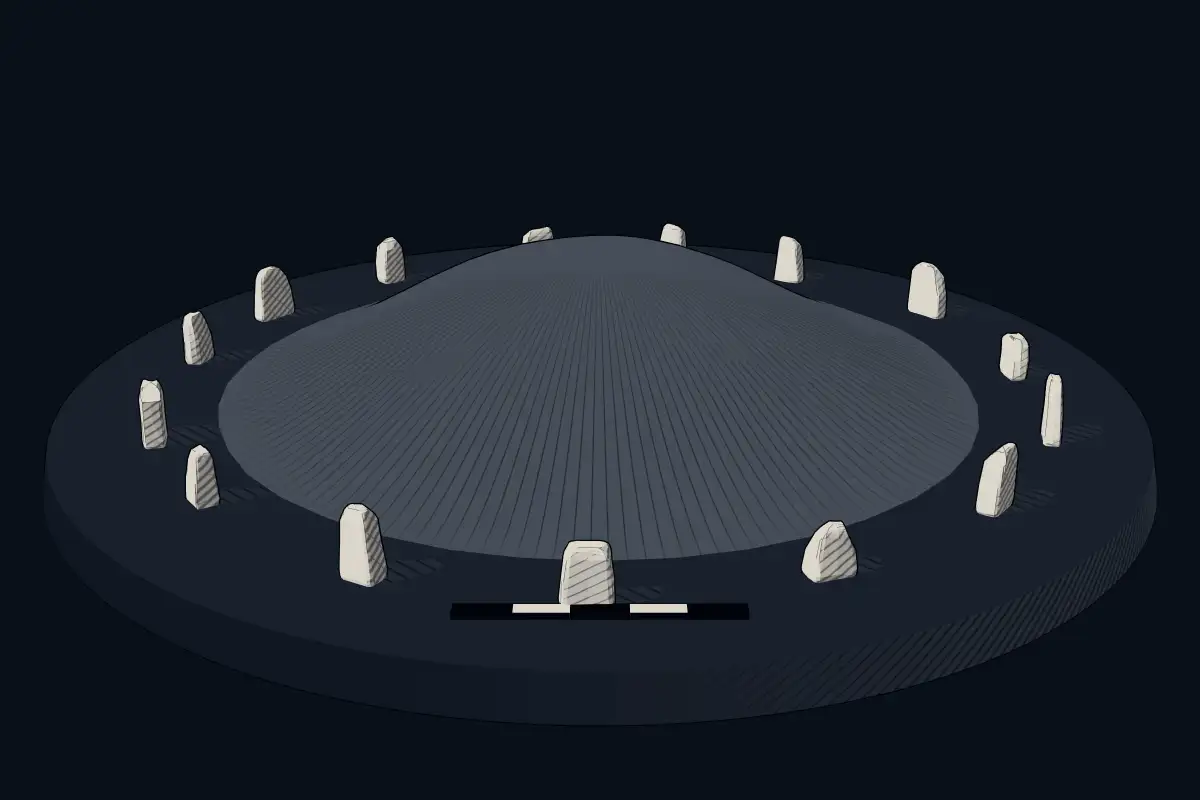
The reconstruction is ours, not a survey: it shows what a monument of this type looks like, at the size the record gives for this one.
Photographs
3 photographs, each with its author and licence
More photographs
Lore
Evidence & Lore
What the sources actually support — and, kept apart, what has been claimed.
What the evidence supports
Dates
Est. 3500–500 BCEHow this date was established: Type comparisonTypical range for megalithic mounds in Germany; this site has not been dated itself. German barrows ( Hugelgraber) run from the Neolithic (construction in central and south-west Germany c. 3500 BC and northern and central Germany c. 3400 BC) to the Late Bronze and Iron Age.Source for this date
Where it stands
Germany
The pin marks the monument itself — its exact point.
- Coordinates
- 54°53′28″ N, 8°22′53″ EFor a GPS or map app: 54.89108, 8.38139
Access is as our sources describe it; we have not visited the site to check.
Nearby
The closest sites in the Atlas, by straight line.


Sources
Every record behind this page, with the link it came from.
2 sources behind this page
- 01Wikidata Q20879464wikidata.org
- 02Source for this dateen.wikipedia.org
Image files
- Tipkenhoog, Keitum, Sylt.jpgAndreas StänderCC BY-SA 4.0
- Tipkenhoog.jpgSölring ForiiningCC BY-SA 4.0
- Keitum Tipkenhoog.jpgMagnus ManskeCC BY-SA 3.0
Report a correctionWrong date, name, photograph or source? Tell us and it will be put right.
Lore, kept apart
Legends and claims
These are stories and claims reported by the sources. They are not evidence, and they never stand in for the dating above.
- Tradition
Local legend holds that the mound was the grave of the guardian of the Sylt Kämpen, the fighting giants.
Local legend holds that the mound was the grave of the guardian of the Sylt Kämpen, the fighting giants. According to the story, this giant fell in battle against Danish invaders and was laid to rest in the Tipkenhoog. Tradition also says that a watchtower of the giant once stood on the spot.
Source
Around this place
The ten nearest sites, by compass
Credit
Text, licence and sources
Text from the Wikipedia article "Tipkenhoog" (German), licensed CC BY-SA 4.0; authors are listed in the page history. Reused under CC BY-SA 4.0. Read on Wikipedia · Edit history and authors
- Wikipedia (German): TipkenhoogCC BY-SA 4.0
- Wikidata Q20879464CC0