Steinkiste von Holsthum
DatedEst. 3500–2800 BCE
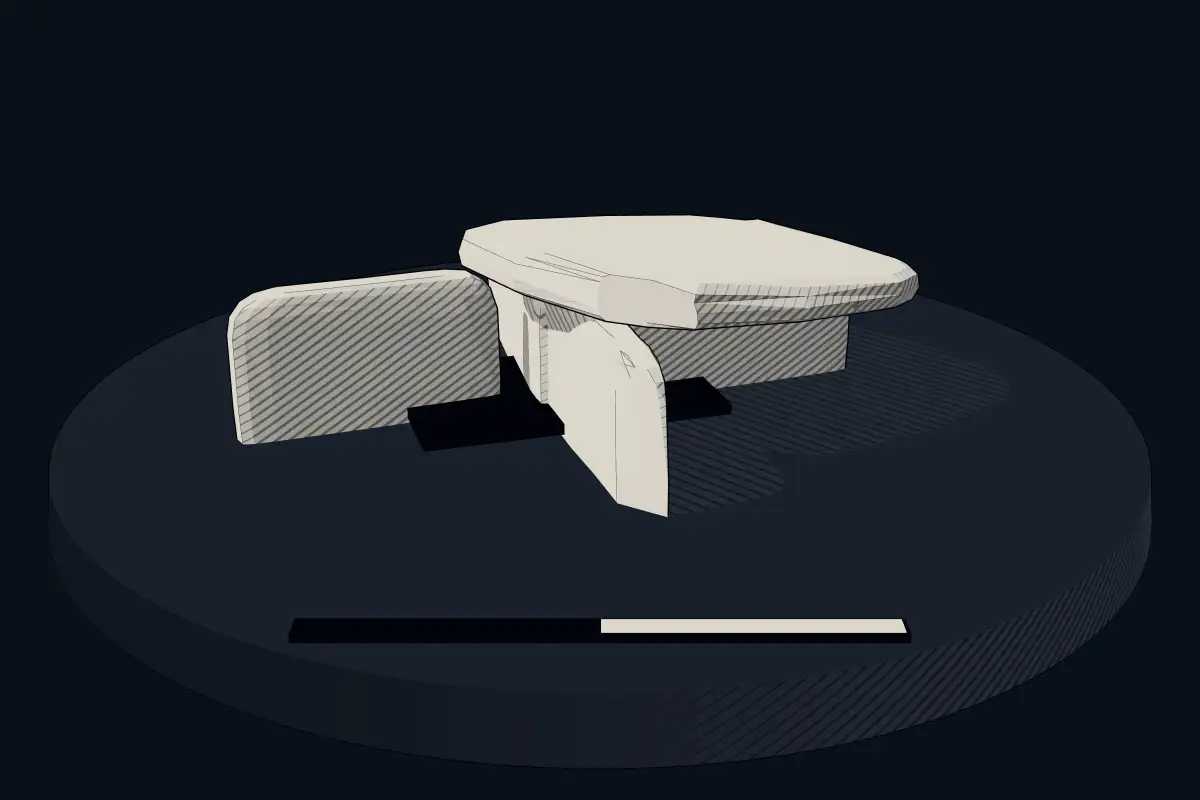
No licensed photograph yetWe have no photograph we may publish for this site, so the interpretive 3D view leads instead.
Overview
About this site
Overview
Steinkiste von Holsthum is a cist in Holsthum, Germany. It lies at 49.8831° N, 6.3974° E.
Catalogue recordSources and licences
Where it sits in time
The site's dated range, placed against world reference points.
The scale is logarithmic: each step to the left is about ten times older than the last.
Article
Steinkiste von Holsthum
ContextSources for this section
- en.wikipedia.orgCC BY-SA 4.0
- en.wikipedia.orgCC BY-SA 4.0
- en.wikipedia.orgCC BY-SA 4.0
- en.wikipedia.orgCC BY-SA 4.0
Sources for this section
- en.wikipedia.orgCC BY-SA 4.0
- en.wikipedia.orgCC BY-SA 4.0
- en.wikipedia.orgCC BY-SA 4.0
- en.wikipedia.orgCC BY-SA 4.0
A cist, or kist, is a small stone-built coffin-like box used to hold the bodies of the dead. It may once have been covered by a cairn or a long barrow, and several cists are sometimes found together within the same cairn or barrow. Ornaments are often found in excavated cists, which shows the wealth or prominence of the person buried. In Scandinavia the stone cist is called the hellekiste in Danish and hällkista in Swedish, and in Nordic megalith architecture it is one of the recognised types alongside dolmens and passage graves. The regional background, “Scandinavian and German stone cists”, is given below.
DatingSources for this section
- en.wikipedia.orgCC BY-SA 4.0
Sources for this section
- en.wikipedia.orgCC BY-SA 4.0
No scientific date has been published for this site. Monuments of this type in Germany are generally dated 3500 BCE to 2800 BCE; the site itself may fall inside or outside that range.
German stone cists (Steinkisten) belong to the Nordic megalith tradition which emerged predominantly between 3500 and 2800 BC.
Setting
9 other recorded monuments lie within 10 km (1 within 1 km, 7 within 5 km), 1 of them of the same type. In Holsthum, Germany, 1 of the 3 recorded monuments are of this type.
The nearest recorded monuments are Holsthum Menhir Langenstein (0.3 km south, menhir); Menhir II von Holsthum (1.4 km east, menhir); Fraubillen cross (2.1 km south-west, menhir); Menhir II von Nusbaum (2.2 km west, menhir).
ProtectionSources for this section
Sources for this section
No heritage designation is recorded for the site.
Tradition and region
About this kind of monument
Scandinavian and German stone cists
A cist, or kist, is a small stone-built coffin-like box used to hold the bodies of the dead. It may once have been covered by a cairn or a long barrow, and several cists are sometimes found together within the same cairn or barrow. Ornaments are often found in excavated cists, which shows the wealth or prominence of the person buried. In Scandinavia the stone cist is called the hellekiste in Danish and hällkista in Swedish, and in Nordic megalith architecture it is one of the recognised types alongside dolmens and passage graves.
The most spectacular cist in Scandinavia is the central chamber of the King's Grave at Kivik in Scania, from about the fifteenth century BCE. It is about 4 metres long and 1.5 metres wide, made of ten upright slabs of which eight are decorated with carvings of people, ships, birds, fish, horses, axes and a chariot. It was opened in 1748 by farmers who were taking stone for field walls.
Other cists are much smaller. Associated with Nordic Bronze Age settlements are burial cairns, mounds and cemeteries, with interments including oak coffins and urn burials. The cists in the Atlas, many of them in Sweden and Denmark, are usually single graves under a cairn or a barrow.
Dating relies on the objects in the cist and on radiocarbon dating of any surviving bone.
When visiting, look for a box formed by slabs, exposed where its covering mound has gone.
Paraphrased from Wikipedia: Cist, Wikipedia: Kivik grave, Wikipedia: Nordic megalith architecture, Wikipedia: Nordic Bronze Age · CC BY-SA 4.0
See it in 3D
An interpretive reconstruction of the monument, standing on the real ground at its exact point, under the sun for that place and season. Drag to look around it.
The reconstruction is ours, not a survey: it shows what a monument of this type looks like, at the size the record gives for this one.
Lore
Evidence & Lore
What the sources actually support — and, kept apart, what has been claimed.
What the evidence supports
Dates
Est. 3500–2800 BCEHow this date was established: Type comparisonTypical range for cists in Germany; this site has not been dated itself. German stone cists (Steinkisten) belong to the Nordic megalith tradition which emerged predominantly between 3500 and 2800 BC.Source for this date
Where it stands
Germany
The pin marks the monument itself — its exact point.
- Coordinates
- 49°52′59″ N, 6°23′51″ EFor a GPS or map app: 49.88308, 6.39744
Access is as our sources describe it; we have not visited the site to check.
Nearby
The closest sites in the Atlas, by straight line.
 Holsthum Menhir Langenstein2800–1800 BCE
- Menhir (standing stone)Menhir II von Holsthum2800–1800 BCE
 Fraubillen cross4000–800 BCE
 Menhir II von Nusbaum2800–1800 BCE
- Menhir III von Nusbaum2800–1800 BCE
- Menhir (standing stone)Menhirfragmente von Nusbaum2800–1800 BCE
- CistHartberg megalithic tomb3000 BCE–600 CE
 US-Monument Iechternach


Sources
Every record behind this page, with the link it came from.
2 sources behind this page
- 01Wikidata Q19964581wikidata.org
- 02Source for this dateen.wikipedia.org
Report a correctionWrong date, name, photograph or source? Tell us and it will be put right.
Around this place
The ten nearest sites, by compass
- Holsthum Menhir Langenstein0.3 km S
- Menhir II von Holsthum1.4 km E
- Fraubillen cross2.1 km SW
- Menhir II von Nusbaum2.2 km W
- Menhir III von Nusbaum2.2 km W
- Menhirfragmente von Nusbaum2.4 km W
- Hartberg megalithic tomb2.5 km N
- US-Monument Iechternach7.6 km S
- Monument Raymond Petit Bäerdref7.8 km SW
- Schnellert11 km SW
Credit
Text, licence and sources
Compiled from open records (Wikidata, CC0; OpenStreetMap, ODbL) and a regional background article based on Wikipedia (CC BY-SA 4.0).
- Wikidata Q19964581CC0
- en.wikipedia.orgCC BY-SA 4.0
- en.wikipedia.orgCC BY-SA 4.0
- en.wikipedia.orgCC BY-SA 4.0
- en.wikipedia.orgCC BY-SA 4.0