
Steingrab Egypten
DatedEst. 3500–2800 BCE
Photo Wikipedia-Benutzer Uwca · Public domainSource file on Wikimedia Commons

Overview
About this site
What the sources say
Das Großsteingrab Egypten ist eine Megalithanlage mit der Sprockhoff-Nr. 943. Es entstand zwischen 3500 und 2800 v. Chr. und ist eine Anlage der Trichterbecherkultur (TBK) aus der Jungsteinzeit in der Gemeinde Dötlingen im niedersächsischen Landkreis Oldenburg.
Article in GermanRead on Wikipedia2 min readCC BY-SA 4.0
Where it sits in time
The site's dated range, placed against world reference points.
The scale is logarithmic: each step to the left is about ten times older than the last.
The full article
Steingrab Egypten: the whole story
Summary in EnglishSources for this section
- Wikipedia (German): Steingrab EgyptenCC BY-SA 4.0
Sources for this section
- Wikipedia (German): Steingrab EgyptenCC BY-SA 4.0
Steingrab Egypten is a dolmen in Dötlingen, Germany. A typological estimate: 3500 BCE to 2800 BCE. No English Wikipedia article exists for it; the full text below is the German article "Steingrab Egypten", shown in the original language.
Des Weiteren gab es früher etwa 35 Meter südwestlich dieses Grabes ein weiteres Großsteingrab.
BeschreibungSources for this section
- Wikipedia (German): Steingrab EgyptenCC BY-SA 4.0
Sources for this section
- Wikipedia (German): Steingrab EgyptenCC BY-SA 4.0
Das Großsteingrab Egypten liegt rund drei Kilometer nordnordwestlich des Dötlinger Ortskerns in Richtung Ostrittrum, etwa 100 m südwestlich der Ortslage Egypten und etwa 400 m westlich des Rittrumer Kirchwegs. Die auf einer Lichtung am Waldrand gelegene, nordwest-südost-orientierte Grabanlage ist ein Bauwerk der Nordischen Megalitharchitektur und verfügt über ein besonderes Erscheinungsbild: Die Tragsteine sind noch bis zur oberen Kante in den vergleichsweise gut erhaltenen Grabhügel eingebettet. Es sind zehn Trag- und zwei Decksteine in ihrer ursprünglichen Position erhalten. Ein Teil des Hügels wurde bei der Untersuchung von 1992 abgetragen, wobei man feststellte, dass der Zugang nicht – wie zuvor angenommen – im Südwesten lag, es konnte vielmehr gar kein Zugang festgestellt werden. Darüber hinaus fand man Reste einer ovalen Umfassung aus Feldsteinen. Der ursprüngliche Hügel muss eine Fläche von ca. 15 × 12,5 Meter gehabt haben. Die an sich kleine Kammer (5,9 × 1,65 Meter) war mit einem größeren Erdhügel überschichtet. So dürften einst alle kleineren Großsteingräber ausgesehen haben. Des Weiteren gab es früher etwa 35 Meter südwestlich dieses Grabes ein weiteres Großsteingrab.
Im Bereich des Naturparks Wildeshauser Geest und seiner näheren Umgebung liegen zahlreiche weitere Anlagen ähnlicher Art.
Tradition and region
About this kind of monument
German and Dutch Hünengräber (hunebedden)
The megalithic tombs of northern Germany and the Netherlands were built by the Funnel Beaker culture (about 4100 to 2800 BCE), and the style, called Nordic megalith architecture, emerged between 3500 and 2800 BCE. In the Netherlands the tombs are the hunebedden, built between 3470 and 3250 BCE by the western group of the Funnel Beaker culture and used until about 2760 BCE. Of an estimated 100 original tombs, 54 are preserved, 52 of them in the province of Drenthe and two in Groningen. After the Funnel Beaker culture ended the sites were reused by the Single Grave and Bell Beaker cultures in the Early Bronze Age and, to a lesser extent, into the Middle Ages.
In Mecklenburg-Vorpommern up to 5,000 megalith tombs were erected, and more than 1,000 are preserved and protected by law; they belong to the youngest and easternmost part of the western European tradition. Most are dolmens, often lying inside a circular or trapezoid frame of standing stones. Locally they are known as Hünengräber, "giants' tombs", or Großsteingräber, "large stone tombs"; the trapezoid frame is a Hünenbett, "giants' bed", and the circular one a Bannkreis. Between 1964 and 1974 Ewald Schuldt excavated over a hundred sites there and sorted them into simple dolmens, extended dolmens, passage graves, great dolmens, unchambered long barrows and stone cists.
Folklore: the German and Dutch names, with Hüne meaning "giant", carry the old idea that giants were buried here. This is a tradition; the stones were placed by Neolithic farmers.
When visiting, look for the capstones on their supports and the frame of kerbstones around them.
Paraphrased from Wikipedia: Megaliths in the Netherlands, Wikipedia: Megaliths in Mecklenburg-Vorpommern, Wikipedia: Nordic megalith architecture, Wikipedia: Funnel beaker culture, Wikipedia: Dolmen · CC BY-SA 4.0
From the article
Dated moments in the story
- 2800 BCE
943. Es entstand zwischen 3500 und 2800 v. Chr. und ist eine Anlage der Trichterbecherkultur (TBK) aus der Jungsteinzeit in der Gemeinde Dötlingen im niedersächsischen Landkreis Oldenburg.
Source - 1992
Ein Teil des Hügels wurde bei der Untersuchung von 1992 abgetragen, wobei man feststellte, dass der Zugang nicht – wie zuvor angenommen – im Südwesten lag, es konnte vielmehr gar kein Zugang festgestellt werden.
Source
See it in 3D
An interpretive reconstruction of the monument, standing on the real ground at its exact point, under the sun for that place and season. Drag to look around it.
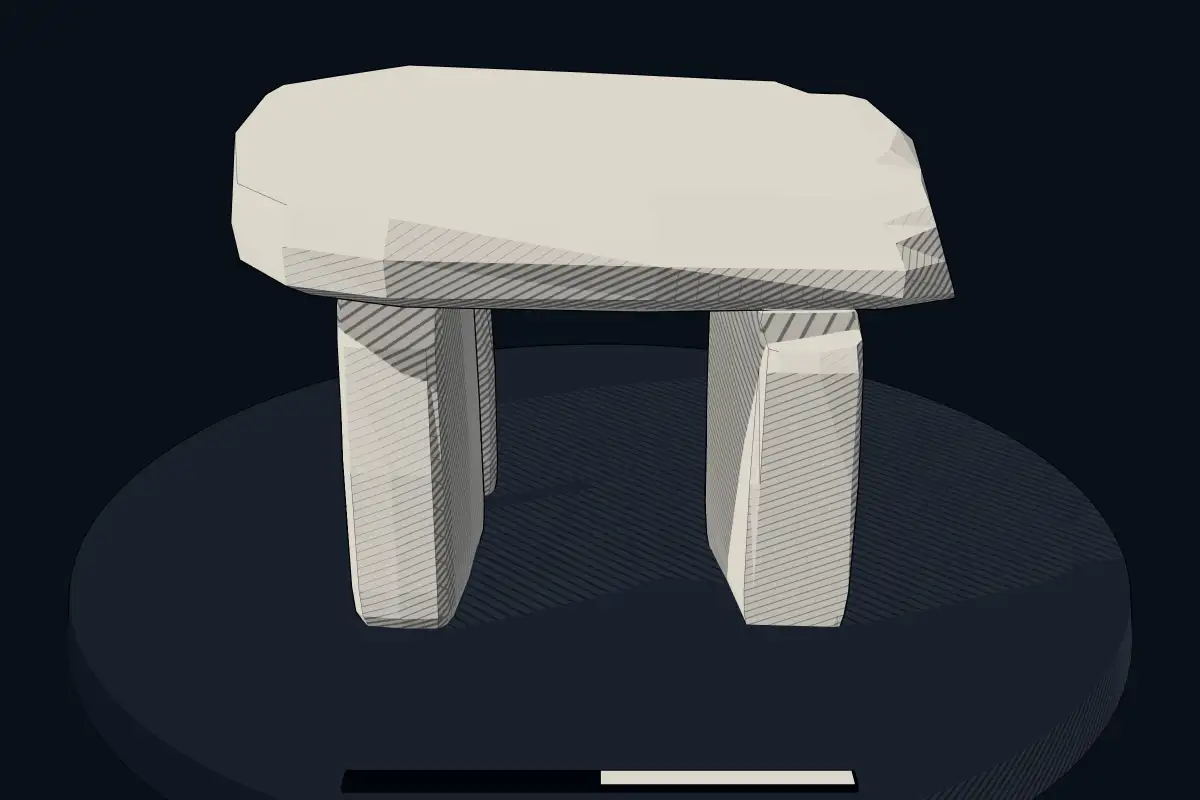
The reconstruction is ours, not a survey: it shows what a monument of this type looks like, at the size the record gives for this one.
Photographs
1 photograph, each with its author and licence
Lore
Evidence & Lore
What the sources actually support — and, kept apart, what has been claimed.
What the evidence supports
Dates
Est. 3500–2800 BCEHow this date was established: Type comparisonTypical range for dolmens in Germany; this site has not been dated itself. German dolmens (Huengrab) belong to the Nordic megalith tradition which emerged predominantly between 3500 and 2800 BC.Source for this date
Where it stands
Germany
The pin marks the monument itself — its exact point.
- Coordinates
- 52°57′29″ N, 8°21′40″ EFor a GPS or map app: 52.95800, 8.36117
Access is as our sources describe it; we have not visited the site to check.
Nearby
The closest sites in the Atlas, by straight line.
 Großsteingrab Dötlingen3500–2800 BCE
- DolmenSteenbarg dolmen3500–2800 BCE
 Glaner Braut3500–2800 BCE
Photo: -- Frank Poppe 17:50, 24. Mai 2007 (CEST) · Public domain
- DolmenBadberger Sand dolmen3500–2800 BCE
 Großsteingrab Gerichtsstätte3500–2800 BCE
 Großsteingrab Steenberg3500–2800 BCE
Photo: Travus ( talk ) 10:41, 26 May 2012 (UTC) · CC BY-SA 3.0
 Kleinenkneter Steine3500–2500 BCE
 Hohe Steine bei Wildeshausen3500–2800 BCE


Sources
Every record behind this page, with the link it came from.
2 sources behind this page
- 01Wikidata Q2340728wikidata.org
- 02Source for this dateen.wikipedia.org
Image files
- Großsteingrab Egypten 2009.JPGWikipedia-Benutzer UwcaPublic domain
Report a correctionWrong date, name, photograph or source? Tell us and it will be put right.
Around this place
The ten nearest sites, by compass
Credit
Text, licence and sources
Text from the Wikipedia article "Steingrab Egypten" (German), licensed CC BY-SA 4.0; authors are listed in the page history. Reused under CC BY-SA 4.0. Read on Wikipedia · Edit history and authors
- Wikipedia (German): Steingrab EgyptenCC BY-SA 4.0
- Wikidata Q2340728CC0