
Kleinenkneter Steine
DatedEst. 3500–2500 BCE
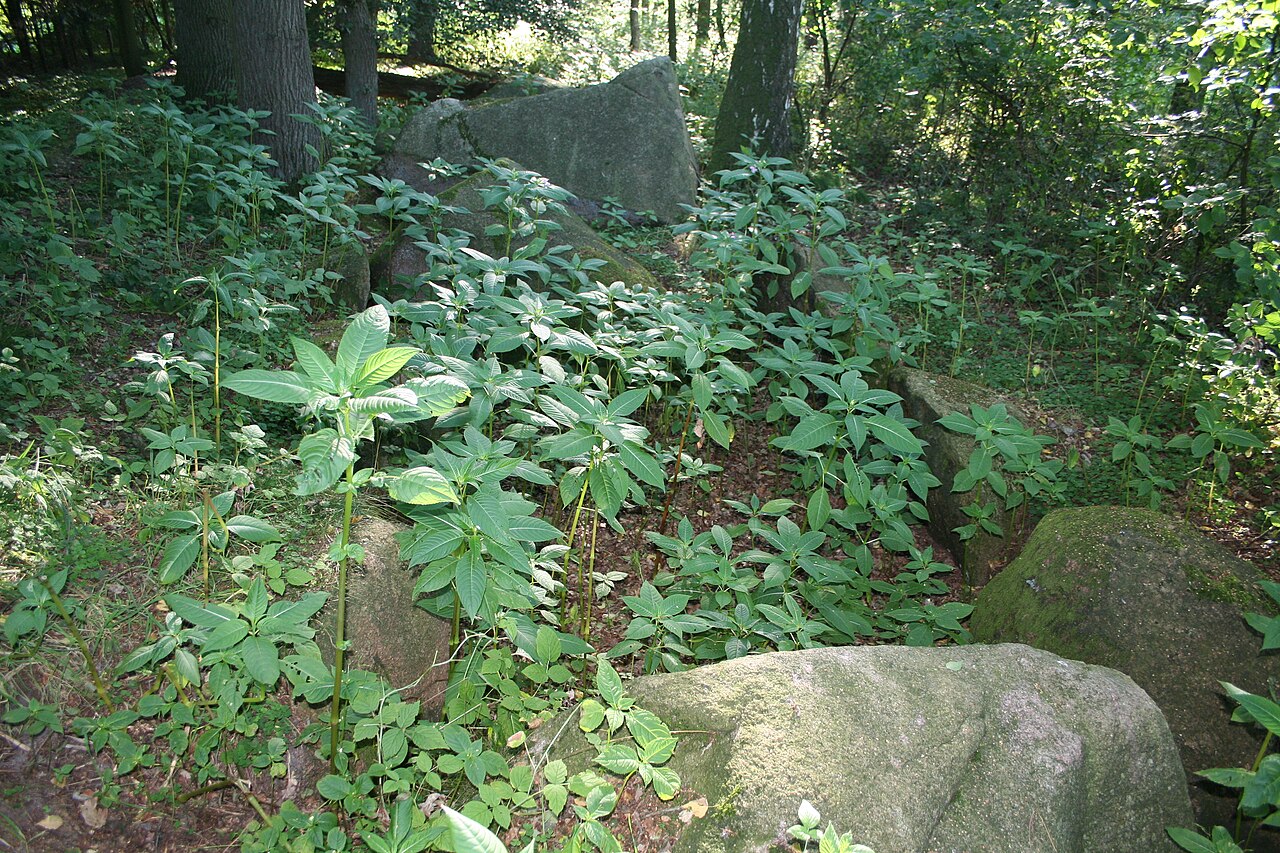
Photo Einsamer Schütze · CC BY-SA 3.0Source file on Wikimedia Commons

Overview
About this site
What the sources say
Das Großsteingrab Wellohsberg, im Volksmund heute Kleinenkneter Steine 3 genannt, ist ein neolithisches Ganggrab mit der Sprockhoff-Nr. 947. Es entstand zwischen 3500 und 2800 v. Chr. und ist eine Megalithanlage der Trichterbecherkultur.
Article in GermanRead on Wikipedia1 min readCC BY-SA 4.0
Where it sits in time
The site's dated range, placed against world reference points.
The scale is logarithmic: each step to the left is about ten times older than the last.
The full article
Kleinenkneter Steine: the whole story
Summary in EnglishSources for this section
- Wikipedia (German): Großsteingrab WellohsbergCC BY-SA 4.0
Sources for this section
- Wikipedia (German): Großsteingrab WellohsbergCC BY-SA 4.0
Kleinenkneter Steine is a megalith (abstract root) in Wildeshausen, Germany. A typological estimate: 3500 BCE to 2500 BCE. No English Wikipedia article exists for it; the full text below is the German article "Großsteingrab Wellohsberg", shown in the original language.
LageSources for this section
- Wikipedia (German): Großsteingrab WellohsbergCC BY-SA 4.0
Sources for this section
- Wikipedia (German): Großsteingrab WellohsbergCC BY-SA 4.0
Das Großsteingrab stand ursprünglich am Wellohsberg, südöstlich von Dötlingen, südlich des Heideweg, der nach Wildeshausen führt. In den 1930er Jahren musste es einem Flugplatz weichen und man versetzte das Grab zu den Kleinenknetener Steinen südlich von Wildeshausen (Koordinaten: ).
BeschreibungSources for this section
- Wikipedia (German): Großsteingrab WellohsbergCC BY-SA 4.0
Sources for this section
- Wikipedia (German): Großsteingrab WellohsbergCC BY-SA 4.0
Zur Zeit der Aufnahme im Jahr 1929 konnte Sprockhoff eine nordwest-südost-orientierte Steinkammer ausmachen. Von der schon in früherer Zeit beschädigten Anlage waren noch die 10 Tragsteine der 5,7 × 1,1 Meter großen Grabkammer erhalten. Die Schlusssteine der Schmalseiten und die Decksteine fehlten. Beim Versetzen des Grabes fanden sich ca. 40 Gefäßscherben.
Dieses Monument der Nordischen Megalitharchitektur liegt zusammen mit den Kleinenknetener Steinen an der Straße der Megalithkultur.
Tradition and region
About this kind of monument
Großsteingräber of northern Germany
In the German north-east, the Funnel Beaker (TRB) people raised up to 5,000 megalith tombs in what is now Mecklenburg-Vorpommern. More than 1,000 are preserved and protected by law, and 144 have been excavated since 1945. They were erected between 3500 and 3200 BCE in a short time period of about 200 years, or seven generations, with the oldest dating to phase C of the Early Neolithic and most built at the beginning of the Middle Neolithic. The tombs were made of glacial erratic boulders, with the gaps filled with red sandstone.
Many lie in groups, and the Atlas records some clusters under a single name. On Rügen the Lancken-Granitz dolmens are a group of seven tombs used by the Funnelbeaker culture, some of them until the early Bronze Age; three are encircled by rectangles or a stone circle of solitary rocks, and one has a "guardian stone" on its east side. One of them has six compartments, an unusually high number. In 1969 the tombs were assessed archaeologically, and Stone Age and Bronze Age grave goods were retrieved.
The Necropolis of Soderstorf in Lower Saxony shows the long use of such places: the site was used for more than 2,000 years and has a megalithic tomb of 3500 to 2800 BCE, excavated in 1883, with an inner chamber of 6.2 by 1.65 metres still covered by a mound, as well as a tumulus tomb, a stone circle and urn burials.
Folklore: in the region the dolmens are called Hünengräber, "giants' tombs", from the old idea that giants lay in them.
When visiting, look for the clusters of tombs, for the frame of the kerb, and for the placement of the entrance.
Paraphrased from Wikipedia: Megaliths in Mecklenburg-Vorpommern, Wikipedia: Lancken-Granitz dolmens, Wikipedia: Necropolis of Soderstorf, Wikipedia: Simple dolmen, Wikipedia: Megalithic entrance · CC BY-SA 4.0
Photographs
3 photographs, each with its author and licence
More photographs
Lore
Evidence & Lore
What the sources actually support — and, kept apart, what has been claimed.
What the evidence supports
Dates
Est. 3500–2500 BCEHow this date was established: Type comparisonTypical range for megaliths in Germany; this site has not been dated itself. German megaliths (Huengrab) are placed at c. 3500 BC in central and south-west Germany and c. 3400 BC in northern and central Germany.Source for this date
Where it stands
Germany
The pin marks the monument itself — its exact point.
- Coordinates
- 52°55′16″ N, 8°24′50″ EFor a GPS or map app: 52.92100, 8.41400
Access is as our sources describe it; we have not visited the site to check.
Nearby
The closest sites in the Atlas, by straight line.
 Großsteingrab Gerichtsstätte3500–2800 BCE
- DolmenBadberger Sand dolmen3500–2800 BCE
- DolmenSteenbarg dolmen3500–2800 BCE
 Glaner Braut3500–2800 BCE
Photo: -- Frank Poppe 17:50, 24. Mai 2007 (CEST) · Public domain
 Großsteingrab Dötlingen3500–2800 BCE
 Hohe Steine bei Wildeshausen3500–2800 BCE
 Bargloyer Steinkiste3500–2800 BCE
 Holzhausener Kellersteine3500–2800 BCE


Sources
Every record behind this page, with the link it came from.
2 sources behind this page
- 01Wikidata Q108628006wikidata.org
- 02Source for this dateen.wikipedia.org
Image files
- Großsteingrab Kleinenkneten 3 01.jpgEinsamer SchützeCC BY-SA 3.0
- Großsteingrab Kleinenkneten 3 03.jpgEinsamer SchützeCC BY-SA 3.0
- Großsteingrab Kleinenkneten 3 04.jpgEinsamer SchützeCC BY-SA 3.0


Report a correctionWrong date, name, photograph or source? Tell us and it will be put right.
Around this place
The ten nearest sites, by compass
Credit
Text, licence and sources
Text from the Wikipedia article "Großsteingrab Wellohsberg" (German), licensed CC BY-SA 4.0; authors are listed in the page history. Reused under CC BY-SA 4.0. Read on Wikipedia · Edit history and authors