

Overview
About this site
Overview
The Steinkiste von Rolfsen (Rolfsen cist) is a small stone cist in a wood in the Lüneburger Heide, Lower Saxony, Germany, about one kilometre west of the village of Rolfsen and 100 m to the left of the minor road to Evendorf. It is assigned today to the stone cists of the beginning of the Bronze Age.
The chamber was formerly regarded as an Urdolmen. Comparison with similar, better dated monuments led to the present attribution.
Read on Wikipedia2 min readCC BY-SA 4.0
Where it sits in time
The site's dated range, placed against world reference points.
The scale is logarithmic: each step to the left is about ten times older than the last.
Article
Rolfsen cist
The cist stands in a flat mound of rolled stones about 80 cm high, whose edge is set with large stones.
DescriptionSources for this section
- Wikipedia (German): Steinkiste von RolfsenCC BY-SA 4.0
Sources for this section
- Wikipedia (German): Steinkiste von RolfsenCC BY-SA 4.0
The cist stands in a flat mound of rolled stones about 80 cm high, whose edge is set with large stones. In its centre lies the small, open chamber, measuring 1.4 × 1.25 m, built of four flat erratic boulders.
ExcavationsSources for this section
- Wikipedia (German): Steinkiste von RolfsenCC BY-SA 4.0
Sources for this section
- Wikipedia (German): Steinkiste von RolfsenCC BY-SA 4.0
The monument was investigated scientifically by the Helms-Museum and received its present appearance through restoration in 1963. The work showed that the mound was originally supported by a ring of stones with dry-stone walling between them, and that its surface consisted of a packing of cobbles. The chamber had been built with care from boulders, with their smooth faces turned inward. A piece of the former capstone had been broken off, leaving it too small for the restoration of the chamber.
FindsSources for this section
- Wikipedia (German): Steinkiste von RolfsenCC BY-SA 4.0
Sources for this section
- Wikipedia (German): Steinkiste von RolfsenCC BY-SA 4.0
The cist had been dug through before the investigation, so no finds were recovered in situ. Sherds of an urn and cremated bone nevertheless showed that a secondary burial had been made in the pre-Roman Iron Age.
ContextSources for this section
- Wikipedia (German): Steinkiste von RolfsenCC BY-SA 4.0
Sources for this section
- Wikipedia (German): Steinkiste von RolfsenCC BY-SA 4.0
A cist, or kist, is a small stone-built coffin-like box used to hold the bodies of the dead. It may once have been covered by a cairn or a long barrow. In Nordic megalith architecture the stone cist is one of the recognised types alongside dolmens and passage graves.
Tradition and region
About this kind of monument
Scandinavian and German stone cists
A cist, or kist, is a small stone-built coffin-like box used to hold the bodies of the dead. It may once have been covered by a cairn or a long barrow, and several cists are sometimes found together within the same cairn or barrow. Ornaments are often found in excavated cists, which shows the wealth or prominence of the person buried. In Scandinavia the stone cist is called the hellekiste in Danish and hällkista in Swedish, and in Nordic megalith architecture it is one of the recognised types alongside dolmens and passage graves.
The most spectacular cist in Scandinavia is the central chamber of the King's Grave at Kivik in Scania, from about the fifteenth century BCE. It is about 4 metres long and 1.5 metres wide, made of ten upright slabs of which eight are decorated with carvings of people, ships, birds, fish, horses, axes and a chariot. It was opened in 1748 by farmers who were taking stone for field walls.
Other cists are much smaller. Associated with Nordic Bronze Age settlements are burial cairns, mounds and cemeteries, with interments including oak coffins and urn burials. The cists in the Atlas, many of them in Sweden and Denmark, are usually single graves under a cairn or a barrow.
Dating relies on the objects in the cist and on radiocarbon dating of any surviving bone.
When visiting, look for a box formed by slabs, exposed where its covering mound has gone.
Paraphrased from Wikipedia: Cist, Wikipedia: Kivik grave, Wikipedia: Nordic megalith architecture, Wikipedia: Nordic Bronze Age · CC BY-SA 4.0
From the article
Dated moments in the story
- 1963
Ihr heutiges Aussehen erhielt die durch das Helms-Museum wissenschaftlich untersuchte Anlage durch ihre Restaurierung im Jahre 1963. Dabei zeigte sich, dass der Hügel ursprünglich durch einen Steinkranz mit dazwischen liegendem Trockenmauerwerk gestützt wurde.
Source
See it in 3D
An interpretive reconstruction of the monument, standing on the real ground at its exact point, under the sun for that place and season. Drag to look around it.
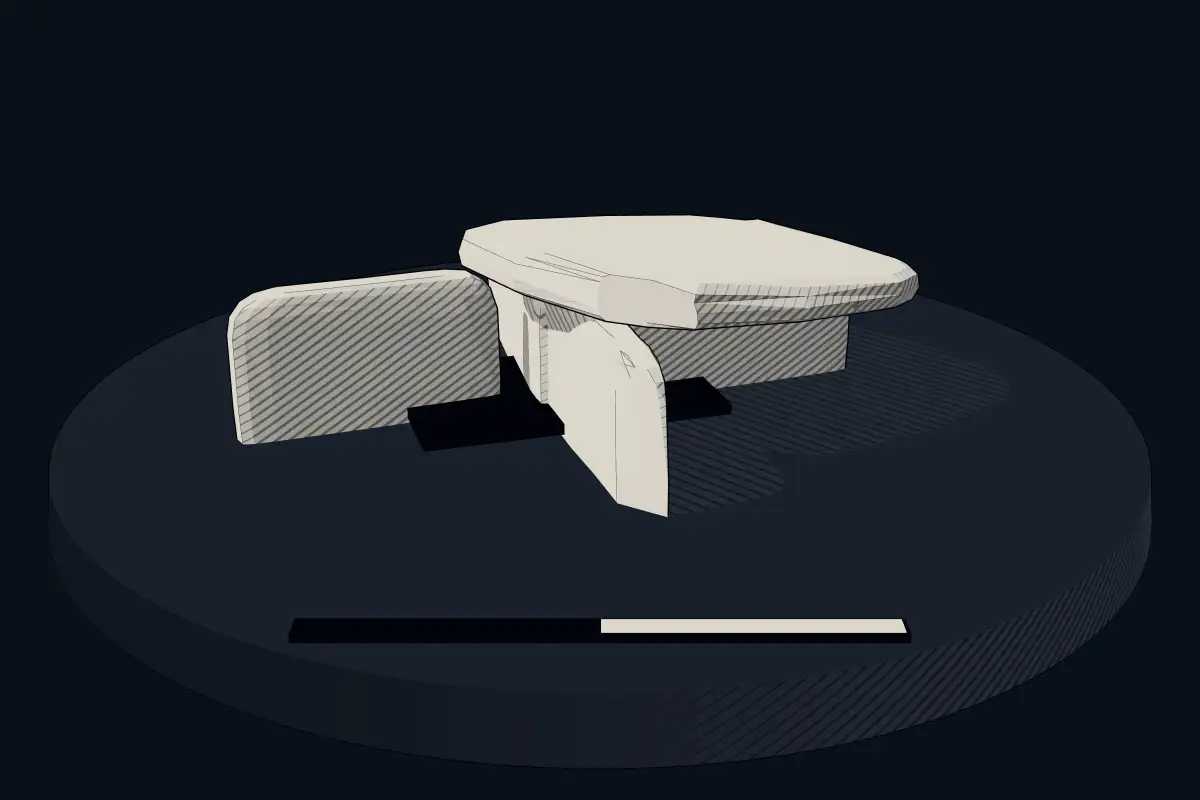
The reconstruction is ours, not a survey: it shows what a monument of this type looks like, at the size the record gives for this one.
Photographs
2 photographs, each with its author and licence
More photographs

Lore
Evidence & Lore
What the sources actually support — and, kept apart, what has been claimed.
What the evidence supports
Dates
Est. 3500–2800 BCEHow this date was established: Type comparisonTypical range for cists in Germany; this site has not been dated itself. German stone cists (Steinkisten) belong to the Nordic megalith tradition which emerged predominantly between 3500 and 2800 BC.Source for this date
Where it stands
Germany
The pin marks the monument itself — its exact point.
- Coordinates
- 53°09′30″ N, 10°08′25″ EFor a GPS or map app: 53.15830, 10.14040
Access is as our sources describe it; we have not visited the site to check.
Nearby
The closest sites in the Atlas, by straight line.
 Necropolis of Soderstorf3500–2800 BCE
 Großsteingrab Raven 13500–2800 BCE
 Großsteingräber bei Eyendorf3500–2800 BCE
- Passage tomb (passage grave)Großsteingräber auf dem Strietberg3500–2800 BCE
 Großsteingräber bei Lübberstedt3500–2800 BCE
 Oldendorfer Totenstatt3500–2800 BCE
- Megalithic tombSottorf Megalithic Tombs3500–2800 BCE
 Großsteingrab Sottorf 13500–2800 BCE


Sources
Every record behind this page, with the link it came from.
2 sources behind this page
- 01Wikidata Q1417839wikidata.org
- 02Source for this dateen.wikipedia.org
Image files
- Steinkiste.jpgGerhard kemmeCC0
- Dolmengrab mit Steinkiste.jpgGerhard kemmeCC0
Report a correctionWrong date, name, photograph or source? Tell us and it will be put right.
Around this place
The ten nearest sites, by compass
- Necropolis of Soderstorf2.5 km SE
- Großsteingrab Raven 13.1 km NE
- Großsteingräber bei Eyendorf3.1 km N
- Großsteingräber auf dem Strietberg3.6 km NE
- Großsteingräber bei Lübberstedt4.1 km NW
- Oldendorfer Totenstatt5.4 km E
- Sottorf Megalithic Tombs6.7 km E
- Großsteingrab Sottorf 16.7 km E
- Großsteingrab Amelinghausen8.4 km SE
- Großsteingräber bei Diersbüttel9.5 km SE
Credit
Text, licence and sources
Adapted from the Wikipedia article "Steinkiste von Rolfsen" (German), licensed CC BY-SA 4.0; authors are listed in the page history. Reused under CC BY-SA 4.0. Read on Wikipedia · Edit history and authors
- Wikipedia (German): Steinkiste von RolfsenCC BY-SA 4.0
- Wikidata Q1417839CC0