
Großsteingrab Restrup
DatedEst. 3500–2800 BCE
Photo Megalithicguy · CC BY-SA 4.0Source file on Wikimedia Commons

Overview
About this site
Overview
The passage grave of Restrup is a Neolithic megalithic tomb south-east of the farm group Restrup, about two kilometres north-west of Döthen (part of Eggermühlen), in the Samtgemeinde Bersenbrück, district of Osnabrück, Lower Saxony, Germany. It carries the Sprockhoff number 886 and was built between 3500 and 2800 BCE as a monument of the Funnel Beaker culture.
A cup-marked boulder, moved to the site, stands directly beside it.
Read on Wikipedia3 min readCC BY-SA 4.0
Where it sits in time
The site's dated range, placed against world reference points.
The scale is logarithmic: each step to the left is about ten times older than the last.
Article
Großsteingrab Restrup
The chamber is a relatively well preserved Emsland chamber about nine metres long, oriented east to west, with no remains of an enclosure.
DescriptionSources for this section
- Wikipedia (German): Ganggrab von RestrupCC BY-SA 4.0
Sources for this section
- Wikipedia (German): Ganggrab von RestrupCC BY-SA 4.0
The tomb stands in a group of trees near the L73 (Bippener Straße) and lies on the Straße der Megalithkultur. The square rampart around the grave is of recent date.
The chamber is a relatively well preserved Emsland chamber about nine metres long, oriented east to west, with no remains of an enclosure. It lies fairly deep in the mound. Two of the original 14 supporting stones are missing. Of the original five capstones, one is missing, one is broken and another is preserved only as a half and bears clear traces of an attempt to split it. The internal width is about 1.8 m at the outer ends and two metres in the middle. The supporting stones of the middle and largest capstone, in the entrance area, project so far from the line of the others that three zones of different width are formed inside. The northern long side curves slightly inward. The entrance, of which no stones survive, is on the south side.
FindsSources for this section
- Wikipedia (German): Ganggrab von RestrupCC BY-SA 4.0
Sources for this section
- Wikipedia (German): Ganggrab von RestrupCC BY-SA 4.0
Directly beside the tomb stands the Teufelsstein or Deuvelstein (devil's stone), also called the Näpfchenstein (cup-marked stone). It is a granite boulder 1.75 m long, 1.15 m wide and 1.1 m high, with 66 cup marks on its domed surface. As with all cup-marked stones, the purpose of the hollows is unknown.
The stone escaped destruction by chance and was examined scientifically in 1956 by Walter Nowothnig (1903-1971). This is one of the rare cases in which archaeological findings were obtained from a cup-marked stone. The stone had been worked to create a sufficient standing surface. Beneath it were found flint cracked by heat, charcoal and bone fragments; anthropological examination could not establish whether the bones were human or animal. After the investigation the stone, originally found a little south of Restrup, was brought to its present position.
FolkloreSources for this section
- Wikipedia (German): Ganggrab von RestrupCC BY-SA 4.0
Sources for this section
- Wikipedia (German): Ganggrab von RestrupCC BY-SA 4.0
The stone owes its name to legends that connect it with the Devil, who is said to have pressed the cups into the stone with his thumb and to be responsible for a larger break in it.
ContextSources for this section
- Wikipedia (German): Ganggrab von RestrupCC BY-SA 4.0
Sources for this section
- Wikipedia (German): Ganggrab von RestrupCC BY-SA 4.0
The megalithic tombs of northern Germany and the Netherlands were built by the Funnel Beaker culture (about 4100 to 2800 BCE), and the style, called Nordic megalith architecture, emerged between 3500 and 2800 BCE.
Tradition and region
About this kind of monument
German and Dutch Hünengräber (hunebedden)
The megalithic tombs of northern Germany and the Netherlands were built by the Funnel Beaker culture (about 4100 to 2800 BCE), and the style, called Nordic megalith architecture, emerged between 3500 and 2800 BCE. In the Netherlands the tombs are the hunebedden, built between 3470 and 3250 BCE by the western group of the Funnel Beaker culture and used until about 2760 BCE. Of an estimated 100 original tombs, 54 are preserved, 52 of them in the province of Drenthe and two in Groningen. After the Funnel Beaker culture ended the sites were reused by the Single Grave and Bell Beaker cultures in the Early Bronze Age and, to a lesser extent, into the Middle Ages.
In Mecklenburg-Vorpommern up to 5,000 megalith tombs were erected, and more than 1,000 are preserved and protected by law; they belong to the youngest and easternmost part of the western European tradition. Most are dolmens, often lying inside a circular or trapezoid frame of standing stones. Locally they are known as Hünengräber, "giants' tombs", or Großsteingräber, "large stone tombs"; the trapezoid frame is a Hünenbett, "giants' bed", and the circular one a Bannkreis. Between 1964 and 1974 Ewald Schuldt excavated over a hundred sites there and sorted them into simple dolmens, extended dolmens, passage graves, great dolmens, unchambered long barrows and stone cists.
Folklore: the German and Dutch names, with Hüne meaning "giant", carry the old idea that giants were buried here. This is a tradition; the stones were placed by Neolithic farmers.
When visiting, look for the capstones on their supports and the frame of kerbstones around them.
Paraphrased from Wikipedia: Megaliths in the Netherlands, Wikipedia: Megaliths in Mecklenburg-Vorpommern, Wikipedia: Nordic megalith architecture, Wikipedia: Funnel beaker culture, Wikipedia: Dolmen · CC BY-SA 4.0
See it in 3D
An interpretive reconstruction of the monument, standing on the real ground at its exact point, under the sun for that place and season. Drag to look around it.
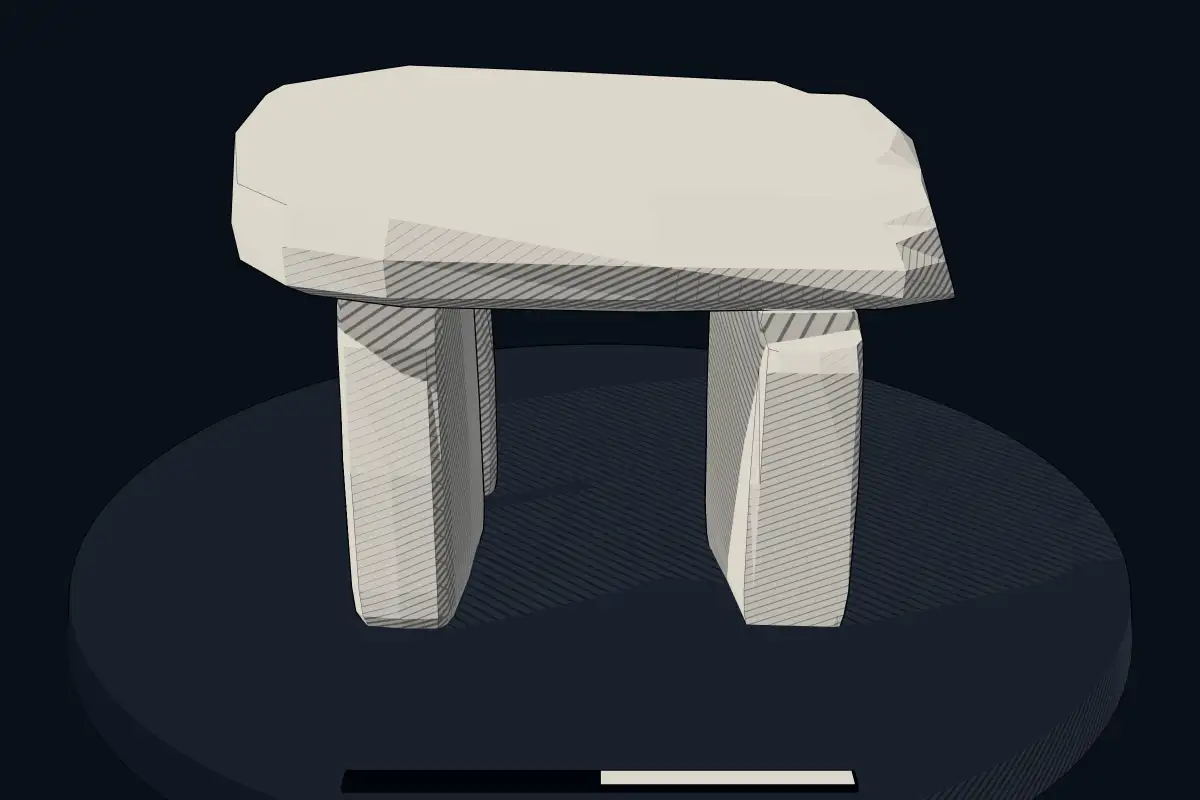
The reconstruction is ours, not a survey: it shows what a monument of this type looks like, at the size the record gives for this one.
Photographs
5 photographs, each with its author and licence
More photographs


Lore
Evidence & Lore
What the sources actually support — and, kept apart, what has been claimed.
What the evidence supports
Dates
Est. 3500–2800 BCEHow this date was established: Type comparisonTypical range for dolmens in Germany; this site has not been dated itself. German dolmens (Huengrab) belong to the Nordic megalith tradition which emerged predominantly between 3500 and 2800 BC.Source for this date
Where it stands
Germany
The pin marks the monument itself — its exact point.
- Coordinates
- 52°34′28″ N, 7°46′30″ EFor a GPS or map app: 52.57456, 7.77494
Access is as our sources describe it; we have not visited the site to check.
Nearby
The closest sites in the Atlas, by straight line.
 Hekeser Steine3500–2800 BCE
 Großsteingrab Bockraden3500–2800 BCE
 Großsteingrab Dalum3500–2800 BCE
- Passage tomb (passage grave)Großsteingrab Klein Bokern3500–2800 BCE
 Großsteingrab Berge3500–2800 BCE
- Megalithic tombGroßsteingrab Westerholte3500–2800 BCE
 Rickelmann 23500–2800 BCE
 Großsteingrab Meyer3500–2800 BCE


Sources
Every record behind this page, with the link it came from.
2 sources behind this page
- 01Wikidata Q1549646wikidata.org
- 02Source for this dateen.wikipedia.org
Image files
Report a correctionWrong date, name, photograph or source? Tell us and it will be put right.
Lore, kept apart
Legends and claims
These are stories and claims reported by the sources. They are not evidence, and they never stand in for the dating above.
- Tradition
Direkt neben der Megalithanlage steht der „Teufels- oder Deuvelstein“.
Direkt neben der Megalithanlage steht der „Teufels- oder Deuvelstein“. Der Findling ist ein 1,75 Meter langer, 1,15 Meter breiter und 1,1 Meter hoher Granitblock. Seinen Namen bekam er von Sagen, die ihn mit dem Teufel in Verbindung brachten, der die Schälchen mit dem Daumen in den Stein gedrückt haben und für eine größere Bruchstelle verantwortlich sein soll. Auf seiner gewölbten Oberfläche trägt er 66 Schälchen. Wie bei allen Schalensteinen ist der Zweck der Vertiefungen, die sich bei diesem Stein an einer der senkrechten Seiten befinden, unbekannt. Durch Zufall entging er der Zerstörung und wurde 1956 von Walter Nowothnig (1903–1971) wissenschaftlich untersucht. Es ist einer der seltenen Fälle, bei denen an einem Schalenstein archäologische Befunde gewonnen wurden. Es zeigte sich, dass der Stein zur Schaffung einer ausreichenden Standfläche bearbeitet wurde. Unter ihm fand man durch Hitze zersprungenen Feuerstein, Holzkohle und Knochenbruchstücke, deren anthropologische Untersuchung nicht klären konnte, ob es sich um menschliche oder tierische Reste handelt. Nach der Untersuchung wurde der ursprünglich wenig südlich von Restrup gefundene Schalenstein an seinen heutigen Platz gebracht.
Source
Around this place
The ten nearest sites, by compass
Credit
Text, licence and sources
Adapted from the Wikipedia article "Ganggrab von Restrup" (German), licensed CC BY-SA 4.0; authors are listed in the page history. Reused under CC BY-SA 4.0. Read on Wikipedia · Edit history and authors
- Wikipedia (German): Ganggrab von RestrupCC BY-SA 4.0
- Wikidata Q1549646CC0