
Großsteingrab Offendorf
DatedEst. 3500–2800 BCE
Photo Genet at de.wikipedia · CC BY-SA 3.0Source file on Wikimedia Commons

Overview
About this site
Overview
The Großsteingrab Offendorf, also called the Langbett in Offendorf, is a Neolithic long bed in the district of Ostholstein, Schleswig-Holstein, Germany. It lies south-west of the village of Kreuzkamp, part of Ratekau, and south of Offendorf at the Hemmelsdorfer See.
It was built by the Funnel Beaker culture between 3500 and 2800 BCE, and is about 56 m long and 18 m wide.
Read on Wikipedia2 min readCC BY-SA 4.0
Where it sits in time
The site's dated range, placed against world reference points.
The scale is logarithmic: each step to the left is about ten times older than the last.
Article
Großsteingrab Offendorf
Two large stones emerge from the mound on the eastern side, and a hollow there may mark the position of the burial chamber.
DescriptionSources for this section
- Wikipedia (German): Großsteingrab OffendorfCC BY-SA 4.0
Sources for this section
- Wikipedia (German): Großsteingrab OffendorfCC BY-SA 4.0
The tomb is catalogued in the Atlas der Megalithgräber Deutschlands as Sprockhoff 247. It stands among trees in a fenced area on a meadow about 50 m from a road. It is aligned roughly south-west, about 56 m long and 18 m wide. The height of the earth mound that covers the monument is very uneven and reaches a maximum of about 1.8 m.
Two large stones emerge from the mound on the eastern side, and a hollow there may mark the position of the burial chamber. The kerbstones that supported the sides of the mound have been largely removed; only on the south-western side do some stones show at the surface.
DatingSources for this section
- Wikipedia (German): Großsteingrab OffendorfCC BY-SA 4.0
Sources for this section
- Wikipedia (German): Großsteingrab OffendorfCC BY-SA 4.0
The megalithic monument of the Funnel Beaker culture (TBK) was built between 3500 and 2800 BCE.
ConservationSources for this section
- Wikipedia (German): Großsteingrab OffendorfCC BY-SA 4.0
Sources for this section
- Wikipedia (German): Großsteingrab OffendorfCC BY-SA 4.0
The long bed is reached across the meadow and is protected as an archaeological monument. It is the last of seven long beds that originally existed in the area south of the Hemmelsdorfer See.
ContextSources for this section
- Wikipedia (German): Großsteingrab OffendorfCC BY-SA 4.0
Sources for this section
- Wikipedia (German): Großsteingrab OffendorfCC BY-SA 4.0
The megalithic tombs of northern Germany and the Netherlands were built by the Funnel Beaker culture (about 4100 to 2800 BCE). The style, called Nordic megalith architecture, emerged between 3500 and 2800 BCE.
Tradition and region
About this kind of monument
German and Dutch Hünengräber (hunebedden)
The megalithic tombs of northern Germany and the Netherlands were built by the Funnel Beaker culture (about 4100 to 2800 BCE), and the style, called Nordic megalith architecture, emerged between 3500 and 2800 BCE. In the Netherlands the tombs are the hunebedden, built between 3470 and 3250 BCE by the western group of the Funnel Beaker culture and used until about 2760 BCE. Of an estimated 100 original tombs, 54 are preserved, 52 of them in the province of Drenthe and two in Groningen. After the Funnel Beaker culture ended the sites were reused by the Single Grave and Bell Beaker cultures in the Early Bronze Age and, to a lesser extent, into the Middle Ages.
In Mecklenburg-Vorpommern up to 5,000 megalith tombs were erected, and more than 1,000 are preserved and protected by law; they belong to the youngest and easternmost part of the western European tradition. Most are dolmens, often lying inside a circular or trapezoid frame of standing stones. Locally they are known as Hünengräber, "giants' tombs", or Großsteingräber, "large stone tombs"; the trapezoid frame is a Hünenbett, "giants' bed", and the circular one a Bannkreis. Between 1964 and 1974 Ewald Schuldt excavated over a hundred sites there and sorted them into simple dolmens, extended dolmens, passage graves, great dolmens, unchambered long barrows and stone cists.
Folklore: the German and Dutch names, with Hüne meaning "giant", carry the old idea that giants were buried here. This is a tradition; the stones were placed by Neolithic farmers.
When visiting, look for the capstones on their supports and the frame of kerbstones around them.
Paraphrased from Wikipedia: Megaliths in the Netherlands, Wikipedia: Megaliths in Mecklenburg-Vorpommern, Wikipedia: Nordic megalith architecture, Wikipedia: Funnel beaker culture, Wikipedia: Dolmen · CC BY-SA 4.0
From the article
Dated moments in the story
- 2800 BCE
Die Megalithanlage der Trichterbecherkultur (TBK) entstand zwischen 3500 und 2800 v. Chr.
Source
See it in 3D
An interpretive reconstruction of the monument, standing on the real ground at its exact point, under the sun for that place and season. Drag to look around it.
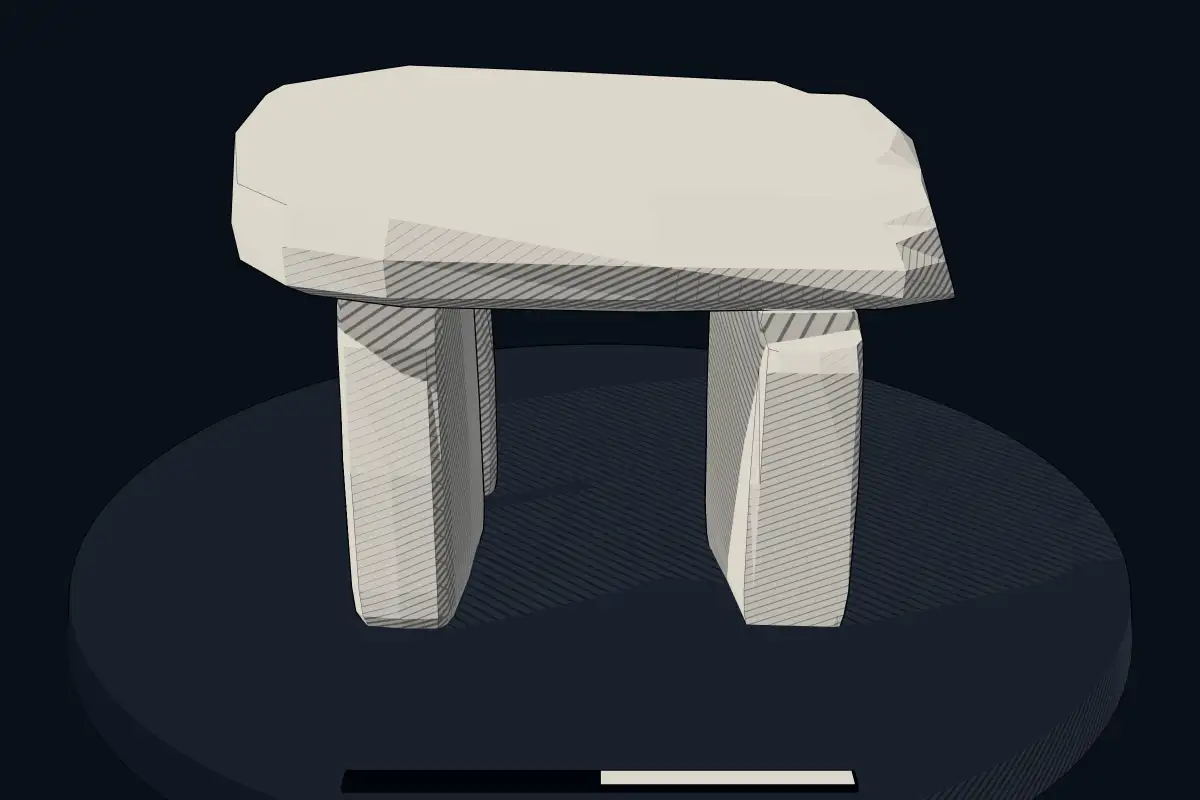
The reconstruction is ours, not a survey: it shows what a monument of this type looks like, at the size the record gives for this one.
Photographs
2 photographs, each with its author and licence
More photographs

Lore
Evidence & Lore
What the sources actually support — and, kept apart, what has been claimed.
What the evidence supports
Dates
Est. 3500–2800 BCEHow this date was established: Type comparisonTypical range for dolmens in Germany; this site has not been dated itself. German dolmens (Huengrab) belong to the Nordic megalith tradition which emerged predominantly between 3500 and 2800 BC.Source for this date
Where it stands
Germany
The pin marks the monument itself — its exact point.
- Coordinates
- 53°55′51″ N, 10°46′18″ EFor a GPS or map app: 53.93080, 10.77180
Access is as our sources describe it; we have not visited the site to check.
Nearby
The closest sites in the Atlas, by straight line.
 Pöppendorfer Großsteingrab3500–2800 BCE
 Ratekau cist3500–2800 BCE
 Grabhügel bei Pansdorf3500–500 BCE
 Grabhügel auf dem Vierth3500–500 BCE
- Megalithic tombGroßsteingrab Feldhusen3500–2800 BCE
- Megalithic tombGronenberg megalithic tomb3500–2800 BCE
 Grabhügel bei Stubbenberg3500–500 BCE
- Megalithic tombGroßsteingrab Prieschendorf3500–2800 BCE


Sources
Every record behind this page, with the link it came from.
2 sources behind this page
- 01Wikidata Q1804881wikidata.org
- 02Source for this dateen.wikipedia.org
Image files
- Ratekau Langbett-Langenrehm W.JPGGenet at de.wikipediaCC BY-SA 3.0
- Ratekau Langbett-Langenrehm N.JPGGenet at de.wikipediaCC BY-SA 3.0
Report a correctionWrong date, name, photograph or source? Tell us and it will be put right.
Around this place
The ten nearest sites, by compass
- Pöppendorfer Großsteingrab2.3 km E
- Ratekau cist3.1 km NW
- Grabhügel bei Pansdorf8.0 km NW
- Grabhügel auf dem Vierth11 km NW
- Großsteingrab Feldhusen12 km E
- Gronenberg megalithic tomb14 km N
- Grabhügel bei Stubbenberg14 km N
- Großsteingrab Prieschendorf16 km E
- Großsteingrab Blankensee16 km S
- Großsteingrab Dahmsdorf16 km SW
Credit
Text, licence and sources
Adapted from the Wikipedia article "Großsteingrab Offendorf" (German), licensed CC BY-SA 4.0; authors are listed in the page history. Reused under CC BY-SA 4.0. Read on Wikipedia · Edit history and authors
- Wikipedia (German): Großsteingrab OffendorfCC BY-SA 4.0
- Wikidata Q1804881CC0