
Großsteingrab Laer
DatedEst. 3500–2800 BCE
Photo F. Jostes, W. Effmann · Public domainSource file on Wikimedia Commons
Overview
About this site
Overview
The Großsteingrab Laer, also called the Düvelstein (“Teufelstein”, devil's stone), is a heavily destroyed tomb of the Neolithic Funnel Beaker culture near Bad Laer in the Landkreis Osnabrück, Lower Saxony, Germany.
Only the remains of a mound survive. Local tradition connects the site with the devil.
Read on Wikipedia2 min readCC BY-SA 4.0
Where it sits in time
The site's dated range, placed against world reference points.
The scale is logarithmic: each step to the left is about ten times older than the last.
Article
Großsteingrab Laer
The tomb lies about three kilometres north-west of Laer, near Vogelsang, on the road Zum Teufelsstein.
SettingSources for this section
- Wikipedia (German): Großsteingrab LaerCC BY-SA 4.0
Sources for this section
- Wikipedia (German): Großsteingrab LaerCC BY-SA 4.0
The tomb lies about three kilometres north-west of Laer, near Vogelsang, on the road Zum Teufelsstein.
DescriptionSources for this section
- Wikipedia (German): Großsteingrab LaerCC BY-SA 4.0
Sources for this section
- Wikipedia (German): Großsteingrab LaerCC BY-SA 4.0
Of the monument only the remains of a mound survive today, and no stones remain in place. One stone built into a former pigsty can be identified as having originally come from the tomb. Several stones seem still to have been present in the 1850s.
F. Jostes and W. Effmann published a description and reconstruction drawing in 1888, when the tomb was already destroyed. According to them, seven smaller stones were grouped in a horseshoe around a larger one, and to the west there were said to have been pillars consisting of upright stones, each with a stone laid beneath it. This construction is rather unusual for megalithic tombs and rests solely on the oral statements of a local farmer, so it reveals little about the original appearance of the tomb.
ExcavationsSources for this section
- Wikipedia (German): Großsteingrab LaerCC BY-SA 4.0
Sources for this section
- Wikipedia (German): Großsteingrab LaerCC BY-SA 4.0
Jostes and Effmann dug into the mound. Their search in the area of the actual burial chamber produced no result. On the southern slope, however, they found sherds of a few very poorly preserved urns.
FolkloreSources for this section
- Wikipedia (German): Großsteingrab LaerCC BY-SA 4.0
Sources for this section
- Wikipedia (German): Großsteingrab LaerCC BY-SA 4.0
Local tradition holds that the remains were a heathen church built by the devil, which is the origin of the name Düvelstein (“devil's stones”). Walls are said once to have stood there. According to Jostes and Effmann, however, the farmer who removed the last stones in the 1850s found no trace of walls.
Tradition and region
About this kind of monument
German and Dutch Hünengräber (hunebedden)
The megalithic tombs of northern Germany and the Netherlands were built by the Funnel Beaker culture (about 4100 to 2800 BCE), and the style, called Nordic megalith architecture, emerged between 3500 and 2800 BCE. In the Netherlands the tombs are the hunebedden, built between 3470 and 3250 BCE by the western group of the Funnel Beaker culture and used until about 2760 BCE. Of an estimated 100 original tombs, 54 are preserved, 52 of them in the province of Drenthe and two in Groningen. After the Funnel Beaker culture ended the sites were reused by the Single Grave and Bell Beaker cultures in the Early Bronze Age and, to a lesser extent, into the Middle Ages.
In Mecklenburg-Vorpommern up to 5,000 megalith tombs were erected, and more than 1,000 are preserved and protected by law; they belong to the youngest and easternmost part of the western European tradition. Most are dolmens, often lying inside a circular or trapezoid frame of standing stones. Locally they are known as Hünengräber, "giants' tombs", or Großsteingräber, "large stone tombs"; the trapezoid frame is a Hünenbett, "giants' bed", and the circular one a Bannkreis. Between 1964 and 1974 Ewald Schuldt excavated over a hundred sites there and sorted them into simple dolmens, extended dolmens, passage graves, great dolmens, unchambered long barrows and stone cists.
Folklore: the German and Dutch names, with Hüne meaning "giant", carry the old idea that giants were buried here. This is a tradition; the stones were placed by Neolithic farmers.
When visiting, look for the capstones on their supports and the frame of kerbstones around them.
Paraphrased from Wikipedia: Megaliths in the Netherlands, Wikipedia: Megaliths in Mecklenburg-Vorpommern, Wikipedia: Nordic megalith architecture, Wikipedia: Funnel beaker culture, Wikipedia: Dolmen · CC BY-SA 4.0
From the article
Dated moments in the story
- 1888
Effmann veröffentlichten 1888 eine Beschreibung und Rekonstruktionszeichnung des bereits damals zerstörten Grabes.
Source
See it in 3D
An interpretive reconstruction of the monument, standing on the real ground at its exact point, under the sun for that place and season. Drag to look around it.
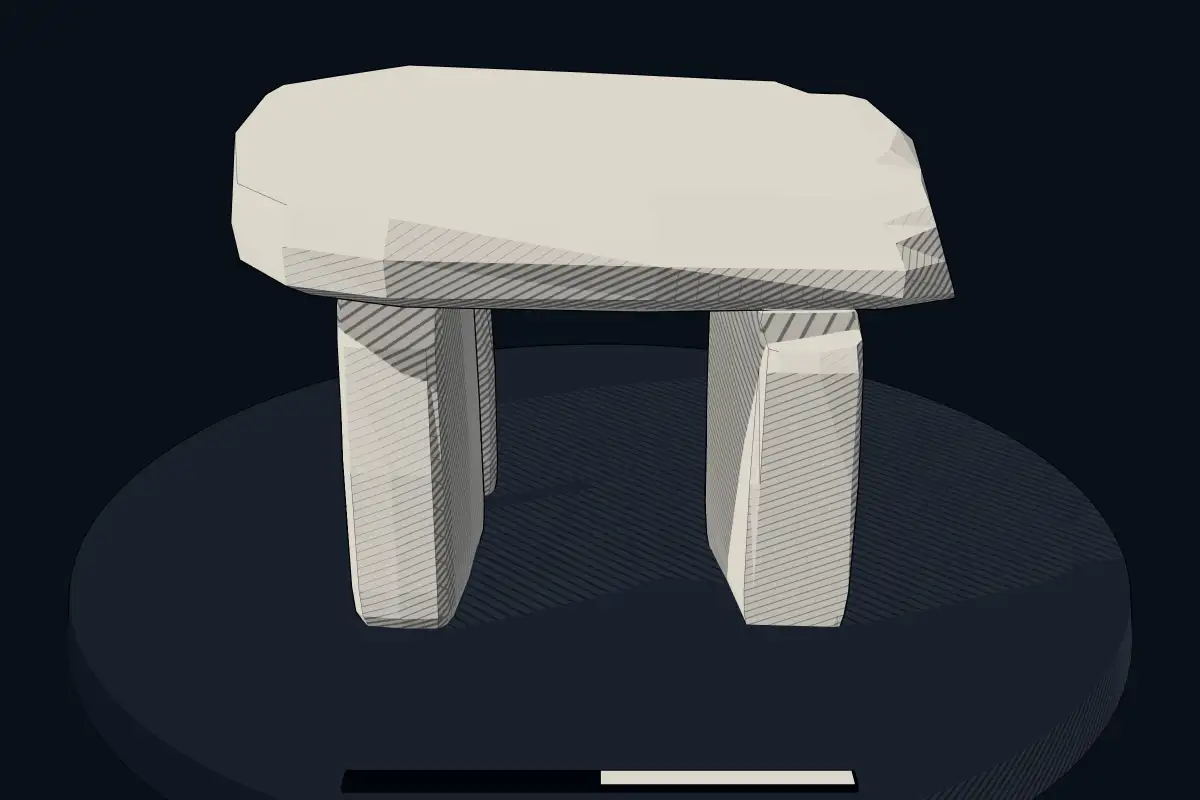
The reconstruction is ours, not a survey: it shows what a monument of this type looks like, at the size the record gives for this one.
Photographs
1 photograph, each with its author and licence
Lore
Evidence & Lore
What the sources actually support — and, kept apart, what has been claimed.
What the evidence supports
Dates
Est. 3500–2800 BCEHow this date was established: Type comparisonTypical range for dolmens in Germany; this site has not been dated itself. German dolmens (Huengrab) belong to the Nordic megalith tradition which emerged predominantly between 3500 and 2800 BC.Source for this date
Where it stands
Germany
The pin marks the monument itself — its exact point.
- Coordinates
- 52°07′14″ N, 8°03′45″ EFor a GPS or map app: 52.12053, 8.06254
Access is as our sources describe it; we have not visited the site to check.
Nearby
The closest sites in the Atlas, by straight line.


Sources
Every record behind this page, with the link it came from.
2 sources behind this page
- 01Wikidata Q15812988wikidata.org
- 02Source for this dateen.wikipedia.org
Image files
- Großsteingrab Laer Jostes Effmann.pngF. Jostes, W. EffmannPublic domain
Report a correctionWrong date, name, photograph or source? Tell us and it will be put right.
Lore, kept apart
Legends and claims
These are stories and claims reported by the sources. They are not evidence, and they never stand in for the dating above.
- Tradition
Einer Sage nach soll es sich bei den Resten des Grabes um eine heidnische Kirche gehandelt haben, die vom Teufel errichtet wurde.
Einer Sage nach soll es sich bei den Resten des Grabes um eine heidnische Kirche gehandelt haben, die vom Teufel errichtet wurde. Daher stammt der Name „Düvelstein(e)“ („Teufelsteine“). Von dieser Kirche sollen einst auch Mauern vorhanden gewesen sein. Nach Jostes und Effmann hat der Bauer, der in den 1850er Jahren die letzten Steine entfernte, allerdings keine Mauerreste ausmachen können.
Source
Around this place
The ten nearest sites, by compass
Credit
Text, licence and sources
Adapted from the Wikipedia article "Großsteingrab Laer" (German), licensed CC BY-SA 4.0; authors are listed in the page history. Reused under CC BY-SA 4.0. Read on Wikipedia · Edit history and authors
- Wikipedia (German): Großsteingrab LaerCC BY-SA 4.0
- Wikidata Q15812988CC0