D8b
DatedEst. 3500–2800 BCE
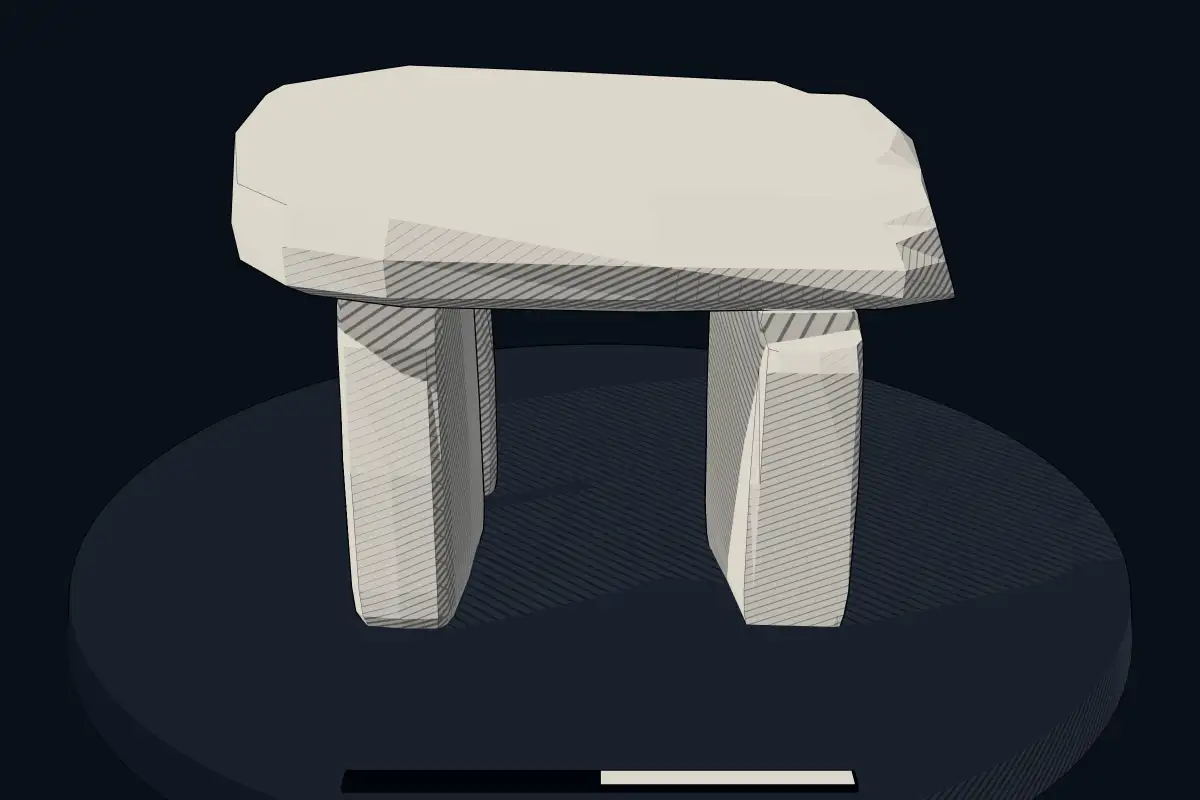
No licensed photograph yetWe have no photograph we may publish for this site, so the interpretive 3D view leads instead.
Overview
About this site
What the sources say
D8b is een verdwenen hunebed, het lag ten zuiden van D8 bij Anloo in de Nederlandse provincie Drenthe.
A. Klein Wassink, J.E. Musch en J. Musch vonden de overblijfselen in 1992. Samen met D8a was het geheel ontmanteld, er restte enkel een flauwe, ovale verlaging met daaromheen de aanzet van een lage dekheuvel. Ook werd er aardewerk uit de trechterbekercultuur en vuursteenmateriaal geborgen.
D8a en D8b waren van vergelijkbare grootte als D8.
Article in DutchRead on Wikipedia2 min readCC BY-SA 4.0
Where it sits in time
The site's dated range, placed against world reference points.
The scale is logarithmic: each step to the left is about ten times older than the last.
The full article
D8b: the whole story
In briefSources for this section
- Wikipedia (Dutch): D8b (hunebed)CC BY-SA 4.0
Sources for this section
- Wikipedia (Dutch): D8b (hunebed)CC BY-SA 4.0
D8b was a dolmen situated just south of D8 near Anloo, in the Dutch province of Drenthe. It has disappeared, and only traces of its former structure remain. D8b was comparable in size to D8a.
A. Klein Wassink, J.E. Musch and J. Musch discovered the remains in 1992. D8a and D8b were dismantled together, leaving only a faint oval depression and the beginnings of a low burial mound around it. The site also yielded pottery associated with the Funnel Beaker culture, together with flint material.
The surviving features indicate that D8b was part of the megalithic tomb tradition of the Netherlands, in which hunebedden were built by the western group of the Funnel Beaker culture. Its estimated date is 3500 BCE to 2800 BCE, based on typological comparison.
Monuments of this kind in northern Germany and the Netherlands are generally known as dolmens in Germany and hunebedden in the Netherlands. They were erected by the Funnel Beaker culture, about 4100 to 2800 BCE, within a style called Nordic megalith architecture that emerged between 3500 and 2800 BCE. Such sites were sometimes reused in later periods.
Summary in EnglishSources for this section
- Wikipedia (Dutch): D8b (hunebed)CC BY-SA 4.0
Sources for this section
- Wikipedia (Dutch): D8b (hunebed)CC BY-SA 4.0
D8b is a dolmen in Aa en Hunze, Germany. Wikidata describes it as: dolmen in the Netherlands. A typological estimate: 3500 BCE to 2800 BCE. No English Wikipedia article exists for it; the full text below is the Dutch article "D8b (hunebed)", shown in the original language.
How this page was madeSources for this section
- Wikipedia (Dutch): D8b (hunebed)CC BY-SA 4.0
Sources for this section
- Wikipedia (Dutch): D8b (hunebed)CC BY-SA 4.0
The summary at the top of this page was written by MiniMax-M3 (2026-11-08) from the cited Wikipedia article “D8b (hunebed)”, translated from Dutch. The numbers in it were checked automatically against the source text. The rest of the page is the article itself, the structured records and computed distances.
Tradition and region
About this kind of monument
German and Dutch Hünengräber (hunebedden)
The megalithic tombs of northern Germany and the Netherlands were built by the Funnel Beaker culture (about 4100 to 2800 BCE), and the style, called Nordic megalith architecture, emerged between 3500 and 2800 BCE. In the Netherlands the tombs are the hunebedden, built between 3470 and 3250 BCE by the western group of the Funnel Beaker culture and used until about 2760 BCE. Of an estimated 100 original tombs, 54 are preserved, 52 of them in the province of Drenthe and two in Groningen. After the Funnel Beaker culture ended the sites were reused by the Single Grave and Bell Beaker cultures in the Early Bronze Age and, to a lesser extent, into the Middle Ages.
In Mecklenburg-Vorpommern up to 5,000 megalith tombs were erected, and more than 1,000 are preserved and protected by law; they belong to the youngest and easternmost part of the western European tradition. Most are dolmens, often lying inside a circular or trapezoid frame of standing stones. Locally they are known as Hünengräber, "giants' tombs", or Großsteingräber, "large stone tombs"; the trapezoid frame is a Hünenbett, "giants' bed", and the circular one a Bannkreis. Between 1964 and 1974 Ewald Schuldt excavated over a hundred sites there and sorted them into simple dolmens, extended dolmens, passage graves, great dolmens, unchambered long barrows and stone cists.
Folklore: the German and Dutch names, with Hüne meaning "giant", carry the old idea that giants were buried here. This is a tradition; the stones were placed by Neolithic farmers.
When visiting, look for the capstones on their supports and the frame of kerbstones around them.
Paraphrased from Wikipedia: Megaliths in the Netherlands, Wikipedia: Megaliths in Mecklenburg-Vorpommern, Wikipedia: Nordic megalith architecture, Wikipedia: Funnel beaker culture, Wikipedia: Dolmen · CC BY-SA 4.0
From the article
Dated moments in the story
- 1992
Musch vonden de overblijfselen in 1992. Samen met D8a was het geheel ontmanteld, er restte enkel een flauwe, ovale verlaging met daaromheen de aanzet van een lage dekheuvel.
Source
See it in 3D
An interpretive reconstruction of the monument, standing on the real ground at its exact point, under the sun for that place and season. Drag to look around it.
The reconstruction is ours, not a survey: it shows what a monument of this type looks like, at the size the record gives for this one.
Lore
Evidence & Lore
What the sources actually support — and, kept apart, what has been claimed.
What the evidence supports
Dates
Est. 3500–2800 BCEHow this date was established: Type comparisonTypical range for dolmens in Germany; this site has not been dated itself. German dolmens (Huengrab) belong to the Nordic megalith tradition which emerged predominantly between 3500 and 2800 BC.Source for this date
Where it stands
Germany
The pin marks the monument itself — its exact point.
- Coordinates
- 53°03′35″ N, 6°42′01″ EFor a GPS or map app: 53.05966, 6.70021
Access is as our sources describe it; we have not visited the site to check.
Nearby
The closest sites in the Atlas, by straight line.
- DolmenD8a3500–2800 BCE
 D83500–2800 BCE
- Megalithic mound (tumulus with integral stones)Terrein met grafheuvel3500–500 BCE
 Terrein met grafheuvel3500–500 BCE
- Megalithic mound (tumulus with integral stones)Terrein met zes grafheuvels3500–500 BCE
 D93500–2800 BCE
 D73500–2800 BCE
- Megalithic mound (tumulus with integral stones)Terrein met vijf grafheuvels3500–500 BCE


Sources
Every record behind this page, with the link it came from.
2 sources behind this page
- 01Wikidata Q30139728wikidata.org
- 02Source for this dateen.wikipedia.org
Report a correctionWrong date, name, photograph or source? Tell us and it will be put right.
Around this place
The ten nearest sites, by compass
Credit
Text, licence and sources
Text from the Wikipedia article "D8b (hunebed)" (Dutch), licensed CC BY-SA 4.0; authors are listed in the page history. Reused under CC BY-SA 4.0. Read on Wikipedia · Edit history and authors
- Wikipedia (Dutch): D8b (hunebed)CC BY-SA 4.0
- Wikidata Q30139728CC0