

Overview
About this site
What the sources say
Das Großsteingrab Havelte 1 (auch Havelteberg genannt) ist eine megalithische Grabanlage der jungsteinzeitlichen Westgruppe der Trichterbecherkultur (TBK) bei Havelte, einem Ortsteil von Westerveld in der niederländischen Provinz Drenthe. Es wurde 1918 unter Leitung von Albert Egges van Giffen archäologisch untersucht. Das Grab trägt die Van-Giffen-Nummer D53.
Article in GermanRead on Wikipedia6 min readCC BY-SA 4.0
Where it sits in time
The site's dated range, placed against world reference points.
The scale is logarithmic: each step to the left is about ten times older than the last.
The full article
D53: the whole story
In briefSources for this section
- Wikipedia (German): Großsteingrab Havelte 1CC BY-SA 4.0
Sources for this section
- Wikipedia (German): Großsteingrab Havelte 1CC BY-SA 4.0
Großsteingrab Havelte 1, also called Havelteberg, is a megalithic passage grave belonging to the western group of the Funnel Beaker culture. It lies north of Havelte in the province of Drenthe, Netherlands, on the Hunebeddenweg. The site carries the Van-Giffen number D53 and was excavated in 1918 under Albert Egges van Giffen.
The grave is aligned east-northeast to west-southwest. Its chamber measures 18,9 m long and 4,4 m wide, making it the Dutch passage grave with the second-largest chamber, after Großsteingrab Borger (D27). Ten enclosure stones survive, and all nine capstones remain in place. Its western end has three closing stones, a feature unique among the surviving Dutch hunebedden.
The chamber contained cremated remains from five people: a young person of unstated sex aged between 10 and 20 years, two men aged between 20 and 40 years, a person who was either a woman or a young person of unstated sex, and a possible woman aged between 30 and 50 years. Pottery from 665 vessels dated the burial to 3300–2760 v. Chr. Finds also included three flint axes, an arrowhead, a hammer axe, three jet beads, an amber bead, and small quantities of burned animal bones.
During the Second World War, the passage grave’s stones were buried and an airfield was built over the site, which was bombed in 1944 and 1945. The monument was afterward reconstructed at its original location using detailed drawings from the 1918 excavation. It was restored in 1991 and has been a Rijksmonument since 1997. In 2017, it was recorded with other surviving Dutch hunebedden in a 3D atlas using photogrammetry.
No English Wikipedia article exists for it; the full text below is the German article "Großsteingrab Havelte 1", shown in the original language.
Summary in EnglishSources for this section
- Wikipedia (German): Großsteingrab Havelte 1CC BY-SA 4.0
Sources for this section
- Wikipedia (German): Großsteingrab Havelte 1CC BY-SA 4.0
D53 is a dolmen in Westerveld, Germany. Wikidata describes it as: dolmen in the Netherlands. A typological estimate: 3500 BCE to 2800 BCE. No English Wikipedia article exists for it; the full text below is the German article "Großsteingrab Havelte 1", shown in the original language.
LageSources for this section
- Wikipedia (German): Großsteingrab Havelte 1CC BY-SA 4.0
Sources for this section
- Wikipedia (German): Großsteingrab Havelte 1CC BY-SA 4.0
Das Grab befindet sich nördlich von Havelte am Hunebeddenweg. Etwa 150 m östlich liegt das Großsteingrab Havelte 2 (D54).
ForschungsgeschichteSources for this section
- Wikipedia (German): Großsteingrab Havelte 1CC BY-SA 4.0
Sources for this section
- Wikipedia (German): Großsteingrab Havelte 1CC BY-SA 4.0
18. und 19. Jahrhundert
Das Grab wurde erstmals 1732 von Andries Schoemaker erwähnt. Im gleichen Jahr fertigte Cornelis Pronk eine Zeichnung an. Abraham de Haen zeichnete das Grab 1737. Leonhardt Johannes Friedrich Janssen, Kurator der Sammlung niederländischer Altertümer im Rijksmuseum van Oudheden in Leiden, besuchte 1847 einen Großteil der noch erhaltenen Großsteingräber der Niederlande, darunter auch das Grab Havelte 1, und publizierte im folgenden Jahr das erste Überblickswerk mit Baubeschreibungen und schematischen Plänen der Gräber. Janssens Nachfolger Willem Pleyte unternahm 1874 zusammen mit dem Fotografen Jan Goedeljee eine Reise durch Drenthe und ließ dort erstmals alle Großsteingräber systematisch fotografieren. Auf Grundlage dieser Fotos fertigte er Lithografien an. Conrad Leemans, Direktor des Rijksmuseums, unternahm 1877 unabhängig von Pleyte eine Reise nach Drenthe. Jan Ernst Henric Hooft van Iddekinge, der zuvor schon mit Pleyte dort gewesen war, fertigte für Leemans Pläne der Großsteingräber an. Leemans’ Bericht blieb allerdings unpubliziert.
20. und 21. Jahrhundert
Zwischen 1904 und 1906 dokumentierte der Mediziner und Amateurarchäologe Willem Johannes de Wilde alle noch erhaltenen Großsteingräber der Niederlande durch genaue Pläne, Fotografien und ausführliche Baubeschreibungen. Seine Aufzeichnungen zum Grab von Havelte sind allerdings verloren gegangen. 1918 dokumentierte Albert Egges van Giffen die Anlage für seinen Atlas der niederländischen Großsteingräber und führte eine vollständige Ausgrabung durch. Im Zweiten Weltkrieg wurden die Steine des Ganggrabes vergraben und an seinem Standort eine Landebahn errichtet. Der Flugplatz wurde 1944 und 1945 bombardiert. Nach dem Krieg wurde die Anlage an der ursprünglichen Stelle wieder aufgebaut. Dass dies möglich war, ist genauen Zeichnungen der Ausgrabung von 1918 zu verdanken. 1991 fand eine Restaurierung statt. Seit 1997 ist die Anlage ein Nationaldenkmal (Rijksmonument). 2017 wurde die Anlage zusammen mit den anderen noch erhaltenen Großsteingräbern der Niederlande in einem Projekt der Provinz Drente und der Reichsuniversität Groningen von der Stiftung Gratama mittels Photogrammetrie in einem 3D-Atlas erfasst.
BeschreibungSources for this section
- Wikipedia (German): Großsteingrab Havelte 1CC BY-SA 4.0
Sources for this section
- Wikipedia (German): Großsteingrab Havelte 1CC BY-SA 4.0
Bei der Anlage handelt es sich um ein ostnordost-westsüdwestlich orientiertes Ganggrab. Von der Umfassung sind noch zehn Steine erhalten. Bei der Ausgrabung waren es noch 14, vier Steine sind mittlerweile verschwunden. Die Standspuren von weiteren 16 verschwundenen Umfassungssteinen wurden bei der Ausgrabung gefunden. Ursprünglich dürfte die Umfassung wohl aus über 40 Steinen bestanden haben. Der Steinkranz der Umfassung markiert die Basis des ursprünglichen Hügelschüttung der Anlage. Die Grabkammer hat eine Länge von 18,9 m und eine Breite von 4,4 m. Es handelt sich somit um das Großsteingrab mit der zweitgrößten Grabkammer in den Niederlanden, nur die des Großsteingrabs Borger (D27) ist größer. Die Kammer von D53 besitzt zehn Wandsteine an der nördlichen und elf an der südlichen Langseite. An der östlichen Schmalseite befindet sich ein Abschlussstein. Die Zahl von drei Abschlusssteinen an der westlichen Schmalseite ist in den Niederlanden einzigartig. Alle neun Decksteine sind noch erhalten und liegen seit der Restaurierung im Jahr 1991 wieder auf den Wandsteinen auf. Der Boden der Kammer bestand aus flachen Findlingen und einer Schicht von zerbranntem Granitsplitt. An der Mitte der südlichen Langseite befindet sich der Zugang zur Kammer. Diesem ist ein Gang aus zwei Wandsteinpaaren und einem Deckstein vorgelagert. Der Boden des Zugangs bestand aus Rollsteinen. zwischen Gang und Kammer befindet sich ein Schwellenstein (niederländisch drempelsteen).
FundeSources for this section
- Wikipedia (German): Großsteingrab Havelte 1CC BY-SA 4.0
Sources for this section
- Wikipedia (German): Großsteingrab Havelte 1CC BY-SA 4.0
Bestattungen
Aus dem Grab stammen Reste von Leichenbrand. Die geborgene Menge betrug nur 1105 g. Die Knochen gehörten zu fünf Individuen: Das erste war eine jugendliche Person unbestimmten Geschlechts, die im Alter zwischen 10 und 20 Jahren verstorben war. Das zweite Individuum war ein Mann, der im Alter zwischen 20 und 40 Jahren verstorben war. Das dritte war eine Frau oder eine jugendliche Person unbestimmten Geschlechts; das Sterbealter ließ sich nicht bestimmen. Das vierte Individuum war möglicherweise eine Frau, die im Alter zwischen 30 und 50 Jahren verstorben war. Das fünfte war ein Mann, der im Alter zwischen 20 und 40 Jahren verstorben war.
Beigaben
Bei der Grabung wurden Scherben von 665 Gefäßen in einer 35 cm dicken Schicht gefunden. Aus keinem anderen Hünengrab in den Niederlanden wurde mehr Keramik geborgen. Die Keramik datiert in die Stufen 3–7 des von Anna Brindley aufgestellten typologischen Systems der Trichterbecher-Westgruppe. Dies entspricht dem Zeitraum 3300–2760 v. Chr. Weitere Funde waren drei Feuerstein-Äxte, eine Pfeilspitze, eine Hammeraxt, drei Gagat-Perlen und eine Bernstein-Perle.
Im Grab wurden auch geringe Reste von verbrannten Tierknochen gefunden. Die geborgene Menge betrug 20 g. Einige der Knochen stammten vom Schwein. Ob es sich um Reste von Werkzeugen oder von Speiseopfern handelte, ließ sich nicht mehr feststellen. Weiterhin wurden Bärenkrallen gefunden. Es könnte sich um Reste eines Bärenfells handeln, mit dem eine Person vor der Verbrennung eingewickelt worden war.
FilmeSources for this section
- Wikipedia (German): Großsteingrab Havelte 1CC BY-SA 4.0
Sources for this section
- Wikipedia (German): Großsteingrab Havelte 1CC BY-SA 4.0
Dutch Dolmens, Skeletal Remains of Burial Mounds. History and Excavation. Drenthe, Netherlands. History With Kayleigh, 2020. In: YouTube. 23. Juni 2020, abgerufen am 6. Oktober 2021.
How this page was madeSources for this section
- Wikipedia (German): Großsteingrab Havelte 1CC BY-SA 4.0
Sources for this section
- Wikipedia (German): Großsteingrab Havelte 1CC BY-SA 4.0
The summary at the top of this page was written by MiniMax-M3 (2026-11-08) from the cited Wikipedia article “Großsteingrab Havelte 1”, translated from German. The numbers in it were checked automatically against the source text. The rest of the page is the article itself, the structured records and computed distances.
Tradition and region
About this kind of monument
German and Dutch Hünengräber (hunebedden)
The megalithic tombs of northern Germany and the Netherlands were built by the Funnel Beaker culture (about 4100 to 2800 BCE), and the style, called Nordic megalith architecture, emerged between 3500 and 2800 BCE. In the Netherlands the tombs are the hunebedden, built between 3470 and 3250 BCE by the western group of the Funnel Beaker culture and used until about 2760 BCE. Of an estimated 100 original tombs, 54 are preserved, 52 of them in the province of Drenthe and two in Groningen. After the Funnel Beaker culture ended the sites were reused by the Single Grave and Bell Beaker cultures in the Early Bronze Age and, to a lesser extent, into the Middle Ages.
In Mecklenburg-Vorpommern up to 5,000 megalith tombs were erected, and more than 1,000 are preserved and protected by law; they belong to the youngest and easternmost part of the western European tradition. Most are dolmens, often lying inside a circular or trapezoid frame of standing stones. Locally they are known as Hünengräber, "giants' tombs", or Großsteingräber, "large stone tombs"; the trapezoid frame is a Hünenbett, "giants' bed", and the circular one a Bannkreis. Between 1964 and 1974 Ewald Schuldt excavated over a hundred sites there and sorted them into simple dolmens, extended dolmens, passage graves, great dolmens, unchambered long barrows and stone cists.
Folklore: the German and Dutch names, with Hüne meaning "giant", carry the old idea that giants were buried here. This is a tradition; the stones were placed by Neolithic farmers.
When visiting, look for the capstones on their supports and the frame of kerbstones around them.
Paraphrased from Wikipedia: Megaliths in the Netherlands, Wikipedia: Megaliths in Mecklenburg-Vorpommern, Wikipedia: Nordic megalith architecture, Wikipedia: Funnel beaker culture, Wikipedia: Dolmen · CC BY-SA 4.0
From the article
Dated moments in the story
- 2760 BCE
Dies entspricht dem Zeitraum 3300–2760 v. Chr.
Source - 665 CE
Das fünfte war ein Mann, der im Alter zwischen 20 und 40 Jahren verstorben war. Bei der Grabung wurden Scherben von 665 Gefäßen in einer 35 cm dicken Schicht gefunden.
Source - 1105
Die geborgene Menge betrug nur 1105 g.
Source - 1737
Abraham de Haen zeichnete das Grab 1737. Leonhardt Johannes Friedrich Janssen, Kurator der Sammlung niederländischer Altertümer im Rijksmuseum van Oudheden in Leiden, besuchte 1847 einen Großteil der noch erhaltenen Großsteingräber der Niederlande, darunter auch das Grab Havelte 1, und publizierte im folgenden Jahr...
Source - 1874
Janssens Nachfolger Willem Pleyte unternahm 1874 zusammen mit dem Fotografen Jan Goedeljee eine Reise durch Drenthe und ließ dort erstmals alle Großsteingräber systematisch fotografieren.
Source - 1877
Conrad Leemans, Direktor des Rijksmuseums, unternahm 1877 unabhängig von Pleyte eine Reise nach Drenthe.
Source - 1918
Es wurde 1918 unter Leitung von Albert Egges van Giffen archäologisch untersucht.
Source - 1918
1918 dokumentierte Albert Egges van Giffen die Anlage für seinen Atlas der niederländischen Großsteingräber und führte eine vollständige Ausgrabung durch.
Source - 1918
Dass dies möglich war, ist genauen Zeichnungen der Ausgrabung von 1918 zu verdanken.
Source - 1944
Der Flugplatz wurde 1944 und 1945 bombardiert.
Source - 1991
1991 fand eine Restaurierung statt.
Source - 1991
Alle neun Decksteine sind noch erhalten und liegen seit der Restaurierung im Jahr 1991 wieder auf den Wandsteinen auf.
Source - 1997
Seit 1997 ist die Anlage ein Nationaldenkmal (Rijksmonument).
Source - 2017
2017 wurde die Anlage zusammen mit den anderen noch erhaltenen Großsteingräbern der Niederlande in einem Projekt der Provinz Drente und der Reichsuniversität Groningen von der Stiftung Gratama mittels Photogrammetrie in einem 3D-Atlas erfasst.
Source
See it in 3D
An interpretive reconstruction of the monument, standing on the real ground at its exact point, under the sun for that place and season. Drag to look around it.
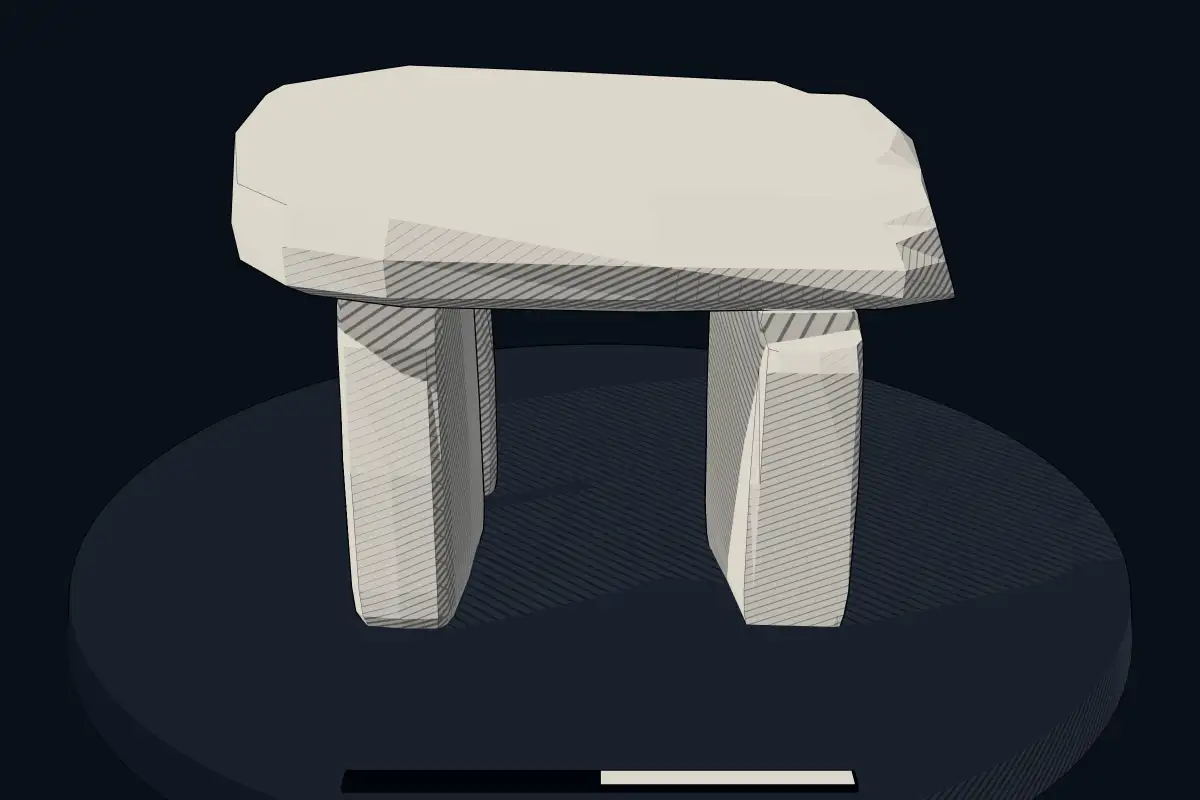
The reconstruction is ours, not a survey: it shows what a monument of this type looks like, at the size the record gives for this one.
Photographs
8 photographs, each with its author and licence
More photographs


Lore
Evidence & Lore
What the sources actually support — and, kept apart, what has been claimed.
What the evidence supports
Dates
Est. 3500–2800 BCEHow this date was established: Type comparisonTypical range for dolmens in Germany; this site has not been dated itself. German dolmens (Huengrab) belong to the Nordic megalith tradition which emerged predominantly between 3500 and 2800 BC.Source for this date
Where it stands
Germany
The pin marks the monument itself — its exact point.
- Coordinates
- 52°47′34″ N, 6°13′05″ EFor a GPS or map app: 52.79269, 6.21803
Access is as our sources describe it; we have not visited the site to check.
Nearby
The closest sites in the Atlas, by straight line.
 D543500–2800 BCE
 Hunebedden in Havelterberg3500–500 BCE
- Megalithic mound (tumulus with integral stones)Eupen Barchien3500–500 BCE
- Megalithic mound (tumulus with integral stones)Terrein waarin grafheuvel3500–500 BCE
- Megalithic mound (tumulus with integral stones)Terrein waarin grafheuvel3500–500 BCE
- Megalithic mound (tumulus with integral stones)Terrein waarin twee grafheuvels3500–500 BCE
 Terrein waarin zes grafheuvels3500–500 BCE
- DolmenDolmen of Steenwijkerwold3500–2800 BCE


Sources
Every record behind this page, with the link it came from.
2 sources behind this page
- 01Wikidata Q2184843wikidata.org
- 02Source for this dateen.wikipedia.org
Image files
- Hunebed D53 Havelterberg.jpgGouwenaarPublic domain
- 20180614 Zicht vanaf de Havelterberg op Hunebed D53.jpgGouwenaarCC BY-SA 4.0
- 20180614 Zicht2 vanaf de Havelterberg op Hunebed D53.jpgGouwenaarCC BY-SA 4.0
- 20150710 Hunebed (detail) Havelte.jpgGouwenaarCC0
- HunebedD53.jpgRuben HolthuijsenCC BY 2.0
- Hunebed D53 - 1.JPGSilver SpoonCC BY-SA 3.0
- Hunebed D53 - 10.JPGSilver SpoonCC BY-SA 3.0
- Hunebed D53.jpgRoepersCC BY 4.0
Report a correctionWrong date, name, photograph or source? Tell us and it will be put right.
Around this place
The ten nearest sites, by compass
- D540.2 km E
- Hunebedden in Havelterberg0.2 km SE
- Eupen Barchien3.0 km SE
- Terrein waarin grafheuvel8.1 km NW
- Terrein waarin grafheuvel8.3 km NW
- Terrein waarin twee grafheuvels8.3 km NW
- Terrein waarin zes grafheuvels8.5 km NW
- Dolmen of Steenwijkerwold8.6 km NW
- Terrein waarin twee grafheuvels9.6 km NW
- D52a10 km NE
Credit
Text, licence and sources
Text from the Wikipedia article "Großsteingrab Havelte 1" (German), licensed CC BY-SA 4.0; authors are listed in the page history. Reused under CC BY-SA 4.0. Read on Wikipedia · Edit history and authors
- Wikipedia (German): Großsteingrab Havelte 1CC BY-SA 4.0
- Wikidata Q2184843CC0