
Overview
About this site
What the sources say
Das Großsteingrab Emmen-Schimmeres ist eine megalithische Grabanlage der jungsteinzeitlichen Westgruppe der Trichterbecherkultur in Emmen in der niederländischen Provinz Drenthe. Mit einer Gesamtlänge von 40,3 m ist es das größte Großsteingrab in den Niederlanden und zugleich das einzige des Landes, das zwei Grabkammern enthält. 1913 wurde es von Jan Hendrik Holwerda und 1960 erneut von Albert Egges van Giffen großflächig archäologisch untersucht. Es trägt die Van-Giffen-Nummer D43.
Article in GermanRead on Wikipedia8 min readCC BY-SA 4.0
Where it sits in time
The site's dated range, placed against world reference points.
The scale is logarithmic: each step to the left is about ten times older than the last.
The full article
D43: the whole story
In briefSources for this section
Sources for this section
The megalithic tomb of Emmen-Schimmeres, catalogued as D43, was built by the western group of the Neolithic Funnel Beaker culture in Emmen, in the Dutch province of Drenthe. With a total length of 40,3 m it is the largest megalithic tomb in the Netherlands and also the only one in the country that contains two burial chambers. D43 is its Van Giffen number. It stands on a green space at the western edge of Emmen, with many other tombs nearby, among them Emmen-Noord (D41) 750 m to the north and Emmerdennen (D45) 1,4 km to the east.
The monument has a long bed, oriented north-north-east to west-south-west, which contains two passage graves. The bed has a slightly trapezoid outline with rounded narrow ends. It is 40,3 m long and 7 m wide in the north and 5 m wide in the south. It is enclosed by 54 stones whose flat sides face outwards, and the gaps between them were originally filled with drystone walling, which was reconstructed after the investigation of 1960. The mound fill was largely removed without proper documentation during a restoration in 1869.
The northern chamber is 4,6 m long, 3 m wide and about 1,5 m high, with three pairs of wall stones, an end stone at each short side and three capstones. Its entrance passage is paved with small stones. The southern chamber is larger, 8,1 m long and 2,9 m wide, with five pairs of wall stones; of its original five capstones, two survive. Three pits were found, two by Holwerda and a third by van Giffen in 1960. Their function is unclear for lack of meaningful finds.
The tomb appears on a map made between 1788 and 1792. Visitors and scholars documented it through the nineteenth century, including a survey in 1878 that produced very precise plans of 40 megalithic tombs. Jan Hendrik Holwerda excavated it in 1913, and Albert Egges van Giffen excavated it again in 1960, after which it was restored; a further restoration followed in 1997. It has been a national monument (Rijksmonument) since 1983.
The chambers held comparatively few finds, mainly pottery sherds, including large bulging vessels, cylindrical vessels, funnel beakers, a collared flask and a spouted bowl. There were also flint fragments, an unfinished axe, a small narrow chisel and an amulet made from a pierced fossil. Holwerda's finds are now in the Rijksmuseum van Oudheden in Leiden. Tombs of this kind in the Netherlands are called hunebedden, and of an estimated 100 original tombs, 54 are preserved, 52 of them in Drenthe.
No English Wikipedia article exists for it; the full text below is the German article "Großsteingrab Emmen-Schimmeres", shown in the original language.
Summary in EnglishSources for this section
Sources for this section
D43 is a dolmen in Emmen, Germany. Wikidata describes it as: dolmen in the Netherlands. A typological estimate: 3500 BCE to 2800 BCE. No English Wikipedia article exists for it; the full text below is the German article "Großsteingrab Emmen-Schimmeres", shown in the original language.
LageSources for this section
Sources for this section
Das Grab befindet sich am westlichen Ortsrand von Emmen auf einer Grünfläche. Es ist über einen vom Odoornerweg abzweigenden Feldweg erreichbar. In der näheren Umgebung gibt es zahlreiche weitere Großsteingräber. 750 m nördlich befindet sich das Großsteingrab Emmen-Noord (D41), 1,2 km westnordwestlich das Großsteingrab Westenesch-Noord (D42), 1,2 km westsüdwestlich das Großsteingrab Westenesch (D44), 1,4 km östlich das Großsteingrab Emmerdennen (D45) und 2 km nördlich die drei Großsteingräber bei Emmerveld (D38–D40). 2,9 km nördlich lag das zerstörte Großsteingrab Weerdinge (D37a).
ForschungsgeschichteSources for this section
Sources for this section
18. und 19. Jahrhundert
Die Existenz des Grabes wurde erstmals auf der zwischen 1788 und 1792 entstandenen Hottinger-Karte erwähnt. Leonhardt Johannes Friedrich Janssen, Kurator der Sammlung niederländischer Altertümer im Rijksmuseum van Oudheden in Leiden, besuchte 1847 einen Großteil der noch erhaltenen Großsteingräber der Niederlande, darunter auch das Grab von Emmen-Schimmeres, und publizierte im folgenden Jahr das erste Überblickswerk mit Baubeschreibungen und schematischen Plänen der Gräber. 1869 wurde das Grab unsachgemäß restauriert. Janssens Nachfolger Willem Pleyte unternahm 1874 zusammen mit dem Fotografen Jan Goedeljee eine Reise durch Drenthe und ließ dort erstmals alle Großsteingräber systematisch fotografieren. Auf Grundlage dieser Fotos fertigte er Lithografien an. Conrad Leemans, Direktor des Rijksmuseums, unternahm 1877 unabhängig von Pleyte eine Reise nach Drenthe. Jan Ernst Henric Hooft van Iddekinge, der zuvor schon mit Pleyte dort gewesen war, fertigte für Leemans Pläne der Großsteingräber an. Leemans’ Bericht blieb allerdings unpubliziert. 1878 erfolgte eine Untersuchung durch William Collings Lukis und Henry Dryden, die auf Anregung von Augustus Wollaston Franks die Provinz Drenthe bereisten und dabei sehr genaue Grundriss- und Schnittzeichnungen von 40 Großsteingräbern anfertigten.
20. und 21. Jahrhundert
Zwischen 1904 und 1906 dokumentierte der Mediziner und Amateurarchäologe Willem Johannes de Wilde alle noch erhaltenen Großsteingräber der Niederlande durch genaue Pläne, Fotografien und ausführliche Baubeschreibungen. Seine Aufzeichnungen zum Grab von Emmen-Schimmeres sind allerdings verloren gegangen. 1913 führte Jan Hendrik Holwerda eine archäologische Grabung durch. 1918 dokumentierte Albert Egges van Giffen die Anlage für seinen Atlas der niederländischen Großsteingräber. 1960 führte van Giffen eine weitere Grabung durch, in deren Anschluss das Grab restauriert wurde. Eine weitere Restaurierung erfolgte 1997. Seit 1983 ist die Anlage ein Nationaldenkmal (Rijksmonument). 2017 wurde die Anlage zusammen mit den anderen noch erhaltenen Großsteingräbern der Niederlande in einem Projekt der Provinz Drente und der Reichsuniversität Groningen von der Stiftung Gratama mittels Photogrammetrie in einem 3D-Atlas erfasst.
BeschreibungSources for this section
Sources for this section
Architektur
Das Langbett
Die Anlage besitzt ein nordnordost-westsüdwestlich orientiertes Langbett, das zwei Ganggräber enthält. Das Bett hat einen leicht trapezförmigen Grundriss mit abgerundeten Schmalseiten. Es hat eine Länge von 40,3 m sowie eine Breite von 7 m im Norden und 5 m im Süden. Die Hügelschüttung wurde bei der Restaurierung von 1869 ohne genauere Dokumentation weitgehend abgetragen. Die Umfassung besteht aus 54 Steinen, deren flache Seiten nach außen zeigen. Die Zwischenräume der Umfassungssteine waren ursprünglich mit Trockenmauerwerk ausgefüllt. Dieses wurde nach der Untersuchung von 1960 rekonstruiert. Holwerda glaubte, dass das gesamte südliche Ende erst bei der Restaurierung von 1869 errichtet worden war, da einige Steine nicht bis in den anstehenden Boden, sondern nur bis in die Hügelschüttung eingetieft waren. Zudem fehlten am Südende Reste von Trockenmauerwerk. Weiterhin glaubte Holwerda, weiter nördlich die Standspuren der ursprünglichen südlichen Abschlusssteine der Umfassung ausgemacht zu haben. Seiner Interpretation zufolge war die Umfassung somit ursprünglich 6 m kürzer gewesen und bei den hinzugefügten Steinen soll es sich in Wirklichkeit um Decksteine der Grabkammern gehandelt haben. Van Giffen verwarf diese Interpretation und konnte nur zwei der betreffenden Steine als eindeutige neuzeitliche Ergänzungen identifizieren.
Die nördliche Grabkammer
Die Kammer ist parallel zum Langbett orientiert. Sie hat eine Länge von 4,6 m und eine Breite von 3 m. Ihre Höhe beträgt etwa 1,5 m. Sie besteht aus drei Wandsteinpaaren an den Langseiten, je einem Abschlussstein an den Schmalseiten und drei Decksteinen. Der mittlere und der nördliche Deckstein waren ein Stück nach Norden verschleppt und wurden erst bei der Restaurierung im Jahr 1960 wieder auf die Wandsteine aufgesetzt. Die Zwischenräume der Wandsteine waren ursprünglich mit Trockenmauerwerk ausgefüllt. Die Kammer wies ein steinernes Bodenpflaster auf. Zwischen dem von Süden aus gesehen ersten und zweiten Wandstein der östlichen Langseite befindet sich der Zugang zur Kammer. Diesem ist ein Gang vorgelagert, der aus zwei Wandsteinen besteht. Der Gang ist ebenfalls mit kleinen Steinen gepflastert und liegt etwa 0,6 m über dem Bodenniveau der Kammer. Der Gang hat eine Breite von 0,55 m und eine Höhe von 0,85 m. Zwischen Gang und Kammer befindet sich ein Schwellenstein.
Die südliche Grabkammer
Auch die südliche Kammer ist parallel zum Langbett orientiert. Sie hat eine Länge von 8,1 m und eine Breite von 2,9 m. Sie besteht aus fünf Wandsteinpaaren an den Langseiten und je einem Abschlussstein an den Schmalseiten. Von den ursprünglich fünf Decksteinen sind noch zwei erhalten. Die Zwischenräume der Wandsteine waren ursprünglich mit Trockenmauerwerk ausgefüllt. Die Kammer wies ein steinernes Bodenpflaster auf. Zwischen dem von Süden aus gesehen zweiten und dritten Wandstein der östlichen Langseite befindet sich der Zugang zur Kammer. Diesem ist ein Gang vorgelagert, der aus zwei Wandsteinen besteht, welche erst 1960 von van Giffen entdeckt wurden.
Die Ritualgruben
Holwerda entdeckte zwischen den beiden Grabkammern eine Grube und eine weitere südwestlich der südlichen Grabkammer. Die erste Grube hatte eine Länge von 2,2 m und eine Breite von 1,65 m. Die zweite hatte eine Länge von 3 m und eine Breite von 1,4 m. Van Giffen entdeckte 1960 eine dritte Grube. Die Funktion dieser Gruben ist mangels aussagekräftiger Funde unklar. Die nördliche von Holwerda entdeckte Grube enthielt nur wenige Keramikscherben sowie „fast unscheinbare weisse Splitterchen“ (vermutlich Reste verbrannter Knochen). Die südliche Grube war fundleer. Die von van Giffen entdeckte Grube enthielt ebenfalls nur wenige Keramikscherben und ein retuschiertes Stück Feuerstein.
Beigaben
Die beiden Grabkammern enthielten vergleichsweise wenige Funde, vor allem Keramikscherben. Holwerda fand in der nördlichen Kammer hauptsächlich große, bauchige Gefäße und zylindrische Gefäße. Becher und Schüsseln waren seltener. Hinzu kommen Fragmente einer Kragenflasche, eines Gefäßes mit Öse, eines kleinen Topfes und eines Napfes mit Ausguss. Weiterhin wurden einige Feuerstein-Splitter, eine unfertige Axt und ein Amulett aus einem durchbohrten Fossil gefunden.
Die südliche Kammer bot ein ähnliches Fundspektrum. Hier dominierten Schüsseln, zylindrische Gefäße und Trichterbecher mit ausladendem, hohen Rand. Hinzu kamen kleine Gefäße mit geradem Rand, bauchige Töpfe, eine einzelne Kragenflasche und ein kleiner Topf mit spitzem Bauch, geradem Rand und Ösen. Weiterhin wurden Feuersteinfragmente und ein kleiner Schmalmeißel gefunden.
Die Funde aus Holwerdas Grabung befinden sich heute im Rijksmuseum van Oudheden in Leiden.
How this page was madeSources for this section
Sources for this section
The summary at the top of this page was written by Claude Sonnet 5.5 (2026-11-06) from the cited Wikipedia article “Großsteingrab Emmen-Schimmeres”, translated from German. The numbers in it were checked automatically against the source text. The rest of the page is the article itself, the structured records and computed distances.
Tradition and region
About this kind of monument
German and Dutch Hünengräber (hunebedden)
The megalithic tombs of northern Germany and the Netherlands were built by the Funnel Beaker culture (about 4100 to 2800 BCE), and the style, called Nordic megalith architecture, emerged between 3500 and 2800 BCE. In the Netherlands the tombs are the hunebedden, built between 3470 and 3250 BCE by the western group of the Funnel Beaker culture and used until about 2760 BCE. Of an estimated 100 original tombs, 54 are preserved, 52 of them in the province of Drenthe and two in Groningen. After the Funnel Beaker culture ended the sites were reused by the Single Grave and Bell Beaker cultures in the Early Bronze Age and, to a lesser extent, into the Middle Ages.
In Mecklenburg-Vorpommern up to 5,000 megalith tombs were erected, and more than 1,000 are preserved and protected by law; they belong to the youngest and easternmost part of the western European tradition. Most are dolmens, often lying inside a circular or trapezoid frame of standing stones. Locally they are known as Hünengräber, "giants' tombs", or Großsteingräber, "large stone tombs"; the trapezoid frame is a Hünenbett, "giants' bed", and the circular one a Bannkreis. Between 1964 and 1974 Ewald Schuldt excavated over a hundred sites there and sorted them into simple dolmens, extended dolmens, passage graves, great dolmens, unchambered long barrows and stone cists.
Folklore: the German and Dutch names, with Hüne meaning "giant", carry the old idea that giants were buried here. This is a tradition; the stones were placed by Neolithic farmers.
When visiting, look for the capstones on their supports and the frame of kerbstones around them.
Paraphrased from Wikipedia: Megaliths in the Netherlands, Wikipedia: Megaliths in Mecklenburg-Vorpommern, Wikipedia: Nordic megalith architecture, Wikipedia: Funnel beaker culture, Wikipedia: Dolmen · CC BY-SA 4.0
From the article
Dated moments in the story
- 1847
Leonhardt Johannes Friedrich Janssen, Kurator der Sammlung niederländischer Altertümer im Rijksmuseum van Oudheden in Leiden, besuchte 1847 einen Großteil der noch erhaltenen Großsteingräber der Niederlande, darunter auch das Grab von Emmen-Schimmeres, und publizierte im folgenden Jahr das erste Überblickswerk mit...
Source - 1869
1869 wurde das Grab unsachgemäß restauriert.
Source - 1869
Die Hügelschüttung wurde bei der Restaurierung von 1869 ohne genauere Dokumentation weitgehend abgetragen.
Source - 1869
Holwerda glaubte, dass das gesamte südliche Ende erst bei der Restaurierung von 1869 errichtet worden war, da einige Steine nicht bis in den anstehenden Boden, sondern nur bis in die Hügelschüttung eingetieft waren.
Source - 1874
Janssens Nachfolger Willem Pleyte unternahm 1874 zusammen mit dem Fotografen Jan Goedeljee eine Reise durch Drenthe und ließ dort erstmals alle Großsteingräber systematisch fotografieren.
Source - 1877
Conrad Leemans, Direktor des Rijksmuseums, unternahm 1877 unabhängig von Pleyte eine Reise nach Drenthe.
Source - 1913
1913 wurde es von Jan Hendrik Holwerda und 1960 erneut von Albert Egges van Giffen großflächig archäologisch untersucht.
Source - 1913
1913 führte Jan Hendrik Holwerda eine archäologische Grabung durch.
Source - 1918
1918 dokumentierte Albert Egges van Giffen die Anlage für seinen Atlas der niederländischen Großsteingräber.
Source - 1960
1960 führte van Giffen eine weitere Grabung durch, in deren Anschluss das Grab restauriert wurde.
Source - 1960
Dieses wurde nach der Untersuchung von 1960 rekonstruiert.
Source - 1960
Der mittlere und der nördliche Deckstein waren ein Stück nach Norden verschleppt und wurden erst bei der Restaurierung im Jahr 1960 wieder auf die Wandsteine aufgesetzt.
Source - 1960
Diesem ist ein Gang vorgelagert, der aus zwei Wandsteinen besteht, welche erst 1960 von van Giffen entdeckt wurden. Holwerda entdeckte zwischen den beiden Grabkammern eine Grube und eine weitere südwestlich der südlichen Grabkammer.
Source - 1960
Van Giffen entdeckte 1960 eine dritte Grube.
Source
See it in 3D
An interpretive reconstruction of the monument, standing on the real ground at its exact point, under the sun for that place and season. Drag to look around it.
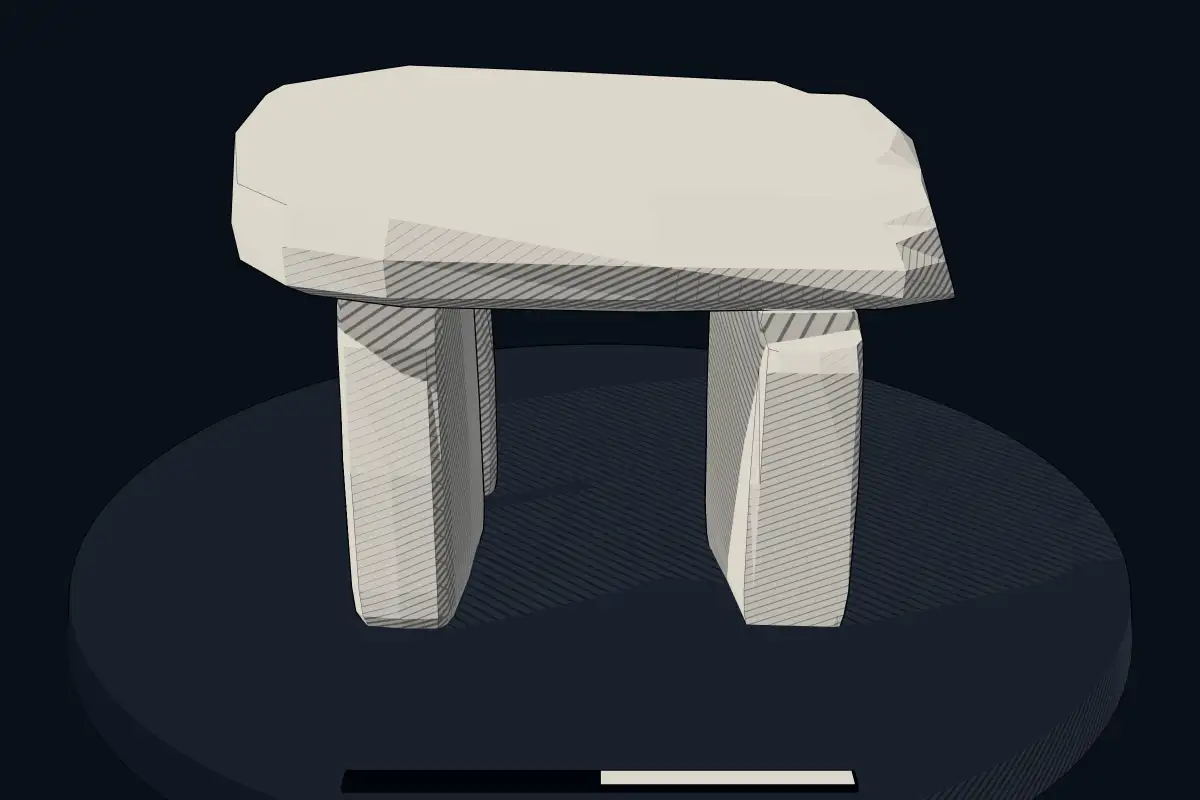
The reconstruction is ours, not a survey: it shows what a monument of this type looks like, at the size the record gives for this one.
Photographs
8 photographs, each with its author and licence
More photographs
Lore
Evidence & Lore
What the sources actually support — and, kept apart, what has been claimed.
What the evidence supports
Dates
Est. 3500–2800 BCEHow this date was established: Type comparisonTypical range for dolmens in Germany; this site has not been dated itself. German dolmens (Huengrab) belong to the Nordic megalith tradition which emerged predominantly between 3500 and 2800 BC.Source for this date
Where it stands
Germany
The pin marks the monument itself — its exact point.
- Coordinates
- 52°47′35″ N, 6°53′13″ EFor a GPS or map app: 52.79316, 6.88694
Access is as our sources describe it; we have not visited the site to check.
Nearby
The closest sites in the Atlas, by straight line.


Sources
Every record behind this page, with the link it came from.
2 sources behind this page
- 01Wikidata Q2487982wikidata.org
- 02Source for this dateen.wikipedia.org
Image files
- Hunebed D43 langgraf op de Emmer-esch.jpgGouwenaarPublic domain
- Hunebed D43 in Emmen Schimmeres.jpgRudolphousCC BY-SA 4.0
- Hunebed D43 v2.jpgRudolphousCC BY-SA 4.0
- Hunedbed D43 Emmen-1.JPGTheunCC BY-SA 3.0
- Hunedbed D43 Emmen-2.JPGTheunCC BY-SA 3.0
- Hunedbed D43 Emmen-3.JPGTheunCC BY-SA 4.0
- Exterieur overzicht hunebed - Emmen - 20321497 - RCE.jpgIJsbrand HeinsCC BY-SA 4.0
- Exterieur overzicht van zogeheten langgraf bestaat uit twee grafkelders met afzondelijke ingang - Emmen - 20323158 - RCE.jpgIJsbrand HeinsCC BY-SA 4.0
Report a correctionWrong date, name, photograph or source? Tell us and it will be put right.
Around this place
The ten nearest sites, by compass
Credit
Text, licence and sources
Text from the Wikipedia article "Großsteingrab Emmen-Schimmeres" (German), licensed CC BY-SA 4.0; authors are listed in the page history. Reused under CC BY-SA 4.0. Read on Wikipedia · Edit history and authors