

Overview
About this site
What the sources say
Das Großsteingrab Eext (auch als Treppengrab von Eext (niederländisch trapgraf), Eexter grafkelder oder Stemberg bezeichnet) ist eine megalithische Grabanlage der jungsteinzeitlichen Westgruppe der Trichterbecherkultur bei Eext, einem Ortsteil von Aa en Hunze in der niederländischen Provinz Drenthe. Die Anlage wurde mehrfach archäologisch untersucht. Die Bezeichnung „Treppengrab“ stammt von der steilen, vierstufigen Treppe, über die die eingetiefte, teilweise noch im Hügel befindliche Grabkammer ursprünglich zugänglich war. Diese Krypta-Form ist in den Niederlanden einzigartig. Das Grab trägt die Van-Giffen-Nummer D13.
Article in GermanRead on Wikipedia7 min readCC BY-SA 4.0
Where it sits in time
The site's dated range, placed against world reference points.
The scale is logarithmic: each step to the left is about ten times older than the last.
The full article
D13: the whole story
In briefSources for this section
- Wikipedia (German): Großsteingrab EextCC BY-SA 4.0
Sources for this section
- Wikipedia (German): Großsteingrab EextCC BY-SA 4.0
The Großsteingrab Eext, also called Treppengrab van Eext or Stemberg, is a megalithic tomb of the western group of the Funnel Beaker culture at Eext, a district of Aa en Hunze in Drenthe, Netherlands. It carries the Van-Giffen number D13. The monument is unusual for its steep, four-stepped stairway, which gave it its name and provides access to the sunken burial chamber. This crypt-like form is unique among the hunebedden of the Netherlands.
The tomb is a passage grave dug into the ground and aligned east-northeast to west-southwest. Its chamber measures 4,3 m in length and 3,2 m in width, with three pairs of wall stones on the long sides and an end stone on each short side. Of the original three capstones, only one survives; it was found nearby and replaced in 1976. The flat wall and cap stones fit so closely that almost no gaps remain. The four-stepped entrance, bordered by walls of rolled stones, was added in the second building phase.
The site was discovered in 1735 and rediscovered by stone seekers in 1756, when vessels and axes were sold to collectors and two capstones were removed. Joannes van Lier examined and partly restored the tomb, and his critical correspondence led to the first monograph on a Dutch megalithic tomb, published in 1760. Investigations continued in the 19th and 20th centuries, including excavations by Albert Egges van Giffen in 1927 and by Jan N. Lanting in 1984. It became a National Monument in 1978 and was recorded by photogrammetry in a 3D atlas in 2017.
Van Lier found numerous ceramic vessels containing burned bones, but these were not preserved. The Rijksmuseum van Oudheden in Leiden holds a prehistoric handled vessel, a flint axe and a medieval ceramic beaker; it is unclear whether the latter two came from Eext or the nearby Großsteingrab Eext-Es (D12). Monuments of this kind in the Netherlands were built as hunebedden by the western group of the Funnel Beaker culture between 3470 and 3250 BCE and used until about 2760 BCE. After that culture ended, the sites were reused by the Single Grave and Bell Beaker cultures in the Early Bronze Age and, less often, into the Middle Ages.
No English Wikipedia article exists for it; the full text below is the German article "Großsteingrab Eext", shown in the original language.
Summary in EnglishSources for this section
- Wikipedia (German): Großsteingrab EextCC BY-SA 4.0
Sources for this section
- Wikipedia (German): Großsteingrab EextCC BY-SA 4.0
D13 is a dolmen in Aa en Hunze, Germany. Wikidata describes it as: dolmen in the Netherlands. A typological estimate: 3500 BCE to 2800 BCE. No English Wikipedia article exists for it; the full text below is the German article "Großsteingrab Eext", shown in the original language.
LageSources for this section
- Wikipedia (German): Großsteingrab EextCC BY-SA 4.0
Sources for this section
- Wikipedia (German): Großsteingrab EextCC BY-SA 4.0
Das Grab befindet sich im Süden von Eext an einem Feldweg zwischen dem Jan Oostingweg und der Stationsstraat. In der näheren Umgebung gibt es mehrere weitere Großsteingräber: 450 m nordnordwestlich befindet sich das Großsteingrab Eext-Es (D12), 1,1 km südsüdöstlich das Großsteingrab Eexterhalte (D14) und 2,5 km nordnordwestlich das Großsteingrab Anloo-Zuid (D11).
ForschungsgeschichteSources for this section
- Wikipedia (German): Großsteingrab EextCC BY-SA 4.0
Sources for this section
- Wikipedia (German): Großsteingrab EextCC BY-SA 4.0
18. Jahrhundert
Das Grab wurde 1735 von einem Steinsucher entdeckt. Hierüber wurde ein anonymer Bericht angefertigt. 1756 wurde es ebenfalls von Steinsuchern wiederentdeckt. Dabei aufgefundene Gefäße und Äxte wurden an Sammler verkauft. Außerdem wurden zwei Decksteine entfernt. Joannes van Lier führte daraufhin eine ausführliche Untersuchung der Anlage durch und versetzte die Grabkammer, so gut es ging, in ihren ursprünglichen Zustand zurück. Nur zwei Tage später veröffentlichte er einen Zeitungsartikel über seine Arbeit. Henrik Cannegieter, Rektor der Lateinschule in Arnhem, schrieb auf Grundlage des Zeitungsartikels eine Abhandlung über das Grab, ohne es selbst je in Augenschein genommen oder mit van Lier Kontakt aufgenommen zu haben. Auf Anregung seines Freundes Arnout Vosmaer setzte van Lier sich in fünf langen Briefen mit dieser Abhandlung kritisch auseinander. Aus diesen Briefen entstand schließlich die erste monografische Abhandlung über ein niederländisches Großsteingrab. Sie wurde 1760 von Vosmaer herausgegeben. Cornelis van Noorde zeichnete das Grab 1756. Abraham Delfos, ein Schüler von Jan Wandelaar, fertigte 1760 einen Stich für van Liers Publikation an. Petrus Camper fertigte 1768 eine weitere Zeichnung an.
19. Jahrhundert
Leonhardt Johannes Friedrich Janssen, Kurator der Sammlung niederländischer Altertümer im Rijksmuseum van Oudheden in Leiden, besuchte 1847 einen Großteil der noch erhaltenen Großsteingräber der Niederlande, darunter auch das Grab von Eext, und publizierte im folgenden Jahr das erste Überblickswerk mit Baubeschreibungen und schematischen Plänen der Gräber. 1871 wurde die Anlage unsachgemäß restauriert. Janssens Nachfolger Willem Pleyte unternahm 1874 zusammen mit dem Fotografen Jan Goedeljee eine Reise durch Drenthe und ließ dort erstmals alle Großsteingräber systematisch fotografieren. Auf Grundlage dieser Fotos fertigte er Lithografien an. Conradus Leemans, Direktor des Rijksmuseums, unternahm 1877 unabhängig von Pleyte eine Reise nach Drenthe. Jan Ernst Henric Hooft van Iddekinge, der zuvor schon mit Pleyte dort gewesen war, fertigte für Leemans Pläne der Großsteingräber an. Leemans’ Bericht blieb allerdings unpubliziert. 1878 erfolgte eine Untersuchung durch William Collings Lukis und Henry Dryden, die auf Anregung von Augustus Wollaston Franks die Provinz Drenthe bereisten und dabei sehr genaue Grundriss- und Schnittzeichnungen von 40 Großsteingräbern anfertigten.
20. und 21. Jahrhundert
Zwischen 1904 und 1906 dokumentierte der Mediziner und Amateurarchäologe Willem Johannes de Wilde alle noch erhaltenen Großsteingräber der Niederlande durch genaue Pläne, Fotografien und ausführliche Baubeschreibungen. Seine Aufzeichnungen zum Grab von Eext sind allerdings verloren gegangen. 1905 wurde das Grab restauriert. 1918 dokumentierte Albert Egges van Giffen die Anlage für seinen Atlas der niederländischen Großsteingräber. 1927 führte van Giffen eine archäologische Grabung durch. Eine weitere Grabung erfolgte 1984 unter Leitung von Jan N. Lanting. 1976 erfolgte eine Restaurierung, bei der ein Deckstein aufgesetzt wurde, der kurz zuvor beim Anlagen eines Abwasserkanals wiederentdeckt worden war. Seit 1978 ist die Anlage ein Nationaldenkmal (Rijksmonument). 2017 wurde die Anlage zusammen mit den anderen noch erhaltenen Großsteingräbern der Niederlande in einem Projekt der Provinz Drenthe und der Rijksuniversiteit Groningen von der Stiftung Gratama mittels Photogrammetrie in einem 3D-Atlas erfasst.
BeschreibungSources for this section
- Wikipedia (German): Großsteingrab EextCC BY-SA 4.0
Sources for this section
- Wikipedia (German): Großsteingrab EextCC BY-SA 4.0
Bei der Anlage handelt es sich um ein ostnordost-westsüdwestlich orientiertes, in den Boden eingetieftes Ganggrab. Eine steinerne Umfassung konnte nicht festgestellt werden. Die Hügelschüttung entstand gemäß Lantings Untersuchung in drei Phasen: Die älteste reichte bis zur Mitte der Wandsteine, die zweite bis zur Unterseite der Decksteine und die dritte bedeckte die Grabkammer vollständig. Diese dritte Phase datiert wohl nicht in die Trichterbecherkultur, sondern ins Endneolithikum (2850–2000 v. Chr.) Die Kammer hat eine Länge von 4,3 m und eine Breite von 3,2 m. Sie besteht aus drei Wandsteinpaaren an den Langseiten und je einem Abschlussstein an den Schmalseiten. Von den ursprünglich drei Decksteinen ist nur noch einer vorhanden. Er wurde 1976 verschleppt in Eext gefunden und wieder auf die Kammer aufgesetzt. Angeblich soll sich ein zweiter Stein irgendwo im Boden in der Nähe der Eexter Kirche befinden. Die Wand- und Decksteine sind ungewöhnlich flach und stehen so passgenau aneinander, dass zwischen ihnen kaum Lücken vorhanden sind. Etwaiges Zwischenmauerwerk ist nicht erhalten und wurde wohl nur in geringem Umfang verbaut. Zwischen dem östlichen und dem mittleren Wandstein der südlichen Langseite befand sich der Zugang zur Grabkammer. Diesem war eine Treppenkonstruktion aus vier Stufen vorgelagert, die mit zwei Mauern aus Rollsteinen eingefasst war. Die Stufen bestanden jeweils aus einem oder zwei flachen Steinen. Zwischen der Treppe und der Kammer lag ein Schwellenstein. Diese Treppenkonstruktion ist für die niederländischen Großsteingräber einzigartig und auch im weiteren Verbreitungsgebiet der Trichterbecherkultur sehr selten. Lediglich vier weitere Großsteingräber in Niedersachsen weisen einen solchen Zugang auf: Das Großsteingrab Deinste 1, das Großsteingrab Krelingen, das Großsteingrab Sieben Steinhäuser C und das zerstörte Großsteingrab Meckelstedt 2. Die Treppe des Großsteingrabes von Eext gehörte nach Lantings Untersuchung nicht zum ursprünglichen Bauplan, sondern wurde erst in der zweiten Bauphase errichtet.
FundeSources for this section
- Wikipedia (German): Großsteingrab EextCC BY-SA 4.0
Sources for this section
- Wikipedia (German): Großsteingrab EextCC BY-SA 4.0
Van Lier fand bei seiner Untersuchung zahlreiche Keramikgefäße mit verbrannten Knochen, die allerdings nicht erhalten sind.
Das Rijksmuseum van Oudheden in Leiden besitzt einige Altfunde aus dem Großsteingrab Eext: Dies sind ein vorgeschichtliches Henkelgefäß sowie ein Feuerstein-Beil und ein mittelalterlicher Keramikbecher. Bei den beiden letzten Funden ist unklar, ob sie aus dem Großsteingrab Eext oder dem benachbarten Großsteingrab Eext-Es (D12) stammen.
How this page was madeSources for this section
- Wikipedia (German): Großsteingrab EextCC BY-SA 4.0
Sources for this section
- Wikipedia (German): Großsteingrab EextCC BY-SA 4.0
The summary at the top of this page was written by MiniMax-M3 (2026-11-07) from the cited Wikipedia article “Großsteingrab Eext”, translated from German. The numbers in it were checked automatically against the source text. The rest of the page is the article itself, the structured records and computed distances.
Tradition and region
About this kind of monument
German and Dutch Hünengräber (hunebedden)
The megalithic tombs of northern Germany and the Netherlands were built by the Funnel Beaker culture (about 4100 to 2800 BCE), and the style, called Nordic megalith architecture, emerged between 3500 and 2800 BCE. In the Netherlands the tombs are the hunebedden, built between 3470 and 3250 BCE by the western group of the Funnel Beaker culture and used until about 2760 BCE. Of an estimated 100 original tombs, 54 are preserved, 52 of them in the province of Drenthe and two in Groningen. After the Funnel Beaker culture ended the sites were reused by the Single Grave and Bell Beaker cultures in the Early Bronze Age and, to a lesser extent, into the Middle Ages.
In Mecklenburg-Vorpommern up to 5,000 megalith tombs were erected, and more than 1,000 are preserved and protected by law; they belong to the youngest and easternmost part of the western European tradition. Most are dolmens, often lying inside a circular or trapezoid frame of standing stones. Locally they are known as Hünengräber, "giants' tombs", or Großsteingräber, "large stone tombs"; the trapezoid frame is a Hünenbett, "giants' bed", and the circular one a Bannkreis. Between 1964 and 1974 Ewald Schuldt excavated over a hundred sites there and sorted them into simple dolmens, extended dolmens, passage graves, great dolmens, unchambered long barrows and stone cists.
Folklore: the German and Dutch names, with Hüne meaning "giant", carry the old idea that giants were buried here. This is a tradition; the stones were placed by Neolithic farmers.
When visiting, look for the capstones on their supports and the frame of kerbstones around them.
Paraphrased from Wikipedia: Megaliths in the Netherlands, Wikipedia: Megaliths in Mecklenburg-Vorpommern, Wikipedia: Nordic megalith architecture, Wikipedia: Funnel beaker culture, Wikipedia: Dolmen · CC BY-SA 4.0
From the article
Dated moments in the story
- 2000 BCE
Diese dritte Phase datiert wohl nicht in die Trichterbecherkultur, sondern ins Endneolithikum (2850–2000 v. Chr.) Die Kammer hat eine Länge von 4,3 m und eine Breite von 3,2 m.
Source - 1756
1756 wurde es ebenfalls von Steinsuchern wiederentdeckt.
Source - 1756
Cornelis van Noorde zeichnete das Grab 1756. Abraham Delfos, ein Schüler von Jan Wandelaar, fertigte 1760 einen Stich für van Liers Publikation an.
Source - 1760
Sie wurde 1760 von Vosmaer herausgegeben.
Source - 1871
1871 wurde die Anlage unsachgemäß restauriert.
Source - 1874
Janssens Nachfolger Willem Pleyte unternahm 1874 zusammen mit dem Fotografen Jan Goedeljee eine Reise durch Drenthe und ließ dort erstmals alle Großsteingräber systematisch fotografieren.
Source - 1877
Conradus Leemans, Direktor des Rijksmuseums, unternahm 1877 unabhängig von Pleyte eine Reise nach Drenthe.
Source - 1905
1905 wurde das Grab restauriert.
Source - 1918
1918 dokumentierte Albert Egges van Giffen die Anlage für seinen Atlas der niederländischen Großsteingräber.
Source - 1927
1927 führte van Giffen eine archäologische Grabung durch.
Source - 1976
1976 erfolgte eine Restaurierung, bei der ein Deckstein aufgesetzt wurde, der kurz zuvor beim Anlagen eines Abwasserkanals wiederentdeckt worden war.
Source - 1976
Er wurde 1976 verschleppt in Eext gefunden und wieder auf die Kammer aufgesetzt.
Source - 1978
Seit 1978 ist die Anlage ein Nationaldenkmal (Rijksmonument).
Source - 1984
Eine weitere Grabung erfolgte 1984 unter Leitung von Jan N.
Source
See it in 3D
An interpretive reconstruction of the monument, standing on the real ground at its exact point, under the sun for that place and season. Drag to look around it.
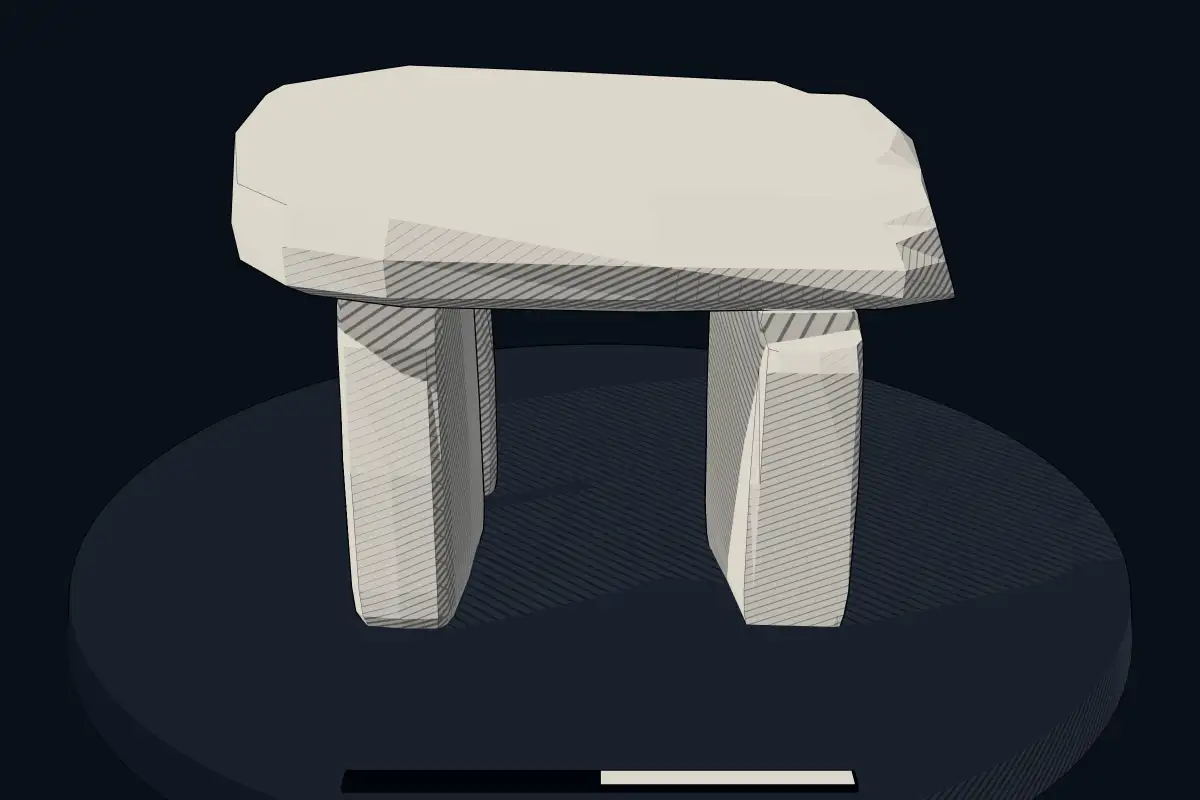
The reconstruction is ours, not a survey: it shows what a monument of this type looks like, at the size the record gives for this one.
Photographs
8 photographs, each with its author and licence
More photographs


Lore
Evidence & Lore
What the sources actually support — and, kept apart, what has been claimed.
What the evidence supports
Dates
Est. 3500–2800 BCEHow this date was established: Type comparisonTypical range for dolmens in Germany; this site has not been dated itself. German dolmens (Huengrab) belong to the Nordic megalith tradition which emerged predominantly between 3500 and 2800 BC.Source for this date
Where it stands
Germany
The pin marks the monument itself — its exact point.
- Coordinates
- 53°00′41″ N, 6°43′37″ EFor a GPS or map app: 53.01135, 6.72699
Access is as our sources describe it; we have not visited the site to check.
Nearby
The closest sites in the Atlas, by straight line.
 D123500–2800 BCE
- Megalithic mound (tumulus with integral stones)Terrein met een grafheuvel3500–500 BCE
- Megalithic mound (tumulus with integral stones)Terrein met vijf grafheuvels3500–500 BCE
 D143500–2800 BCE
- Megalithic mound (tumulus with integral stones)Terrein met een grafheuvel3500–500 BCE
- Megalithic mound (tumulus with integral stones)Terrein met twee grafheuvels3500–500 BCE
- Megalithic mound (tumulus with integral stones)Ketenberg3500–500 BCE
- Megalithic mound (tumulus with integral stones)Terrein met elf grafheuvels3500–500 BCE


Sources
Every record behind this page, with the link it came from.
2 sources behind this page
- 01Wikidata Q2428057wikidata.org
- 02Source for this dateen.wikipedia.org
Image files
- D13 4.JPGEncyachtCC BY-SA 4.0
- Hunebed D13 01.jpgHelenaCC BY 2.0
- D13 1.JPGEncyachtCC BY-SA 4.0
- D13 3.JPGEncyachtCC BY-SA 4.0
- Romeinse grafkelder tussen Eext en Rolde te Drenthe, Inventarisnummer NL-HlmNHA 53013418.JPGNoorde, Cornelis van (1731-1795)CC0
- Hunebed D13 Goedeljee.jpgJan Goedeljee (1824-1905)CC BY 4.0
- Hunebed D13 bij Eext.jpgGouwenaarPublic domain
- Hunebed D13 bij Eext (prent).jpgJohannes van LierPublic domain
Report a correctionWrong date, name, photograph or source? Tell us and it will be put right.
Around this place
The ten nearest sites, by compass
Credit
Text, licence and sources
Text from the Wikipedia article "Großsteingrab Eext" (German), licensed CC BY-SA 4.0; authors are listed in the page history. Reused under CC BY-SA 4.0. Read on Wikipedia · Edit history and authors
- Wikipedia (German): Großsteingrab EextCC BY-SA 4.0
- Wikidata Q2428057CC0