
Megalithic mound (tumulus with integral stones)
Blocksberg
DatedEst. 3500–500 BCE
Photo Olaf Meister · CC BY-SA 4.0Source file on Wikimedia Commons

Overview
About this site
What the sources say
Der Blocksberg ist ein Hügelgrab in Kühlungsborn in Mecklenburg-Vorpommern. Er befindet sich im südlichen Teil des Stadtwalds Kühlungsborn. Er ist 2,5 m hoch und hat einen Durchmesser von 13 Metern.
In den 1950er Jahren fanden spielende Kinder auf dem Blocksberg, welcher sich deutlich als Hügel abzeichnet, Tonscherben und ein Tongefäß. Zwischen 1957 und 1958 erfolgten Grabungen an dem 2,5 Meter hohen Hügel, bei welchen Bodendenkmalpfleger diese Funde überprüften.
Bei den Grabungen wurde eine aus der Bronzezeit zwischen 1800 und 600 v. Chr. stammende Grabanlage gefunden. Neben einem Hauptgrab fanden sich zwei Nachbestattungen. Alle drei als Steinsetzungen ausgeführte Gräber waren weitgehend leer. Außerdem fand man eine zum Totenkult gehörende Brandstelle. Der Grabhügel war ursprünglich von einem Steinkreis umgeben.
Der Name Blocksberg verweist darauf, dass dieser Hügel als Ort galt, an dem nachts Hexen, unter der Herrschaft des Teufels in Gestalt eines Ziegenbocks, tanzten.
Article in GermanRead on Wikipedia3 min readCC BY-SA 4.0
Where it sits in time
The site's dated range, placed against world reference points.
The scale is logarithmic: each step to the left is about ten times older than the last.
The full article
Blocksberg: the whole story
In briefSources for this section
- Wikipedia (German): Blocksberg (Kühlungsborn)CC BY-SA 4.0
Sources for this section
- Wikipedia (German): Blocksberg (Kühlungsborn)CC BY-SA 4.0
The Blocksberg is a burial mound in Kühlungsborn, Mecklenburg-Vorpommern, Germany, dating from 3500 BCE to 500 BCE by typological estimate. It lies in the southern part of the Kühlungsborn town forest and stands 2.5 metres high with a diameter of 13 metres.
Children playing on the mound discovered pottery sherds and a clay vessel in the 1950s. Excavations took place in 1957 and 1958, with heritage officers checking the finds. They revealed a Bronze Age burial complex from between 1800 and 600 BCE, consisting of a main grave and two later burials, all built as stone settings and found largely empty. A burnt area connected with funerary practices was also identified, and the mound was once surrounded by a stone circle.
The name Blocksberg reflects a local belief that the mound was a place where witches danced at night under the rule of the devil in the form of a he-goat.
Across Germany, burial mounds range from the northern plain to the south. Middle Bronze Age mounds gave the Tumulus culture its name; this culture was dominant in Central Europe from about 1600 to 1300 BCE and descended from the Unetice culture. The graves show evidence of a warrior society. The Late Bronze Age Urnfield culture that followed preferred cremation, while the Early Iron Age Hallstatt culture revived large mounds for chieftains.
Summary in EnglishSources for this section
- Wikipedia (German): Blocksberg (Kühlungsborn)CC BY-SA 4.0
Sources for this section
- Wikipedia (German): Blocksberg (Kühlungsborn)CC BY-SA 4.0
Blocksberg is a megalithic mound (tumulus with integral stones) in Kühlungsborn, Germany. A typological estimate: 3500 BCE to 500 BCE. No English Wikipedia article exists for it; the full text below is the German article "Blocksberg (Kühlungsborn)", shown in the original language.
How this page was madeSources for this section
- Wikipedia (German): Blocksberg (Kühlungsborn)CC BY-SA 4.0
Sources for this section
- Wikipedia (German): Blocksberg (Kühlungsborn)CC BY-SA 4.0
The summary at the top of this page was written by MiniMax-M3 (2026-11-08) from the cited Wikipedia article “Blocksberg (Kühlungsborn)”, translated from German. The numbers in it were checked automatically against the source text. The rest of the page is the article itself, the structured records and computed distances.
Tradition and region
About this kind of monument
German Hügelgräber and megalithic mounds
Burial mounds are found across Germany, from the northern plain to the south. Those of the Middle Bronze Age give a whole culture its name: the Tumulus culture (Hügelgräberkultur), which was dominant in Central Europe from about 1600 to 1300 BCE and buried its dead beneath mounds. It descended from the Unetice culture and covered parts of southern Germany, the Czech Republic, Austria, Switzerland, Poland and France. Its society was a warrior society, as the weapons in the graves show. The Late Bronze Age Urnfield culture, which followed it, preferred cremation, and the Hallstatt culture of the Early Iron Age revived the great mound for chieftains.
Hallstatt-period mounds can be spectacular. The Hochdorf grave in Baden-Württemberg, of about 530 BCE, was found in 1968 and excavated in 1978 to 1979. Its mound, originally 6 metres high and about 60 metres across, had been worn down to about 1 metre. Inside lay a man of about fifty on a bronze recliner with eight wheels, wearing a gold-plated torc, with a four-wheeled wagon and drinking horns.
In the north, many mounds are older and belong to the Funnel Beaker culture, whose stone-chambered tombs are described in the articles on northern German megalithic tombs. Here a mound may cover a megalithic chamber, and the Atlas's classification sometimes cannot tell the two apart without a field visit.
Dating usually combines typology, pottery and metalwork and, where timber survives, tree-ring dating. Many mounds have been ploughed down, as Hochdorf shows.
When visiting, look for mounds in groups in woodland, where they survive best, for the hollow of an old central trench, and for kerbs of stone.
Paraphrased from Wikipedia: Tumulus culture, Wikipedia: Hallstatt culture, Wikipedia: Funnel beaker culture, Wikipedia: Tumulus, Wikipedia: Heuneburg, Wikipedia: Hochdorf Chieftain's Grave · CC BY-SA 4.0
From the article
Dated moments in the story
See it in 3D
An interpretive reconstruction of the monument, standing on the real ground at its exact point, under the sun for that place and season. Drag to look around it.
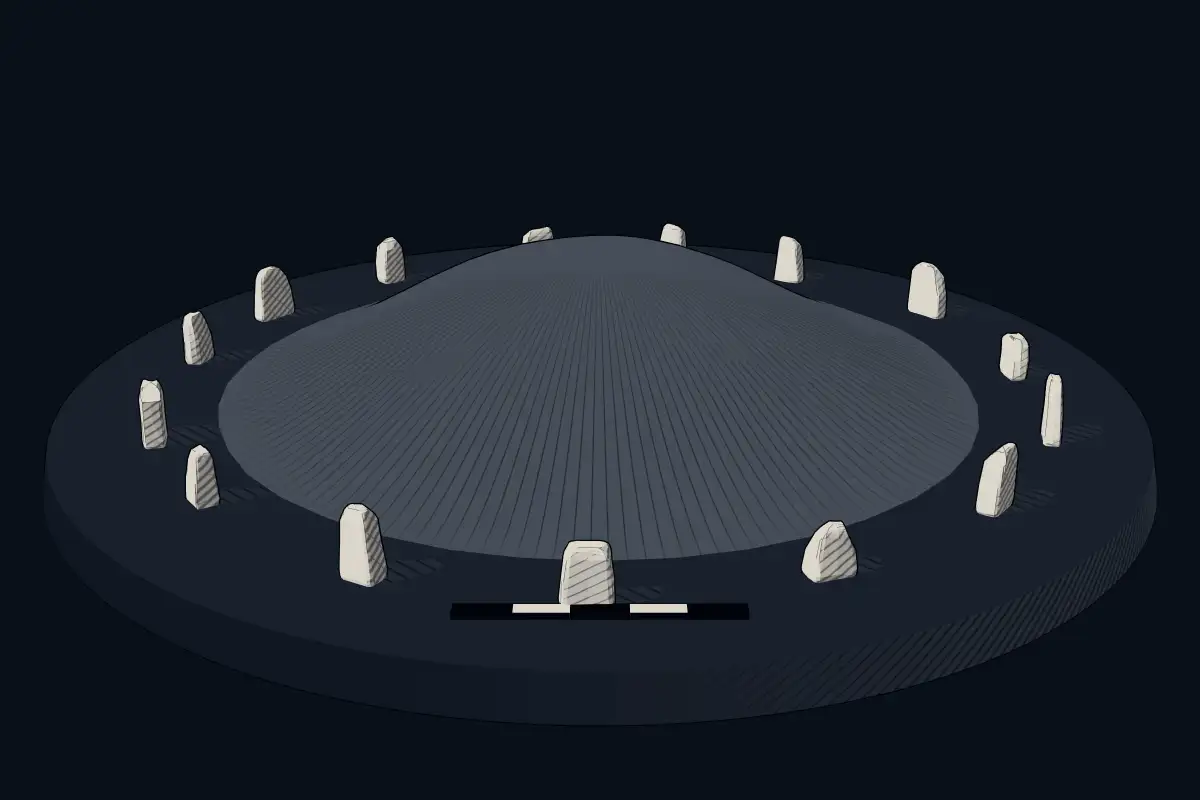
The reconstruction is ours, not a survey: it shows what a monument of this type looks like, at the size the record gives for this one.
Photographs
1 photograph, each with its author and licence
Lore
Evidence & Lore
What the sources actually support — and, kept apart, what has been claimed.
What the evidence supports
Dates
Est. 3500–500 BCEHow this date was established: Type comparisonTypical range for megalithic mounds in Germany; this site has not been dated itself. German barrows ( Hugelgraber) run from the Neolithic (construction in central and south-west Germany c. 3500 BC and northern and central Germany c. 3400 BC) to the Late Bronze and Iron Age.Source for this date
Where it stands
Germany
The pin marks the monument itself — its exact point.
- Coordinates
- 54°08′47″ N, 11°44′41″ EFor a GPS or map app: 54.14638, 11.74480
Access is as our sources describe it; we have not visited the site to check.
Nearby
The closest sites in the Atlas, by straight line.
 Großsteingrab Neu Gaarz 23500–2800 BCE
 Großsteingrab Mechelsdorf 33500–2800 BCE
 Großsteingrab Blengow3500–2800 BCE
 Großsteingrab Gaarzer Hof 13500–2800 BCE
 Ganggrab von Neu Gaarz3500–2800 BCE
- DolmenGroßsteingrab Roggentin3500–2800 BCE
- Megalithic tombGroßsteingrab Langen Trechow3500–2800 BCE
 Großsteingrab Katelbogen3500–2800 BCE


Sources
Every record behind this page, with the link it came from.
2 sources behind this page
- 01Wikidata Q101020026wikidata.org
- 02Source for this dateen.wikipedia.org
Image files
- Blocksberg in Kühlungsborn.jpgOlaf MeisterCC BY-SA 4.0
Report a correctionWrong date, name, photograph or source? Tell us and it will be put right.
Around this place
The ten nearest sites, by compass
- Großsteingrab Neu Gaarz 27.1 km SW
- Großsteingrab Mechelsdorf 37.4 km SW
- Großsteingrab Blengow8.1 km SW
- Großsteingrab Gaarzer Hof 18.3 km SW
- Ganggrab von Neu Gaarz8.5 km SW
- Großsteingrab Roggentin31 km E
- Großsteingrab Langen Trechow31 km SE
- Großsteingrab Katelbogen35 km S
- Großsteingrab Qualitz35 km S
- Großsteingrab Pennewitt35 km S
Credit
Text, licence and sources
Text from the Wikipedia article "Blocksberg (Kühlungsborn)" (German), licensed CC BY-SA 4.0; authors are listed in the page history. Reused under CC BY-SA 4.0. Read on Wikipedia · Edit history and authors