
Bexhövede dolmen
DatedEst. 3500–2800 BCE
Photo Einsamer Schütze · CC BY-SA 4.0Source file on Wikimedia Commons

Overview
About this site
Overview
The Großsteingräber bei Bexhövede, also called the Großsteingräber bei Dünenfähr, were two tombs of the Neolithic Funnel Beaker culture near Bexhövede, a village in the municipality of Loxstedt in the Landkreis Cuxhaven, Lower Saxony, Germany. Only one of them still exists. It carries the Sprockhoff number 619. Its date is given as 3500 to 2800 BCE, a typological estimate.
The surviving tomb has a mound 35 m in diameter, and a local legend associates it with dwarfs.
Read on Wikipedia3 min readCC BY-SA 4.0
Where it sits in time
The site's dated range, placed against world reference points.
The scale is logarithmic: each step to the left is about ten times older than the last.
Article
Bexhövede dolmen
Grave 1 lies on the south-western edge of Bexhövede, immediately next to the settlement of Dünenfähr.
SettingSources for this section
Sources for this section
Grave 1 lies on the south-western edge of Bexhövede, immediately next to the settlement of Dünenfähr. About one kilometre to the east, in the Steertmoor, there was originally a second tomb.
DescriptionSources for this section
Sources for this section
The surviving grave has a mound 35 m in diameter and 2 m high. Inside it lies a burial chamber oriented roughly north-east to south-west and 2 m wide; its length cannot be determined exactly. The stones are still deep in the soil, so that it is not possible to say how many of them are preserved. Two capstones are clearly visible. The south-western one is 2.2 m long, 3.5 m wide and 1.15 m thick. It rests on wall stones that project only a short way out of the ground: there appears to be one on the south-east side and apparently two on the north-west side. The north-eastern capstone is still deep in the soil, so that its exact dimensions cannot be determined.
ConservationSources for this section
Sources for this section
The south-western capstone has two rows of wedge holes, which date from a planned destruction of the tomb in 1840. This was averted at the last minute by the landowner von Hodenberg.
FolkloreSources for this section
Sources for this section
According to the legend ‘Die Zwerge von Dünenfähr’ (the dwarfs of Dünenfähr), Bexhövede grave 1 and two neighbouring tombs were regarded as the dwellings of dwarfs. The dwarfs were well disposed towards the local people and often repaired their broken metal tools, but for the repairs they frequently used metal stolen from the farmers. They liked in particular to lie in wait on a path that passed their dwellings and to steal the linchpins from passing carts.
One day a farmhand drove his cart past the spot and cracked his whip. The crack knocked the cap from the head of a dwarf, who thereby became visible. The dwarf would return the cap only in exchange for the stolen linchpins, but he had long since melted them down. He promised the farmhand a suitable reward, which he would find on his way home. The farmhand gave back the cap but found on the way back only a dead horse. He first thought the dwarfs had tricked him, but cut a piece of meat from the carcass as food for his dog. When he reached the farm he found that the meat had turned into pure gold. He returned at once to the place where the horse had lain, but it had disappeared without trace.
Tradition and region
About this kind of monument
German and Dutch Hünengräber (hunebedden)
The megalithic tombs of northern Germany and the Netherlands were built by the Funnel Beaker culture (about 4100 to 2800 BCE), and the style, called Nordic megalith architecture, emerged between 3500 and 2800 BCE. In the Netherlands the tombs are the hunebedden, built between 3470 and 3250 BCE by the western group of the Funnel Beaker culture and used until about 2760 BCE. Of an estimated 100 original tombs, 54 are preserved, 52 of them in the province of Drenthe and two in Groningen. After the Funnel Beaker culture ended the sites were reused by the Single Grave and Bell Beaker cultures in the Early Bronze Age and, to a lesser extent, into the Middle Ages.
In Mecklenburg-Vorpommern up to 5,000 megalith tombs were erected, and more than 1,000 are preserved and protected by law; they belong to the youngest and easternmost part of the western European tradition. Most are dolmens, often lying inside a circular or trapezoid frame of standing stones. Locally they are known as Hünengräber, "giants' tombs", or Großsteingräber, "large stone tombs"; the trapezoid frame is a Hünenbett, "giants' bed", and the circular one a Bannkreis. Between 1964 and 1974 Ewald Schuldt excavated over a hundred sites there and sorted them into simple dolmens, extended dolmens, passage graves, great dolmens, unchambered long barrows and stone cists.
Folklore: the German and Dutch names, with Hüne meaning "giant", carry the old idea that giants were buried here. This is a tradition; the stones were placed by Neolithic farmers.
When visiting, look for the capstones on their supports and the frame of kerbstones around them.
Paraphrased from Wikipedia: Megaliths in the Netherlands, Wikipedia: Megaliths in Mecklenburg-Vorpommern, Wikipedia: Nordic megalith architecture, Wikipedia: Funnel beaker culture, Wikipedia: Dolmen · CC BY-SA 4.0
See it in 3D
An interpretive reconstruction of the monument, standing on the real ground at its exact point, under the sun for that place and season. Drag to look around it.
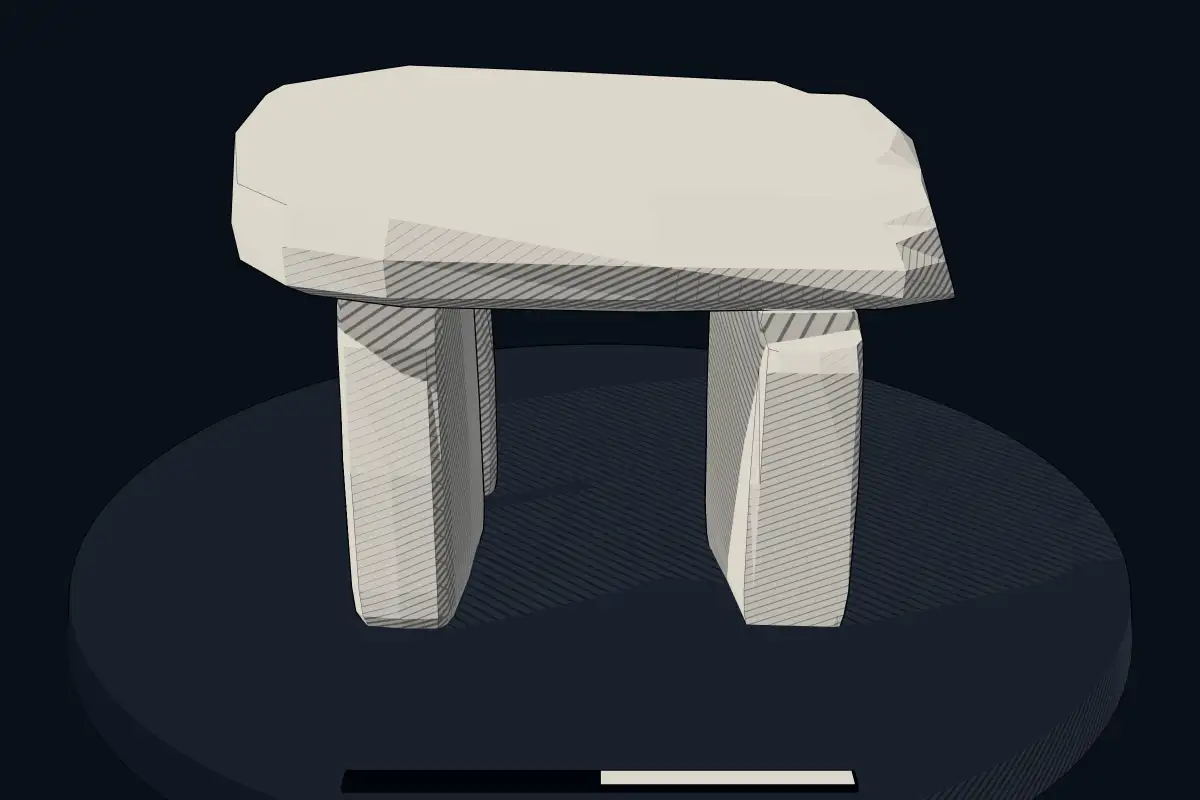
The reconstruction is ours, not a survey: it shows what a monument of this type looks like, at the size the record gives for this one.
Photographs
4 photographs, each with its author and licence
More photographs


Lore
Evidence & Lore
What the sources actually support — and, kept apart, what has been claimed.
What the evidence supports
Dates
Est. 3500–2800 BCEHow this date was established: Type comparisonTypical range for dolmens in Germany; this site has not been dated itself. German dolmens (Huengrab) belong to the Nordic megalith tradition which emerged predominantly between 3500 and 2800 BC.Source for this date
Where it stands
Germany
The pin marks the monument itself — its exact point.
- Coordinates
- 53°28′38″ N, 8°40′20″ EFor a GPS or map app: 53.47718, 8.67227
Access is as our sources describe it; we have not visited the site to check.
Nearby
The closest sites in the Atlas, by straight line.
 Steinkiste von Heerstedt3500–2800 BCE
 Großsteingrab Wittstedt3500–2800 BCE
- DolmenGroßsteingräber bei Bramstedt3500–2800 BCE
- Megalithic tombBokel megalithic tombs3500–2800 BCE
 Großsteingrab Axstedt3500–2800 BCE
 Großsteingrab Wehden3500–2800 BCE
 Großsteingrab Langen3500–2800 BCE
 Großsteingräber bei Steden3500–2800 BCE


Sources
Every record behind this page, with the link it came from.
2 sources behind this page
- 01Wikidata Q15813013wikidata.org
- 02Source for this dateen.wikipedia.org
Image files
- Großsteingrab Bexhövede 05.JPGEinsamer SchützeCC BY-SA 4.0
- Großsteingrab Bexhövede 01.JPGEinsamer SchützeCC BY-SA 4.0
- Großsteingrab Bexhövede 02.JPGEinsamer SchützeCC BY-SA 4.0
- Großsteingrab Bexhövede 03.JPGEinsamer SchützeCC BY-SA 4.0
Report a correctionWrong date, name, photograph or source? Tell us and it will be put right.
Lore, kept apart
Legends and claims
These are stories and claims reported by the sources. They are not evidence, and they never stand in for the dating above.
- Tradition
Das Grab Bexhövede 1 und zwei benachbarte Anlagen wurden gemäß der Sage Die „Zwerge von Dünenfähr“ als Wohnungen von Zwergen angesehen.
Das Grab Bexhövede 1 und zwei benachbarte Anlagen wurden gemäß der Sage Die „Zwerge von Dünenfähr“ als Wohnungen von Zwergen angesehen. Diese waren den Einheimischen wohlgesinnt und reparierten oft deren zerbrochene Metallgeräte. Für die Reparatur verwendeten sie aber häufig Metall, das sie den Bauern stahlen. Besonders gerne lauerten sie an einem Weg, der an ihren Wohnstätten vorbeiführte und entwendeten die Achsnägel aus vorbeifahrenden Gespannen. Eines Tages kam ein Knecht mit seinem Wagen an dieser Stelle vorbei und ließ seine Peitsche knallen. Daraufhin wurde ein Zwerg sichtbar, denn der Kecht hatte ihm mit dem Peitschenknall die Mütze vom Kopf gerissen. Er wollte diese nun nur im Austausch gegen die gestohlenen Achsnägel zurückgeben, doch diese hatte der Zwerg längst eingeschmolzen. Er versprach dem Knecht aber stattdessen eine angemessene Belohnung, die er auf dem Heimweg finden würde. Der Knecht gab daraufhin die Mütze zurück, fand auf dem Rückweg aber nur ein totes Pferd. Er dachte zunächst, die Zwerge hätten ihn hereingelegt, schnitt aber dann ein Stück Fleisch als Hundefutter aus dem Kadaver. Als er den Hof erreichte, stellte er plötzlich fest, dass das Fleisch sich in pures Gold verwandelt hatte. Er kehrte sofort an die Stelle zurück, wo das Pferd gelegen hatte, aber dieses war spurlos verschwunden.
Source
Around this place
The ten nearest sites, by compass
- Steinkiste von Heerstedt6.7 km E
- Großsteingrab Wittstedt8.6 km S
- Großsteingräber bei Bramstedt11 km S
- Bokel megalithic tombs12 km S
- Großsteingrab Axstedt14 km S
- Großsteingrab Wehden14 km N
- Großsteingrab Langen14 km N
- Großsteingräber bei Steden19 km SE
- Großsteingrab Lehnstedt 220 km S
- Vorgeschichtspfad Flögeln21 km NE
Credit
Text, licence and sources
Adapted from the Wikipedia article "Großsteingräber bei Bexhövede" (German), licensed CC BY-SA 4.0; authors are listed in the page history. Reused under CC BY-SA 4.0. Read on Wikipedia · Edit history and authors