
Stone circle in Fan Lau
Also known asFan Lau Stone Circle
Photo ( Father Vice (惡德神父) ) · CC BY-SA 3.0Source file on Wikimedia Commons
Overview
About this site
What the sources say
分流石圓環是香港一個石器時代晚期至青銅時代的遺跡,位於新界大嶼山西南的分流,於1983年4月15日被列為香港法定古蹟。
分流石圓環是一組長2.7米、寬1.7米的橢圓形結構,由約20塊未經琢磨的石塊刻意堆疊而成,排列有序。堆疊石圓環的目的難以稽考,考古學家估計是與祭祀儀式有關。
Article in ChineseRead on Wikipedia1 min readCC BY-SA 4.0
The full article
Stone circle in Fan Lau: the whole story
Summary in EnglishSources for this section
- Wikipedia (Chinese): 分流石圓環CC BY-SA 4.0
Sources for this section
- Wikipedia (Chinese): 分流石圓環CC BY-SA 4.0
Stone circle in Fan Lau is a stone circle in Hong Kong, People's Republic of China. Wikidata describes it as: prehistoric stone circle in Hong Kong. No English Wikipedia article exists for it; the full text below is the Chinese article "分流石圓環", shown in the original language.
外部連結Sources for this section
- Wikipedia (Chinese): 分流石圓環CC BY-SA 4.0
Sources for this section
- Wikipedia (Chinese): 分流石圓環CC BY-SA 4.0
康樂及文化事務署 - 分流石圓環 (页面存档备份,存于互联网档案馆)
Tradition and region
About this kind of monument
Stone circles in other regions
Stone circles are found far beyond their north-western European heartland. The most famous Asian example is the Ōyu Stone Circles in Kazuno, Akita Prefecture, in northern Japan, a late Jōmon period site of about 2000 to 1500 BCE. It consists of two large stone circles built on an artificially flattened plateau on the left bank of the Ōyu River. The site was discovered in 1931, excavated in detail in 1946 and in 1951 to 1952, and designated a Special National Historic Site in 1956. Each circle is made of rounded river stones brought from a river about 7 kilometres away, set in two concentric rings. The larger, called Manza, is the largest stone circle found in Japan; its clusters of stones have been read as a sundial pointing to the summer solstice sunset.
The word cromlech is also applied to large stone circles such as those in Odry in Poland and among the Carnac stones in Brittany, and in many languages, including Azerbaijani, Armenian, Greek, Indonesian, Italian and Spanish, it is the usual term for a megalithic stone circle. Odry is the Polish cromlech. Elsewhere in Europe the Atlas has small numbers of circles in the Czech Republic, Bulgaria and Germany. Some structures are called stone circles for historic reasons or by mistake, so labels need care. The Senegambian stone circles of West Africa have their own article.
Often similar structures are called stone circles by historic habit or by mistake, and the name alone does not show that a ring is prehistoric. The Atlas does not guess, and gives each circle the range of the culture it belongs to.
When visiting, compare the circle with the landscape, and look at what is visible from its centre.
Paraphrased from Wikipedia: Ōyu Stone Circles, Wikipedia: Stone circle, Wikipedia: Cromlech · CC BY-SA 4.0
See it in 3D
An interpretive reconstruction of the monument, standing on the real ground at its exact point, under the sun for that place and season. Drag to look around it.
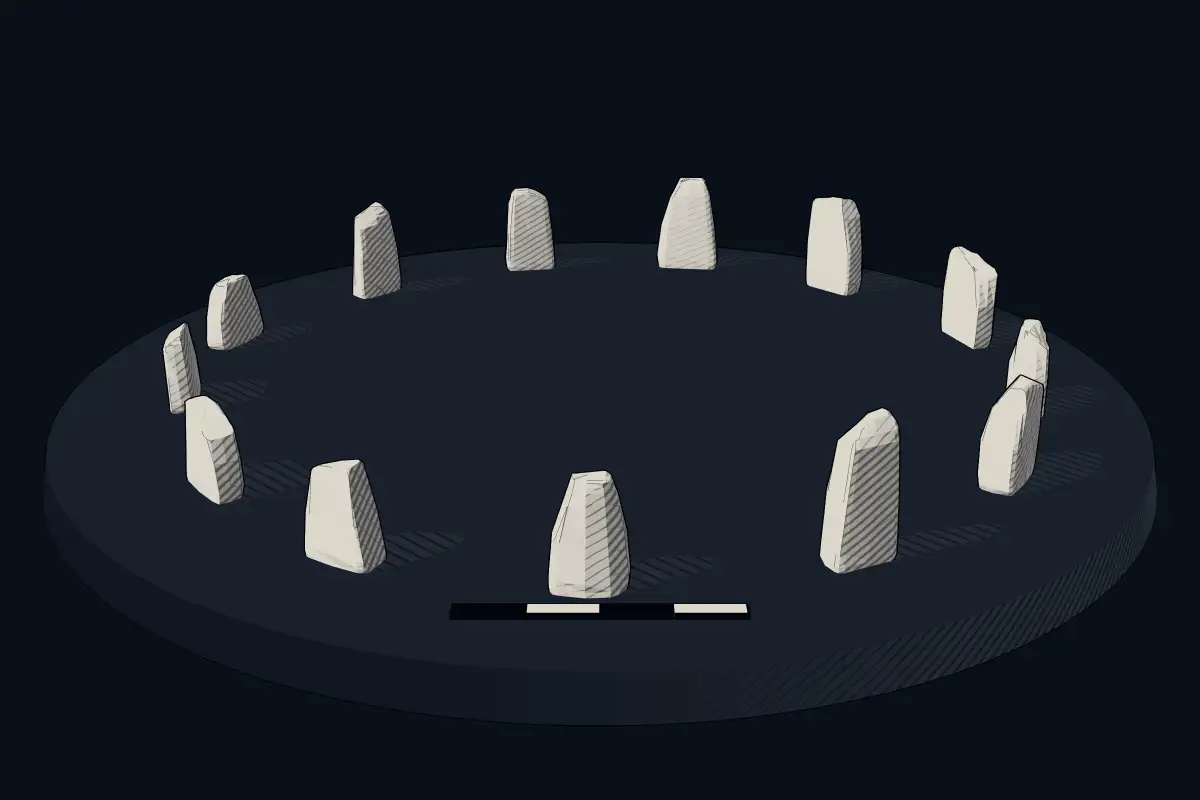
The reconstruction is ours, not a survey: it shows what a monument of this type looks like, at the size the record gives for this one.
Photographs
1 photograph, each with its author and licence
Where it stands
People's Republic of China
The pin marks the monument itself — its exact point.
- Coordinates
- 22°11′52″ N, 113°50′53″ EFor a GPS or map app: 22.19773, 113.84801
Access is as our sources describe it; we have not visited the site to check.
Nearby
The closest sites in the Atlas, by straight line.


Sources
Every record behind this page, with the link it came from.
1 source behind this page
- 01Wikidata Q7618897wikidata.org
Image files
- Stone Circle at Fan Lau.JPG( Father Vice (惡德神父) )CC BY-SA 3.0
Report a correctionWrong date, name, photograph or source? Tell us and it will be put right.
Around this place
The ten nearest sites, by compass
Credit
Text, licence and sources
Text from the Wikipedia article "分流石圓環" (Chinese), licensed CC BY-SA 4.0; authors are listed in the page history. Reused under CC BY-SA 4.0. Read on Wikipedia · Edit history and authors
- Wikipedia (Chinese): 分流石圓環CC BY-SA 4.0
- Wikidata Q7618897CC0