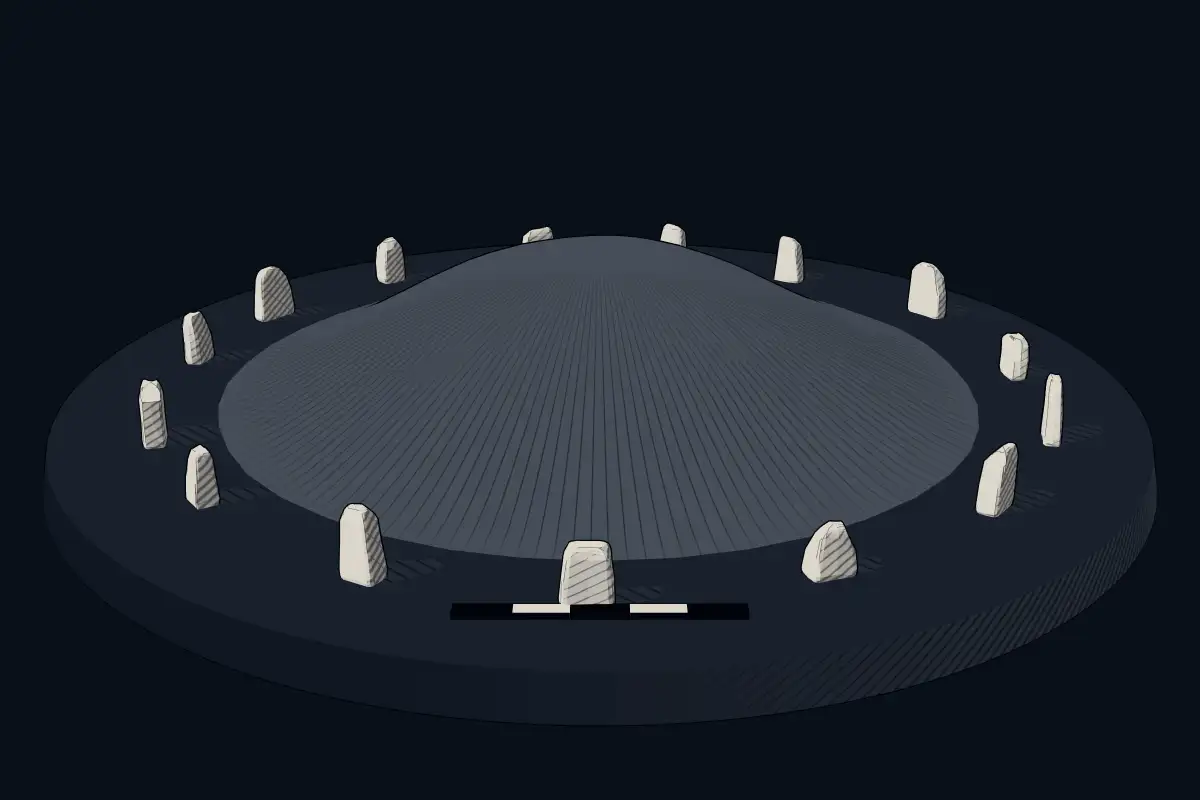
Megalithic mound (tumulus with integral stones)
Terrein waarin grafheuvel #45942
DatedEst. 4000–2000 BCE
No licensed photograph yetWe have no photograph we may publish for this site, so the interpretive 3D view leads instead.
Overview
About this site
Overview
Terrein waarin grafheuvel #45942 is a megalithic mound in Bergeijk, Belgium. It lies at 51.3444° N, 5.3560° E.
Catalogue recordSources and licences
Where it sits in time
The site's dated range, placed against world reference points.
The scale is logarithmic: each step to the left is about ten times older than the last.
Article
Terrein waarin grafheuvel #45942
ContextSources for this section
- en.wikipedia.orgCC BY-SA 4.0
- en.wikipedia.orgCC BY-SA 4.0
- en.wikipedia.orgCC BY-SA 4.0
- en.wikipedia.orgCC BY-SA 4.0
- en.wikipedia.orgCC BY-SA 4.0
Sources for this section
- en.wikipedia.orgCC BY-SA 4.0
- en.wikipedia.orgCC BY-SA 4.0
- en.wikipedia.orgCC BY-SA 4.0
- en.wikipedia.orgCC BY-SA 4.0
- en.wikipedia.orgCC BY-SA 4.0
Round barrows are found across the Low Countries and France. Many were raised in the Late Neolithic and the Bronze Age. The Bell Beaker phenomenon of the late third millennium BCE brought a new burial rite to western Europe: individual burials, often under a tumulus and with weapons, in contrast to the collective, weaponless burials of the earlier Neolithic. The Dutch hunebedden, the megalithic tombs of the north, belong to the earlier tradition and are described in their own article. The regional background, “Low Countries and French barrows”, is given below.
DatingSources for this section
- en.wikipedia.orgCC BY-SA 4.0
Sources for this section
- en.wikipedia.orgCC BY-SA 4.0
No scientific date has been published for this site. Monuments of this type in Belgium are generally dated 4000 BCE to 2000 BCE; the site itself may fall inside or outside that range.
Belgian barrows: the tumuli of Weris in the Belgian Luxembourg date from the 4th and 3rd millennia BC and the tumulus of Court-Saint-Etienne to around 3,000 BC.
Setting
20 other recorded monuments lie within 10 km (1 within 1 km, 6 within 5 km), 20 of them of the same type. In Bergeijk, Belgium, 5 of the 5 recorded monuments are of this type.
The nearest recorded monuments are Terrein waarin drie grafheuvels en een urnenveld (0.7 km south-east, megalithic mound); Terrein waarin twee grafheuvels en een urnenveld (1.4 km north, megalithic mound); Terrein waarin 4 grafheuvels (1.6 km south, megalithic mound); Terrein waarin grafheuvels en urnenveld (4.6 km north, megalithic mound).
ProtectionSources for this section
Sources for this section
Heritage status: Rijksmonument.
Tradition and region
About this kind of monument
Low Countries and French barrows
Round barrows are found across the Low Countries and France. Many were raised in the Late Neolithic and the Bronze Age. The Bell Beaker phenomenon of the late third millennium BCE brought a new burial rite to western Europe: individual burials, often under a tumulus and with weapons, in contrast to the collective, weaponless burials of the earlier Neolithic. The Dutch hunebedden, the megalithic tombs of the north, belong to the earlier tradition and are described in their own article.
Round barrows are hemispherical mounds raised over a central burial, which may be an inhumation or a cremation placed in a vessel. Barrows were often reused: later graves were cut into the mound, sometimes long after the first burial, and many attract satellite burials. In France and Belgium, tumuli of the Hallstatt period belong to the early Iron Age, from about 800 BCE; from phase B of the Hallstatt sequence, tumulus burial becomes common and cremation predominates.
Dating relies on pottery and metalwork, and on radiocarbon dating where a mound has been dug. Many have been ploughed down, so the Atlas map reflects where mounds survived and were recorded as much as where they were built.
When visiting, look for the surrounding ditch or kerb, and for a later disturbance at the centre where a later grave or an old digging has cut the mound.
Paraphrased from Wikipedia: Tumulus, Wikipedia: Round barrow, Wikipedia: Bell Beaker culture, Wikipedia: Hallstatt culture, Wikipedia: Hunebed · CC BY-SA 4.0
See it in 3D
An interpretive reconstruction of the monument, standing on the real ground at its exact point, under the sun for that place and season. Drag to look around it.
The reconstruction is ours, not a survey: it shows what a monument of this type looks like, at the size the record gives for this one.
Lore
Evidence & Lore
What the sources actually support — and, kept apart, what has been claimed.
What the evidence supports
Dates
Est. 4000–2000 BCEHow this date was established: Type comparisonTypical range for megalithic mounds in Belgium; this site has not been dated itself. Belgian barrows: the tumuli of Weris in the Belgian Luxembourg date from the 4th and 3rd millennia BC and the tumulus of Court-Saint-Etienne to around 3,000 BC.Source for this date
Where it stands
Belgium
The pin marks the monument itself — its exact point.
- Coordinates
- 51°20′40″ N, 5°21′22″ EFor a GPS or map app: 51.34439, 5.35598
Access is as our sources describe it; we have not visited the site to check.
Nearby
The closest sites in the Atlas, by straight line.
- Megalithic mound (tumulus with integral stones)Terrein waarin drie grafheuvels en een urnenveld4000–2000 BCE
- Megalithic mound (tumulus with integral stones)Terrein waarin twee grafheuvels en een urnenveld4000–2000 BCE
- Megalithic mound (tumulus with integral stones)Terrein waarin 4 grafheuvels4000–2000 BCE
 Terrein waarin grafheuvels en urnenveld4000–2000 BCE
 Terrein waarin grafheuvel #5250304000–2000 BCE
- Megalithic mound (tumulus with integral stones)Tumulus Gendersteyn4000–2000 BCE
 Terrein waarin 2 grafheuvels4000–2000 BCE
- Megalithic mound (tumulus with integral stones)Terrein waarin tien grafheuvels, een brede aarden wal en mogelijk een urnenveld4000–2000 BCE


Sources
Every record behind this page, with the link it came from.
2 sources behind this page
- 01Wikidata Q17454339wikidata.org
- 02Source for this dateen.wikipedia.org
Report a correctionWrong date, name, photograph or source? Tell us and it will be put right.
Around this place
The ten nearest sites, by compass
- Terrein waarin drie grafheuvels en een urnenveld0.7 km SE
- Terrein waarin twee grafheuvels en een urnenveld1.4 km N
- Terrein waarin 4 grafheuvels1.6 km S
- Terrein waarin grafheuvels en urnenveld4.6 km N
- Terrein waarin grafheuvel #5250304.6 km N
- Tumulus Gendersteyn4.6 km N
- Terrein waarin 2 grafheuvels5.1 km N
- Terrein waarin tien grafheuvels, een brede aarden wal en mogelijk een urnenveld5.6 km NE
- Tumuli Huismeer6.8 km N
- Terrein waarin 2 grafheuvels en een urnenveld7.7 km NW
Credit
Text, licence and sources
Compiled from open records (Wikidata, CC0; OpenStreetMap, ODbL) and a regional background article based on Wikipedia (CC BY-SA 4.0).
- Wikidata Q17454339CC0
- en.wikipedia.orgCC BY-SA 4.0
- en.wikipedia.orgCC BY-SA 4.0
- en.wikipedia.orgCC BY-SA 4.0
- en.wikipedia.orgCC BY-SA 4.0
- en.wikipedia.orgCC BY-SA 4.0