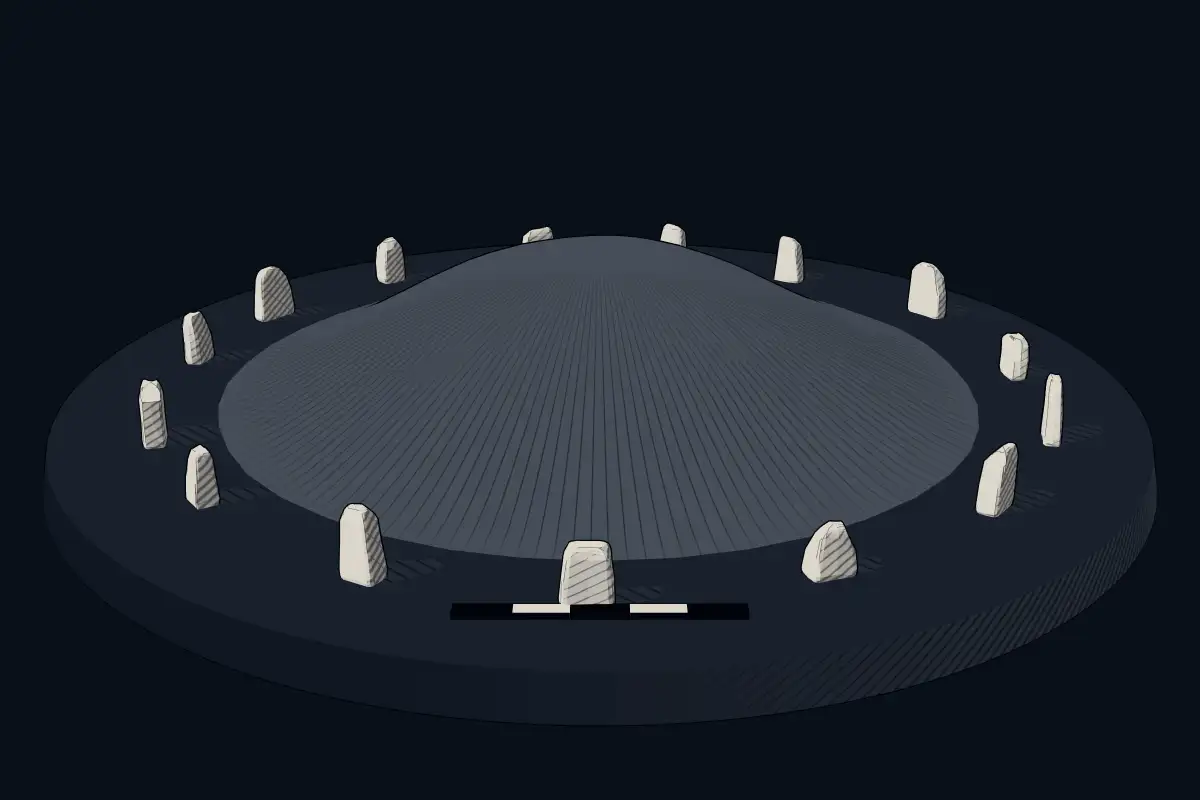
Megalithic mound (tumulus with integral stones)
Səfikürd kurqanı
No licensed photograph yetWe have no photograph we may publish for this site, so the interpretive 3D view leads instead.
Overview
About this site
What the sources say
Səfikürd kurqanı is a megalithic mound in Goranboy District, Azerbaijan. In open records it appears as Wikidata item Q140658792, mapped at 40.5303° N, 46.7886° E.
Built from structured records, not from an articleSources and licences
The full article
About Səfikürd kurqanı
This kind of monument hereSources for this section
- en.wikipedia.orgCC BY-SA 4.0
- en.wikipedia.orgCC BY-SA 4.0
- en.wikipedia.orgCC BY-SA 4.0
- en.wikipedia.orgCC BY-SA 4.0
- en.wikipedia.orgCC BY-SA 4.0
Sources for this section
- en.wikipedia.orgCC BY-SA 4.0
- en.wikipedia.orgCC BY-SA 4.0
- en.wikipedia.orgCC BY-SA 4.0
- en.wikipedia.orgCC BY-SA 4.0
- en.wikipedia.orgCC BY-SA 4.0
A kurgan is a burial mound built over a grave, often a single body with grave vessels, weapons and horses. Originally in use on the Pontic-Caspian steppe, kurgans spread across Central Asia and Eastern, Southeast, Western and Northern Europe during the third millennium BCE. The earliest date to the fourth millennium BCE in the Caucasus, and the Maykop culture there is one of the early sources. Some researchers associate early kurgans with the Indo-Europeans, a debated link; the Yamnaya culture of the steppe is the best known of the steppe cultures that built them. The word comes from a Turkic term meaning fortified place, embankment or high grave. The full article, “Eurasian kurgans”, follows below under About this kind of monument.
Dating
This site is undated in the open records the Atlas draws on, and the Atlas does not guess a date for it. Where a regional range exists for this kind of monument it is given in the notes on this page, as background and not as a date for this site.
Landscape and neighbours
Within 10 km lie 3 other catalogued sites (0 within 1 km, 0 within 5 km); 3 of them are also classed as megalithic mound. In Goranboy District, Azerbaijan, 7 of the 7 catalogued sites are classed as megalithic mound.
The nearest neighbours in the catalogue are Kurqanlar (7.0 km south-west, megalithic mound); Kurqanlar (7.1 km south-west, megalithic mound); Hacılı Qobusu kurqanları (8.8 km south, megalithic mound); Borsunlu kurqanları (11.5 km south-east, megalithic mound). The catalogue is assembled from open records and is not complete, so unrecorded monuments may lie closer.
Records and protectionSources for this section
Sources for this section
Wikidata lists the site with the heritage status cultural heritage monument in Azerbaijan. The open records for it are Wikidata (Q140658792), where corrections and further identifiers can be added. Access varies from open common land to private fields; check local access rules, ask where needed, and take care not to damage the monument.
How this page was madeSources for this section
Sources for this section
This page was built automatically from Wikidata (CC0), the heritage register named above and the regional article “Eurasian kurgans”, written for the Atlas from the Wikipedia articles it cites (CC BY-SA 4.0), plus distances and counts computed from the catalogue coordinates. It contains no AI-written text.
Tradition and region
About this kind of monument
Eurasian kurgans
A kurgan is a burial mound built over a grave, often a single body with grave vessels, weapons and horses. Originally in use on the Pontic-Caspian steppe, kurgans spread across Central Asia and Eastern, Southeast, Western and Northern Europe during the third millennium BCE. The earliest date to the fourth millennium BCE in the Caucasus, and the Maykop culture there is one of the early sources. Some researchers associate early kurgans with the Indo-Europeans, a debated link; the Yamnaya culture of the steppe is the best known of the steppe cultures that built them. The word comes from a Turkic term meaning fortified place, embankment or high grave.
Kurgans were built in the Eneolithic, the Bronze and Iron Ages, antiquity and the Middle Ages, and the tradition is still alive in southern Siberia and Central Asia. The Scythian kurgans of Ukraine and the Pazyryk burials of the Altai are the most famous. The Pazyryk culture, of the sixth to third centuries BCE, buried people under mounds; in the Siberian permafrost the mummies and artefacts were preserved, because the frozen ground kept the burial chambers cold.
Kurgans are dated by their contents, by radiocarbon dating and, where timbers survive, by tree rings.
The Atlas's records in Azerbaijan, Ukraine and Russia are mostly mounds recorded in archaeological registers. Where a mound has not been excavated, its dating is a range based on form.
When visiting, look for mounds standing alone on the skyline, a sign of a burial placed to be seen from afar, and for groups strung out along a ridge or an old route.
Paraphrased from Wikipedia: Kurgan, Wikipedia: Yamnaya culture, Wikipedia: Scythians, Wikipedia: Pazyryk culture, Wikipedia: Maykop culture · CC BY-SA 4.0
See it in 3D
An interpretive reconstruction of the monument, standing on the real ground at its exact point, under the sun for that place and season. Drag to look around it.
The reconstruction is ours, not a survey: it shows what a monument of this type looks like, at the size the record gives for this one.
Where it stands
Azerbaijan
The pin marks the monument itself — its exact point.
- Coordinates
- 40°31′49″ N, 46°47′19″ EFor a GPS or map app: 40.53035, 46.78861
Access is as our sources describe it; we have not visited the site to check.
Nearby
The closest sites in the Atlas, by straight line.
- Megalithic mound (tumulus with integral stones)Kurqanlar
- Megalithic mound (tumulus with integral stones)Kurqanlar
- Megalithic mound (tumulus with integral stones)Hacılı Qobusu kurqanları
 Borsunlu kurqanları
- Megalithic mound (tumulus with integral stones)Kurqan
- Megalithic mound (tumulus with integral stones)Kurqan
- Megalithic mound (tumulus with integral stones)Kurqanlar (3 ədəd)
- Megalithic mound (tumulus with integral stones)Xoşbulaq Kurgan

Sources
Every record behind this page, with the link it came from.
1 source behind this page
- 01Wikidata Q140658792wikidata.org
Report a correctionWrong date, name, photograph or source? Tell us and it will be put right.
Around this place
The ten nearest sites, by compass
Credit
Text, licence and sources
This page is assembled from open records (Wikidata, CC0; OpenStreetMap, ODbL) and a tradition article paraphrasing Wikipedia (CC BY-SA 4.0). No article exists for this site, and nothing here is written by a model.
- Wikidata Q140658792CC0
- en.wikipedia.orgCC BY-SA 4.0
- en.wikipedia.orgCC BY-SA 4.0
- en.wikipedia.orgCC BY-SA 4.0
- en.wikipedia.orgCC BY-SA 4.0
- en.wikipedia.orgCC BY-SA 4.0