Megalithic mound (tumulus with integral stones)
Çoban Qurban oğlu kurqanı
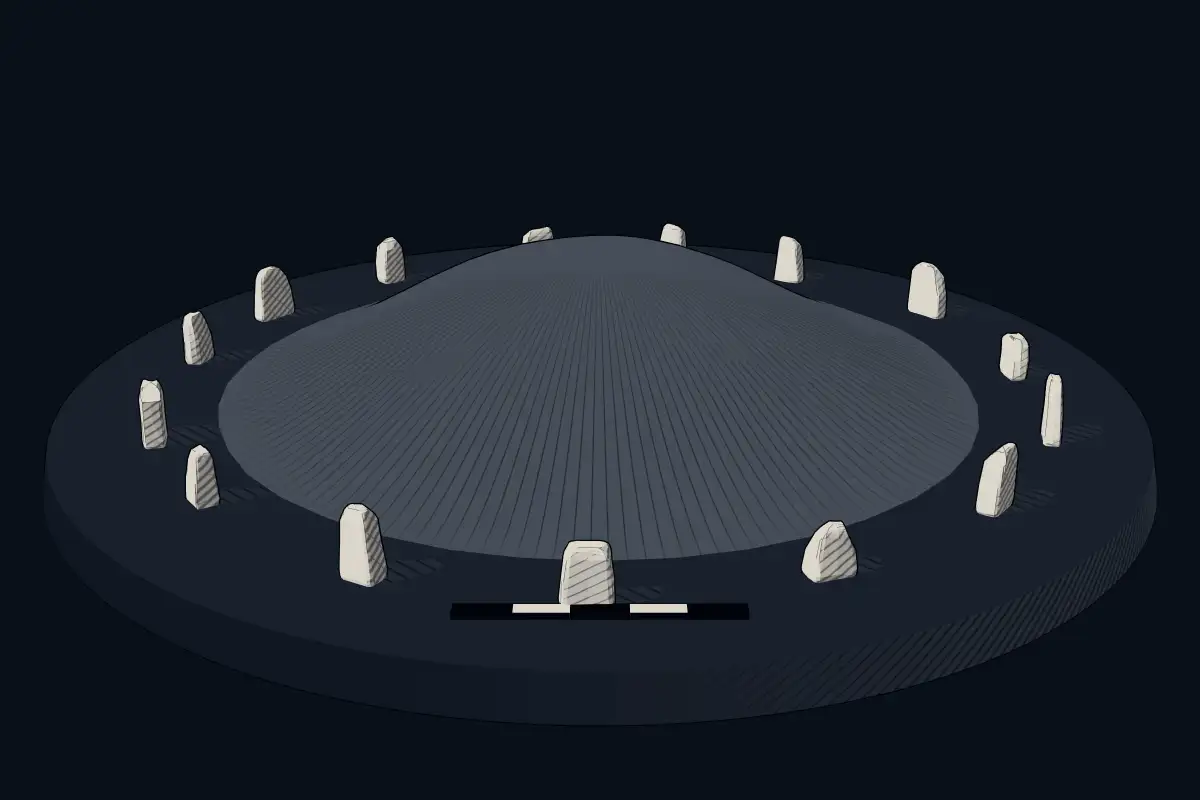
No licensed photograph yetWe have no photograph we may publish for this site, so the interpretive 3D view leads instead.
Overview
About this site
Overview
The Çoban Qurban oğlu kurgan (Çoban Qurban oğlu kurqanı, also written Çoban Qurbanoğlu Kurqanı) is a burial mound in the Qazax District of Azerbaijan, in the territory of Daş Salahlı village. It is an archaeological monument of national significance and belongs to the Late Bronze Age and Early Iron Age.
The mound is 1.5 metres high and 4 metres in diameter. It lies within the Avey State History and Culture Reserve and is under state protection.
Read on Wikipedia2 min readCC BY-SA 4.0
Article
Çoban Qurban oğlu kurqanı
The kurgan stands in the area of Daş Salahlı village known as Xəzallının Ağzı, around the tomb of Çoban Qurbanoğlu, within the Avey State History and Culture Reserve.
SettingSources for this section
Sources for this section
The kurgan stands in the area of Daş Salahlı village known as Xəzallının Ağzı, around the tomb of Çoban Qurbanoğlu, within the Avey State History and Culture Reserve. A large kurgan is also reported on the right-hand side of the road at the entrance to the village. Daş Salahlı is also the site of a Palaeolithic cave of the same name, which is one of the region's ancient places of settlement.
Research historySources for this section
Sources for this section
The mound was discovered and recorded in 1961 during research by the Qazax archaeological expedition. That work also revealed Bronze Age settlement sites and many kurgans built of stone and earth.
DatingSources for this section
Sources for this section
The kurgan and the other mounds around it are dated to the end of the second millennium BCE and the beginning of the first millennium BCE, that is, the Late Bronze Age and Early Iron Age. The Bronze and Early Iron Ages are described as the final stage of the primitive communal social order on the territory of Azerbaijan.
DescriptionSources for this section
Sources for this section
The kurgans of the group are oval or round in plan. Their heights range from about 0.6 metres to 1.5 metres, and their diameters from 4 metres to more than 60 metres for the large examples. They consist of a heap of stones and dark earth.
ConservationSources for this section
Sources for this section
The Daş Salahlı kurgan is among the immovable historical and cultural monuments placed under state protection by Decision No. 132 of the Cabinet of Ministers of the Republic of Azerbaijan, dated 2 August 2001. Its registration number is 1252.
ContextSources for this section
Sources for this section
A kurgan is a burial mound built over a grave, often of a single body with grave vessels, weapons and horses. Kurgans originated on the Pontic-Caspian steppe and spread across Central Asia and Europe during the third millennium BCE; the earliest in the Caucasus date to the fourth millennium BCE. The word comes from a Turkic term meaning fortified place, embankment or high grave. Some researchers associate early kurgans with the Indo-Europeans, a debated link.
Tradition and region
About this kind of monument
Eurasian kurgans
A kurgan is a burial mound built over a grave, often a single body with grave vessels, weapons and horses. Originally in use on the Pontic-Caspian steppe, kurgans spread across Central Asia and Eastern, Southeast, Western and Northern Europe during the third millennium BCE. The earliest date to the fourth millennium BCE in the Caucasus, and the Maykop culture there is one of the early sources. Some researchers associate early kurgans with the Indo-Europeans, a debated link; the Yamnaya culture of the steppe is the best known of the steppe cultures that built them. The word comes from a Turkic term meaning fortified place, embankment or high grave.
Kurgans were built in the Eneolithic, the Bronze and Iron Ages, antiquity and the Middle Ages, and the tradition is still alive in southern Siberia and Central Asia. The Scythian kurgans of Ukraine and the Pazyryk burials of the Altai are the most famous. The Pazyryk culture, of the sixth to third centuries BCE, buried people under mounds; in the Siberian permafrost the mummies and artefacts were preserved, because the frozen ground kept the burial chambers cold.
Kurgans are dated by their contents, by radiocarbon dating and, where timbers survive, by tree rings.
The Atlas's records in Azerbaijan, Ukraine and Russia are mostly mounds recorded in archaeological registers. Where a mound has not been excavated, its dating is a range based on form.
When visiting, look for mounds standing alone on the skyline, a sign of a burial placed to be seen from afar, and for groups strung out along a ridge or an old route.
Paraphrased from Wikipedia: Kurgan, Wikipedia: Yamnaya culture, Wikipedia: Scythians, Wikipedia: Pazyryk culture, Wikipedia: Maykop culture · CC BY-SA 4.0
From the article
Dated moments in the story
- 1252
Onun qeydiyyat nömrəsi 1252-dir.
Source - 1961
1961-ci ildə Aparılan tədqiqat işləri bunu təsdiqləyir.
Source - 1961
1961-ci ildə Qazax arxeoloji ekspedisyasının apardığı tədqiqatlar zamanı aşkar edilmiş və qeydə alınmışdır.
Source - 2001
Onlar çoxlu daş və qaratorpaq töküntüsündən ibarətdir. Əhəmiyyəti: Daş Salahlı kurqanı, Azərbaycan Respublikası Nazirlər Kabinetinin 2 avqust 2001-ci il tarixli 132 nömrəli qərarı ilə təsdiq edilmiş və Dövlət mühafizəsinə götürülmüş Daşınmaz Tarix və Mədəniyyət abidələrindən biridir.
Source - 2001
Çoban Qurbanoğlu kurqanı Azərbaycan Respublikası Nazirlər Kabinetinin 2 avqust 2001-ci il tarixli 132 nömrəli qərarı ilə təsdiq edilmiş və Dövlət mühafizəsinə götürülmüş Daşınmaz Tarix və Mədəniyyət abidələrindən biridir.
Source
See it in 3D
An interpretive reconstruction of the monument, standing on the real ground at its exact point, under the sun for that place and season. Drag to look around it.
The reconstruction is ours, not a survey: it shows what a monument of this type looks like, at the size the record gives for this one.
Where it stands
Azerbaijan
The pin marks the monument itself — its exact point.
- Coordinates
- 41°09′47″ N, 45°15′04″ EFor a GPS or map app: 41.16296, 45.25116
Access is as our sources describe it; we have not visited the site to check.
Nearby
The closest sites in the Atlas, by straight line.
- Megalithic mound (tumulus with integral stones)Daşlı çökək kurqanları (6 ədəd)
- Megalithic mound (tumulus with integral stones)Ağdərə kurqanları (2 ədəd)
- Megalithic mound (tumulus with integral stones)Yovşanlıtəpə kurqanları
- Megalithic mound (tumulus with integral stones)Kurqanlar
- Megalithic mound (tumulus with integral stones)Bərkin ağzı kurqanları
- Megalithic mound (tumulus with integral stones)Kurqanlar (3 ədəd)
- Megalithic mound (tumulus with integral stones)Daş Salahlı kurqanı
- Megalithic mound (tumulus with integral stones)Xoşbulaq Kurgan
Sources
Every record behind this page, with the link it came from.
1 source behind this page
- 01Wikidata Q140659091wikidata.org
Report a correctionWrong date, name, photograph or source? Tell us and it will be put right.
Around this place
The ten nearest sites, by compass
Credit
Text, licence and sources
Adapted from the Wikipedia article "Çoban Qurban oğlu kurqanı" (Azerbaijani), licensed CC BY-SA 4.0; authors are listed in the page history. Reused under CC BY-SA 4.0. Read on Wikipedia · Edit history and authors