
Megalithic mound (tumulus with integral stones)
Borsunlu kurqanları
Photo Xayala Mammadli · CC BY-SA 4.0Source file on Wikimedia Commons

Overview
About this site
Overview
The Borsunlu kurgans (Borsunlu kurqanları, also called the Borsunlu necropolis) are a group of Bronze Age and Early Iron Age burial mounds about 0.5 km north-east of the village of Borsunlu, on the right bank of the İncəçay (Incha) river in Tartar District, Azerbaijan. Systematic excavations between 1981 and 1987 studied 35 monuments there, among them 32 kurgans.
The necropolis is the only monument in Karabakh where the development of culture can be followed from the beginning of the 3rd millennium BCE to the middle of the 1st millennium BCE.
Read on Wikipedia6 min readCC BY-SA 4.0
Article
Borsunlu kurqanları
The necropolis occupies a wide area in the middle course of the İncəçay basin, where the river leaves a deep valley and spreads out over the plain in a fan-shaped zone.
SettingSources for this section
- Wikipedia (Azerbaijani): Borsunlu nekropoluCC BY-SA 4.0
Sources for this section
- Wikipedia (Azerbaijani): Borsunlu nekropoluCC BY-SA 4.0
The necropolis occupies a wide area in the middle course of the İncəçay basin, where the river leaves a deep valley and spreads out over the plain in a fan-shaped zone. The village of Borsunlu lies where the hills of the Karabakh mountains fall away on the west, south and east and give way to the plain. The hills are divided into islands by gullies running towards the plain.
The kurgans lie in separate groups, on both banks of the İncəçay. Groups on the left bank include Gen dərə, and groups on the right bank include Göllər, Narlı dərə and Şorsu. Each group typically has one or two large mounds surrounded by small and medium ones. The large central mounds are interpreted as the burials of wealthy members of the tribe and the surrounding ones as those of ordinary members, a pattern said to hold for all stages of the Bronze Age.
DescriptionSources for this section
- Wikipedia (Azerbaijani): Borsunlu nekropoluCC BY-SA 4.0
Sources for this section
- Wikipedia (Azerbaijani): Borsunlu nekropoluCC BY-SA 4.0
The mound covers consist of earth, stone, or a mixture of the two. Most are built of a mixture of earth and fine gravel, and some of gravel and river stones. As a rule they are surrounded by a cromlech (a ring wall) of one or two rows of stones.
Hidayət Cəfərov, who studied a group of the kurgans, divided them into five types by external appearance. The first has a cover only of large river stones, and in some the centre is sunken. The second has a cover of large fragmentary gravel. The third has a cromlech and a stone cover at the centre, with the space between filled with gypsum mixed with fine gravel. The fourth has a cromlech and a centre of gypsum, with a very weak cover of up to 0.5 m. The fifth has an earth cover and is the least common.
The Great Borsunlu kurgan (no. 8) is distinguished in many respects, among them the immense size of its cover.
ExcavationsSources for this section
- Wikipedia (Azerbaijani): Borsunlu nekropoluCC BY-SA 4.0
Sources for this section
- Wikipedia (Azerbaijani): Borsunlu nekropoluCC BY-SA 4.0
The second detachment of the Mil-Karabakh archaeological expedition recorded numerous monuments in the Tartar region in 1981–1987, and systematic research was carried out at Borsunlu in those years with a short break in 1984. Of the 35 monuments studied (32 kurgans, two inserted graves and one earth grave), 5 belong to the Early Bronze Age, 3 to the Middle Bronze Age and 1 to the transition from the Middle to the Late Bronze Age. The rest belong to various stages of the Late Bronze Age and the Early Iron Age and make up most of the group, concentrated on the right bank of the İncəçay.
FindsSources for this section
- Wikipedia (Azerbaijani): Borsunlu nekropoluCC BY-SA 4.0
Sources for this section
- Wikipedia (Azerbaijani): Borsunlu nekropoluCC BY-SA 4.0
Kurgan 2, in the Gen dərə group on the left bank, has a stone cover 2 m high and 24 m in diameter. In its north-western part a rectangular grave (4 × 2.5 × 1.5 m), filled with river stones and with walls strengthened by gypsum plaster, had been robbed. Teeth, ribs and long bones suggest a flexed burial. Fragments of a black round-bodied jar were found near the south wall; the vessel is characteristic of the early Late Bronze Age (14th to 13th centuries BCE).
Kurgan 3 (0.7 m high, 8 m in diameter) has a cover of large stones with gypsum and fine gravel. Fragments of three red handmade pots lay under stones at the west of its cromlech. A rectangular chamber (3 × 2 × 1.2 m) beneath held a vertical slab of white limestone against the east wall and the decayed remains of a body, with no grave goods. Kurgan 6, with a stone cover 10 m in diameter and 0.5 m high, contained a grave (3 × 1.5 × 1 m) with gypsum-plastered walls and a floor of flat stones. A skeleton lay flexed on its side beside fragments of a grey burnished jar, and the mound is dated to the 14th to 13th centuries BCE.
Kurgan 7 (1 m high, 12 m in diameter) stands on the right bank at the south-eastern end of the village. Its grave walls were built of soft limestone slabs 5–6 cm thick and 20–25 cm long, laid in gypsum mortar, and the chamber was edged with two rows of large river stones. Pottery was placed in three layers: one vessel in the top layer, two in the second and eight in the third. The vessels show features of those from early kurgans of the Kura-Araxes culture. Kurgan 12 (excavated in 1983, in the Göllər group) held dead placed in strongly flexed positions around the grave and burned, together with burnt bones of cattle and small ruminants, and 11 pottery vessels. In a pit under the cromlech on its north side more than 40 stone tools of dəvəgözü stone were found, with features characteristic of various stages of the Palaeolithic. A burial inserted into the mound is dated to the middle of the 2nd millennium BCE (15th century BCE).
Kurgan 15, in the Narlı dərə group (1.3 m high, 12 m in diameter), had a central chamber (4 × 2.2 × 1.7 m) with a flexed burial, head to the west, and four burnished vessels similar in form to pottery of the 12th to 11th centuries BCE. In 1986, 16 kurgans were studied. Three of them (nos. 16, 22 and 31) were cenotaphs. The others had rectangular earth graves, mostly oriented west to east, each with a single burial, and in some (nos. 17, 18, 23, 24 and 25) no grave goods were laid. Of the kurgans studied that year, two (nos. 20 and 26) belong to the Early Bronze Age and one (no. 30) to the Middle Bronze Age. Kurgan 20 (1.5 m high, 18 m in diameter), in the Şorsu dərəsi group, covered a strongly flexed child skeleton with a black burnished single-handled jar in front of it. Its chamber (3 × 1.7 × 1.4 m) held human remains whose position could not be determined because salts in the gypsum had affected them, and no grave goods. Kurgan 16 (16 m in diameter, 1 m high), in the Məlikli dərəsi group, had a tidy stone cover and cromlech but no chamber, burial trace or goods.
ContextSources for this section
- Wikipedia (Azerbaijani): Borsunlu nekropoluCC BY-SA 4.0
Sources for this section
- Wikipedia (Azerbaijani): Borsunlu nekropoluCC BY-SA 4.0
A kurgan is a burial mound built over a grave, often a single body with grave vessels, weapons and horses. Originally in use on the Pontic-Caspian steppe, kurgans spread across Central Asia and Eastern, Southeast, Western and Northern Europe during the third millennium BCE, and the earliest date to the fourth millennium BCE in the Caucasus. The word comes from a Turkic term meaning fortified place, embankment or high grave.
Tradition and region
About this kind of monument
Eurasian kurgans
A kurgan is a burial mound built over a grave, often a single body with grave vessels, weapons and horses. Originally in use on the Pontic-Caspian steppe, kurgans spread across Central Asia and Eastern, Southeast, Western and Northern Europe during the third millennium BCE. The earliest date to the fourth millennium BCE in the Caucasus, and the Maykop culture there is one of the early sources. Some researchers associate early kurgans with the Indo-Europeans, a debated link; the Yamnaya culture of the steppe is the best known of the steppe cultures that built them. The word comes from a Turkic term meaning fortified place, embankment or high grave.
Kurgans were built in the Eneolithic, the Bronze and Iron Ages, antiquity and the Middle Ages, and the tradition is still alive in southern Siberia and Central Asia. The Scythian kurgans of Ukraine and the Pazyryk burials of the Altai are the most famous. The Pazyryk culture, of the sixth to third centuries BCE, buried people under mounds; in the Siberian permafrost the mummies and artefacts were preserved, because the frozen ground kept the burial chambers cold.
Kurgans are dated by their contents, by radiocarbon dating and, where timbers survive, by tree rings.
The Atlas's records in Azerbaijan, Ukraine and Russia are mostly mounds recorded in archaeological registers. Where a mound has not been excavated, its dating is a range based on form.
When visiting, look for mounds standing alone on the skyline, a sign of a burial placed to be seen from afar, and for groups strung out along a ridge or an old route.
Paraphrased from Wikipedia: Kurgan, Wikipedia: Yamnaya culture, Wikipedia: Scythians, Wikipedia: Pazyryk culture, Wikipedia: Maykop culture · CC BY-SA 4.0
From the article
Dated moments in the story
- 948 CE
Pullar hicri ilə 948–958-ci illər arasında Naxçıvan, Təbriz, Şamaxı, Gəncə, Ordubad, Ərdəbil, Sultaniyə, İrəvan, Qəzvin, Qum şəhərlərinin zərbxanalarında Səfəvilər sülaləsinin nümayəndəsi I Şah Təhmasibin adından kəsilmişdir.
Source - 1240
1240–1170-ci illərə aid edilir ki, bu da böyük Borsunlu kurqanı dövrünə uyğun gəlir.
Source - 1300
Ön Asiyada yalnız Laşiş (Tell-Çuveyir) abidəsinin e.ə.1400–1300-cü illərə aid son tunc dövrü qəbirində lotos naxışlı pilək-çənbərlər tapılıb.
Source - 1981
Müxtəlif dövrlü qədim abidələri ilə zəngin Qarabağın Tərtər bölgəsində Mil-Qarabağ arxeoloji ekspedisiyasının 2-ci dəstəsi 1981–1987-ci illərdə çoxsaylı arxeoloji abidələr qeydə alıb ki, Borsunlu nekropolu da Tərtər rayonu ərazisində qeydə alınmış zəngin abidələrdəndir.
Source - 1981
Müxtəlif dövrlü qədim abidələri ilə zəngin Qarabağın Tərtər bölgəsində Mil-Qarabağ arxeoloji ekspedisiyasının 2-ci dəstəsi 1981–1987-ci illərdə burada çoxsaylı arxeoloji abidələr qeydə alıb ki, Borsunlu nekropolu da Tərtər rayonu ərazisində qeydə alınmış zəngin abidələrdəndir.
Source - 1981
Həmin kurqanlar 1981, 1983 və 1986-cı illərdə qazılmışdır.
Source - 1981
Bu abidələr 1981-ci ilin tədqiqatları zamanı öyrənilib.
Source - 1983
Nekropolda qazılmış kurqanların böyük əksəriyyəti bu qrupa daxil olub və onların bir hissəsi 1983-cü ildə öyrənilib. Hündürlüyü 1 m, diametri 12 m olan 7 saylı kurqan İncəçayın sağ sahilində, Borsunlu kəndinin cənub-şərq qurtaracağında yerləşir.
Source - 1983
Qablar Kür-Araz mədəniyyətinin erkən dövrü kurqanlarından aşkar olunmuş qablara məxsus xüsusiyyətlərini əks etdirir. 1983-cü ildə öyrənilmiş 12 saylı kurqan Borsunlu kəndinin cənubunda, İncəçayın sağ sahilində, "Göllər" adlı sahədə yerləşmiş abidələr qrupuna daxildir.
Source - 1984
Kiçik fasilə (1984-cü il) ilə 1981–1987-ci illərdə sistemli arxeoloji tədqiqatlar aparılmışdır.
Source - 1984
Burada kiçik fasilə (1984-cü il) ilə 1981–1987-ci illərdə sistemli arxeoloji tədqiqatlar aparılmışdır.
Source - 1986
Borsunlu nekropolunda 1986-cı ildə 16 kurqan öyrənilib.
Source - 1986
Həmin il tədqiq olunmuş kurqanlardan ikisi (20, 26 saylı) ilk tunc dövrünə, biri (30 saylı) orta tunc dövrünə, qalanları isə son tunc və ilk dəmir dövrünə aid kenotaf və əşyasız kurqanlardır. 20 saylı kurqan (1986-cı il qazıntıları) İncəçayın sağ sahil zonasında "Şorsu dərəsi" adlı sahədəki kurqanlar qrupuna daxildir.
Source - 2022
06 June 2022. Archived from the original on 6 June 2022. İstifadə tarixi: 30 avq 2025. "Prof.
Source
See it in 3D
An interpretive reconstruction of the monument, standing on the real ground at its exact point, under the sun for that place and season. Drag to look around it.
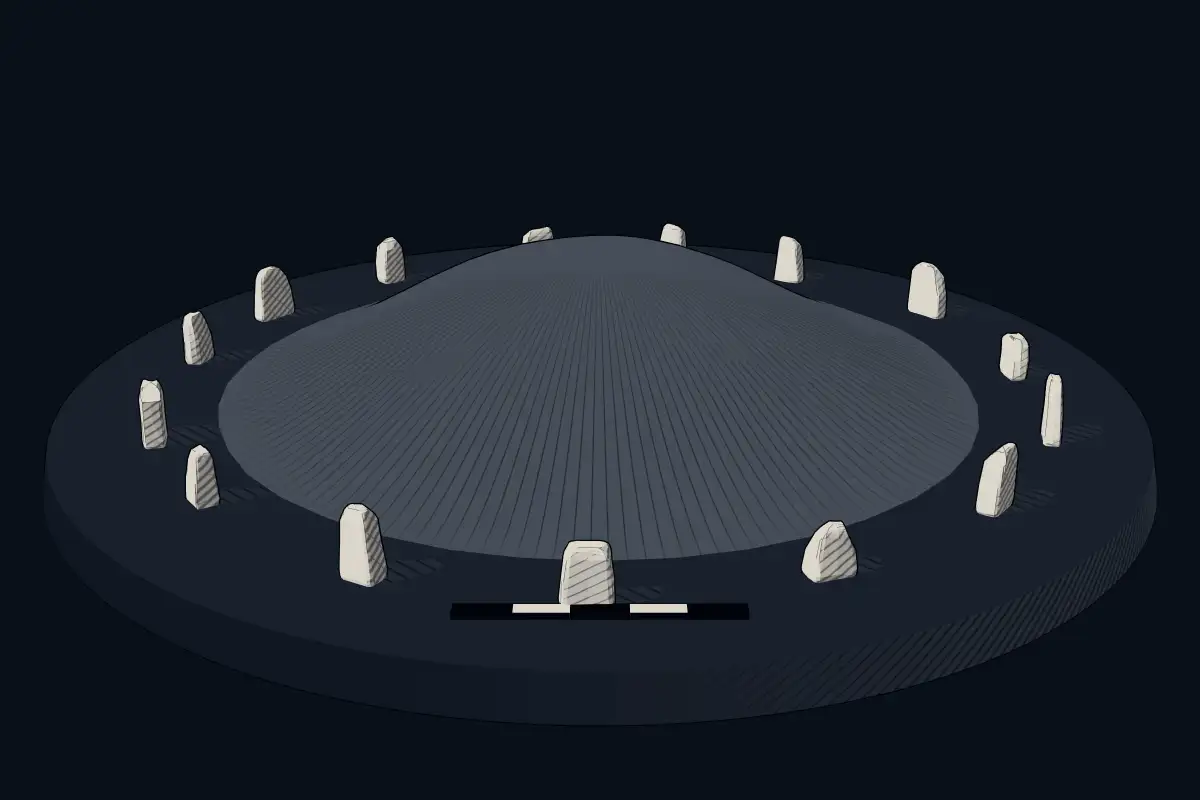
The reconstruction is ours, not a survey: it shows what a monument of this type looks like, at the size the record gives for this one.
Photographs
5 photographs, each with its author and licence
More photographs


Where it stands
Azerbaijan
The pin marks the monument itself — its exact point.
- Coordinates
- 40°26′37″ N, 46°51′48″ EFor a GPS or map app: 40.44361, 46.86333
Access is as our sources describe it; we have not visited the site to check.
Nearby
The closest sites in the Atlas, by straight line.
- Megalithic mound (tumulus with integral stones)Hacılı Qobusu kurqanları
- Megalithic mound (tumulus with integral stones)Səfikürd kurqanı
- Megalithic mound (tumulus with integral stones)Kurqanlar
- Megalithic mound (tumulus with integral stones)Kurqanlar
- Megalithic mound (tumulus with integral stones)Kurqan
- Megalithic mound (tumulus with integral stones)Kurqan
- Megalithic mound (tumulus with integral stones)Kurqanlar (3 ədəd)
 Xocalı kurqanları

Sources
Every record behind this page, with the link it came from.
1 source behind this page
- 01Wikidata Q110108714wikidata.org
Image files
- Borsunlu necropolis.jpgXayala MammadliCC BY-SA 4.0
- The Boyuk Borsunlu barrow7.jpgXayala MammadliCC BY-SA 4.0
- Borsunlu necropolis1.jpgXayala MammadliCC BY-SA 4.0
- Borsunlu nec.jpgXayala MammadliCC0
- The Boyuk Borsunlu barrow2.jpgXayala MammadliCC BY-SA 4.0
Report a correctionWrong date, name, photograph or source? Tell us and it will be put right.
Around this place
The ten nearest sites, by compass
Credit
Text, licence and sources
Adapted from the Wikipedia article "Borsunlu nekropolu" (Azerbaijani), licensed CC BY-SA 4.0; authors are listed in the page history. Reused under CC BY-SA 4.0. Read on Wikipedia · Edit history and authors